
Introduction to Mobile App Development Courses
There’s a specific kind of frustration that comes with wanting to build something and not knowing where to begin. You search “how to make an app,” and thirty browser tabs later, you’re more confused than when you started. One article tells you to learn Swift. Another says Flutter is the future. A YouTube comment insists you should know JavaScript first. Meanwhile, your idea — the one you’ve been carrying around for months — is still just an idea.
Mobile app development courses exist precisely to cut through that noise. But here’s the problem nobody warns you about: the course market is just as overwhelming as the information landscape. There are thousands of them, ranging from free YouTube playlists to $20,000 bootcamps, from weekend crash courses to multi-year degree programs. Sorting the genuinely useful from the mediocre is a job in itself.
This guide does that sorting for you. These are the top 10 mobile app development courses worth your time and money in 2026 — evaluated honestly, not ranked by affiliate commission. Whether you’re a complete beginner or a web developer making the jump to mobile, there’s a course here that fits where you actually are.
What are Mobile App Development Courses?
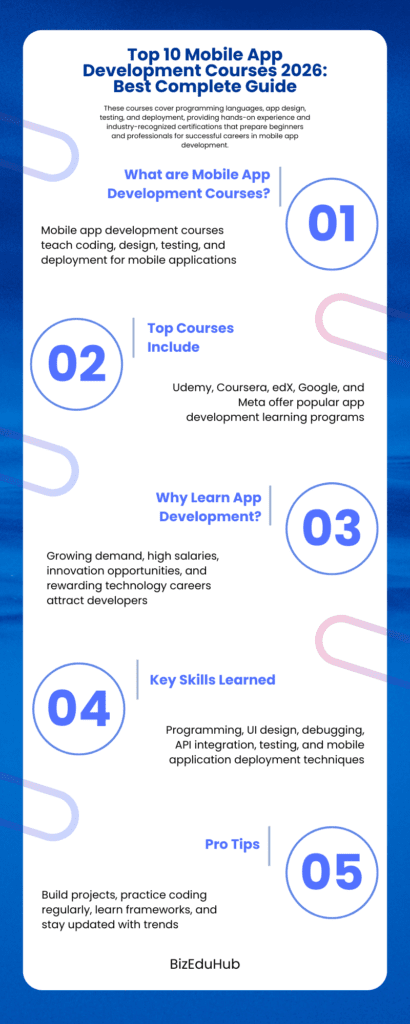
Mobile app development courses are structured learning programs designed to teach you to build applications for smartphones and tablets. That sounds obvious, but the definition matters because the category is genuinely broad.
At one end, you have short online courses — 10 to 40 hours of video content covering a specific language or framework. These are typically self-paced, hosted on platforms like Udemy, Coursera, or LinkedIn Learning, and cost anywhere from free to a few hundred dollars. They’re best suited for people who already know how to learn independently and just need the technical content organized for them.
At the other end, you have intensive bootcamps — structured 12 to 24 week programs with instructors, peer cohorts, live feedback, and sometimes job placement support. These cost significantly more (often $5,000–$15,000), but they provide the structure and accountability that many self-taught developers genuinely need to finish what they start.
In between, you have university courses and degree programs, YouTube channels with structured curricula, community-based learning platforms like The Odin Project, and corporate training programs offered through platforms like Pluralsight or O’Reilly.
The right type of course depends on two things: how you learn best, and what outcome you’re actually aiming for. Someone who wants to freelance needs a different course than someone building their own startup, who needs a different course than someone trying to land a junior developer job at a tech company in mobile app development courses.
Why Mobile App Development Courses Matter in 2026
The mobile economy is not slowing down. Global app store revenue crossed $170 billion in 2025, and the demand for skilled mobile developers continues to outpace supply in most markets. But that’s the macro picture — here’s what it means practically.
Learning mobile app development courses without a structured course is possible. Developers do it by piecing together documentation, Stack Overflow threads, and GitHub repositories. But it’s slow, and more importantly, it produces gaps. You might learn how to build a screen, but not how to manage state properly. You might learn how to make an API call, but not how to handle errors gracefully. You get functional code that works until it doesn’t, and you don’t fully understand why.
A good mobile app development courses doesn’t just teach you syntax. It teaches you patterns — the mental models experienced developers use to organize their code, think through architecture, and debug systematically. Those patterns are what separate developers who can ship production-quality apps from those who can only follow tutorials.
Beyond that, the market in 2026 has gotten more competitive. Companies hiring junior mobile developers expect more than they did three years ago. A well-chosen course — especially one with a portfolio project component — is part of what makes your application stand out.
The Top 10 Mobile App Development Courses in 2026
1. iOS & Swift — The Complete iOS App Development Bootcamp (Udemy — Dr. Angela Yu)
Dr. Angela Yu’s iOS bootcamp has been the most consistently recommended beginner iOS course for several years running, and the 2026 edition holds up that reputation. It covers Swift fundamentals, SwiftUI, UIKit basics, Core Data, networking, and finishes with portfolio-worthy projects, including a clone of a weather app and a basic social feed.
What separates this course from most competitors is the teaching style. Yu explains the why behind every concept before showing the how, which means students actually understand what they’re building rather than copying code they can’t modify later.
Length: ~60 hours | Price: ~$20 on sale | Best for: Complete beginners targeting iOS
2. The Complete Android Development Course — Kotlin Edition (Udemy — Catalin Stefan)
For Android beginners, this course covers Kotlin from the ground up, moves through Android fundamentals (Activities, Fragments, RecyclerView), and then into modern Android development with Jetpack Compose, ViewModel, and Room database. It’s methodical in a way that some find slow,w but most beginners find essential in mobile app development courses.
The Jetpack Compose coverage is genuinely current, which matters — a lot of Android courses still teach the older XML-based UI approach that Google is actively moving away from.
Length: ~45 hours | Price: ~$20 on sale | Best for: Beginners who want to learn Android/Kotlin properly from the start
3. The Flutter & Dart Complete Developer Course (Udemy — Stephen Grider)
Stephen Grider has a reputation for making complex technical concepts approachable without dumbing them down, and his Flutter course lives up to that. It covers Dart fundamentals, Flutter widget architecture, state management with Bloc and Riverpod, Firebase integration, and REST API consumption.
What’s notable here is the state management depth. Most beginner Flutter courses gloss over this, which leaves students unable to build anything beyond a basic counter app. Grider’s course prepares you to build real, scalable applications.
Length: ~50 hours | Price: ~$20 on sale | Best for: Developers who want cross-platform reach and are willing to learn Dart
4. React Native — The Practical Guide (Udemy — Maximilian Schwarzmüller)
“Academind” courses by Maximilian Schwarzmüller have a consistent reputation: thorough, well-organized, and kept up to date. This React Native course covers the New Architecture (Fabric + JSI), Expo workflow, navigation with React Navigation, state management, and native module integration.
If you come from a React web background, this is the single best starting point for mobile development. The course doesn’t waste time re-explaining JavaScript fundamentals — it assumes you know the web side and focuses on what’s different about mobile.
Length: ~48 hours | Price: ~$20 on sale | Best for: React/JavaScript developers moving into mobile
5. CS193p — Developing Apps for iOS (Stanford University — Free)
Stanford’s iOS development course has been free on iTunes U and YouTube for years. The 2026 edition uses SwiftUI and assumes some programming background — this is not a beginner course. But for developers with prior coding experience who want a rigorous, academically grounded approach to iOS development, nothing else comes close at zero cost.
The lectures are given by an actual Stanford professor (Paul Hegarty) for actual Stanford students, which means the quality of thinking and explanation is genuinely different from most mobile app development courses. You’ll understand Swift and SwiftUI at a deeper level than most bootcamp graduates.
Length: ~20 hours of lectures (self-paced) | Price: Free | Best for: Experienced developers who want depth over hand-holding
6. Google’s Android Basics with Compose (Google — Free)
Google’s own official Android training has been restructured significantly for 2026, now centering entirely on Jetpack Compose and modern Android development practices. It’s available free at developer.android.com/courses and is well-paced for beginners with no prior Android experience.
Because it’s maintained by Google, it’s always current. It doesn’t suffer from the “this feature was deprecated two years ago, but the course still teaches it” problem that plagues many third-party courses.
Length: Self-paced, roughly 30–40 hours of material | Price: Free | Best for: Beginners who want official, always-current Android training
7. Flutter Apprentice (Kodeco / Ray Wenderlich)
Kodeco (formerly Ray Wenderlich) has been producing developer education content since the early days of iOS development. Their Flutter Apprentice book and course package is one of the most thorough Flutter resources available, covering not just widgets and state management but also testing, performance optimization, and publishing.
It’s more expensive than Udemy alternatives and more textbook-like in format — some people love the depth, others find it dense. But for developers who want to go beyond “functional app” to “well-built app,” the quality difference is noticeable.
Length: ~35 hours | Price: ~$60–80 standalone or via Kodeco subscription | Best for: Intermediate Flutter learners who want depth and production quality
8. App Brewery’s iOS Development Bootcamp (London App Brewery — Angela Yu’s original platform)
The London App Brewery offers a more structured bootcamp experience compared to standalone Udemy courses. It includes instructor support, a community forum with active moderators, and access to live Q&A sessions. The curriculum covers Swift, SwiftUI, Core Data, networking, and the App Store submission process.
The community element genuinely matters. One of the biggest reasons people abandon self-paced courses is isolation — when you’re stuck and no one answers, you quit. The App Brewery’s community reduces that dropout rate noticeably.
Length: ~70 hours | Price: ~$200–250 | Best for: Learners who need community and accountability alongside technical content
9. ZTM Academy — Complete React Native Developer (Zero To Mastery)
Zero to Mastery has built a strong reputation for developer courses that stay current and have engaged communities. Their React Native course covers Expo, the New Architecture, performance optimization, and deployment — with sections on turning app ideas into actual products (monetization, App Store optimization basics).
The “product thinking” component is underrated. Most mobile app development courses teach you to code an app; this one spends real time on what happens after you build it.
Length: ~40 hours | Price: via ZTM subscription (~$40/month) | Best for: Developers who want to build apps as products, not just coding exercises
10. Kodeco’s iOS & Swift Learning Path (Subscription)
For developers who want to commit seriously to iOS development over 6–12 months rather than taking a single course, Kodeco’s full iOS learning path is one of the most comprehensive options available. It covers Swift fundamentals, SwiftUI, UIKit, networking, testing, ARKit, and advanced topics like Combine and async/await concurrency.
It’s not cheap on a per-month basis, but if you complete even 70% of the content, you’ll be more prepared for a junior iOS role than most coding bootcamp graduates.
Length: 200+ hours across the full path | Price: ~$30/month (Kodeco subscription) | Best for: Committed learners who want a structured 6–12 month iOS education
Practical Tips for Getting the Most Out of Any Mobile App Development Courses

- Finish the project before you move to the next lesson. Passive watching feels like learning. It isn’t. The actual learning happens when you get something wrong and fix it.
- Don’t watch at 2x speed until you’ve done the exercise at 1x. Speed-running video content is how you build the illusion of progress.
- Modify every project the course gives you. Change the color scheme, add a feature, break something intentionally,y and fix it. The moment you diverge from the tutorial is the moment you start learning in mobile app development courses.
- Keep a “what I still don’t understand” list. As you go through a course, flag concepts that feel foggy. Return to them at the end of each week. Some will have resolved themselves through later content. The ones that haven’t are worth spending extra time on.
- Build one original project before you take another course. The biggest trap in developer education is course-hopping — taking five courses and finishing none of them, or taking them back to back without ever applying the skills. One messy, imperfect original project teaches you more than five finished tutorials.
- Use the official documentation alongside your course. Mobile App Development Courses give you structure; documentation gives you accuracy. When a course tells you to use a certain function, look it up in the official docs. See what else it can do. See what it can’t.
Real-Life Examples of Mobile App Development Courses
Marcus, 28, career changer: Marcus was working in logistics and wanted to build a delivery-tracking app for his employer. He took Dr. Angela Yu’s iOS course, finished it over four months of evening sessions, then spent two months building a simplified version of his idea. His employer didn’t adopt the app, but the experience landed him a junior iOS developer job at a local startup, where he’s been for eighteen months for mobile app development courses.
Priya, 34, freelance web developer: Priya already knew React well. She took Maximilian Schwarzmüller’s React Native course over six weeks, then immediately started taking freelance mobile projects. She didn’t learn anything radically new — she applied existing knowledge to a new platform. Her first mobile client was a small restaurant chain that wanted a simple ordering app.
James, 22, computer science student: James found Stanford’s CS193p during his second year of university. He completed it alongside his regular coursework and used the project work to build a portfolio. He graduated with four published App Store apps, which were the main differentiator in his job applications for mobile app development courses.
Common Mistakes to Avoid in Mobile App Development Courses
- Picking a course based on star ratings alone: A mobile app development courses with 4.7 stars and 80,000 reviews might have those reviews because it was good three years ago. Check the last update date — anything not updated in 18 months is suspect for a field that moves this fast.
- Starting with the wrong level: Beginners who pick “advanced” courses because they look more impressive end up frustrated and quit. Experienced developers who pick beginner courses are bored and also quit. Be honest about where you are.
- Buying multiple courses before finishing one: Udemy sales create a hoarding instinct. Having ten courses in your library creates the feeling of progress while actually replacing it. One course, finished, is worth more than ten purchased.
- Skipping the boring parts: Every course has a section on error handling, testing, or debugging. These are the sections students skip because they’re not glamorous. They’re also the sections that determine whether you can build real apps or just demos.
- Measuring progress by hours watched: The metric that matters is: “Can I build something I couldn’t build before?” That’s it. Hours watched are a vanity metric in mobile app development courses.
Frequently Asked Questions About Mobile App Development Courses
Q1. Which mobile app development courses are best for absolute beginners with no coding experience?
Dr. Angela Yu’s iOS & Swift Bootcamp on Udemy or Google’s free Android Basics with Compose course are both genuinely beginner-friendly. Yu’s course has the edge in teaching style and pacing. Google’s course has the edge in being free and always current. If the budget is a constraint, start with Google’s official course.
Q2. Are free mobile app development courses worth taking, or do paid courses offer more value?
Some of the best mobile app development courses on this list are free (Stanford’s CS193p, Google’s Android Basics). Free does not mean low quality. What free courses often lack is community support and accountability structures — if you’re self-disciplined, free courses are entirely sufficient. If you need accountability, a paid course with community features is worth the cost.
Q3. How long does it realistically take to complete a mobile app development courses and be job-ready?
A beginner mobile app development courses (40–60 hours) takes most people 2–4 months working part-time. Being genuinely job-ready — able to pass a technical interview and contribute to a production codebase — typically takes 12–18 months of consistent work beyond that. Anyone who promises job-readiness in 8 weeks is misleading you.
Q4. Should I take an iOS course or an Android course first?
Take whichever corresponds to the platform you personally use and care about most. You’ll be more motivated to finish it, more likely to test your own apps, and more likely to actually care about the user experience. The concepts transfer reasonably well between platforms once you’ve learned one.
Q5. Is a mobile development bootcamp worth the $10,000+ price tag?
For the right person — someone who has tried self-paced learning and failed to finish, who has the financial resources, and who is genuinely committing to a career change — yes. For someone who is disciplined, has income constraints, or is still testing whether they like development, start with a $20 Udemy course and see if you finish it before spending more.
Conclusion
Here’s what all of this comes down to: the best mobile app development courses are the ones you finish. That sounds like a motivational poster platitude, but it’s actually a filtering mechanism. Most people who buy courses don’t complete them. The dropout rate on online courses across platforms averages above 90%. So the first question isn’t “which course has the best curriculum?” It’s “which course is structured in a way that matches how I learn, with enough support that I won’t quit when it gets hard?”
That’s why this guide doesn’t just list courses with star ratings. It tells you who each course is actually for. A complete beginner and an experienced JavaScript developer looking at the same React Native course are in fundamentally different situations — one needs the foundations explained, the other needs them assumed.
The mobile app development courses opportunity in 2026 is real. The tools are better than they’ve ever been, the platforms are mature, and the market rewards people who can ship working apps. But none of that matters if you spend six months course-hopping and never build anything.
Pick one course from this list. Finish it. Build something imperfect with what you’ve learned. Then pick the next one. That’s the path — not because it’s inspirational, but because it’s the only one that actually works.
!You might be interested in reading this page as well
Top 10 Mobile App Development Languages in 2026: Complete Guide for Beginners