
Introduction to Python Backend Developer
There’s a moment many aspiring developers remember clearly — the first time they ran a Python script and something actually worked. Maybe it printed “Hello, World!” or scraped a webpage or parsed a CSV file. Whatever it was, something clicked. And from that moment, a question usually follows: Where do I go from here?
If you’ve been wondering how to turn your Python curiosity into a full-fledged career as a Python backend developer, you’re in exactly the right place. The backend world — that invisible engine humming behind every app, website, and digital product you use — is one of the most rewarding and in-demand specializations in tech today. And Python? It’s arguably the best language to get there with, especially in 2026, where the ecosystem has matured into something genuinely powerful and beginner-friendly at the same time.
This roadmap isn’t just a list of technologies to memorize. It’s a human guide — built from the real-world experience of Python backend developers who started exactly where you are. Let’s walk through it together.
What is a Python Backend Developer?
A Python backend developer is someone who builds and maintains the server-side logic of web applications and digital systems. While a frontend developer handles what users see — buttons, colors, layouts — the backend developer handles what happens underneath: the data, the logic, the databases, the APIs, and the servers that make everything function.
Think of a food delivery app. When you tap “Order Now,” the frontend shows you a loading spinner. But behind the scenes, a backend system written in Python (or another language) is verifying your payment, checking restaurant availability, dispatching a notification to the driver, and updating your order status in a database — all in a fraction of a second. That’s the backend.
Python is especially popular in backend development because of its clean, readable syntax and its massive ecosystem of libraries and frameworks. Frameworks like Django and FastAPI allow developers to build APIs and web services rapidly, without reinventing the wheel. Meanwhile, Python’s dominance in data science and machine learning has made it the go-to language when backend systems need to interface with intelligent features — recommendation engines, fraud detection, personalization layers, and more.
In short, a Python backend developer is part architect, part problem-solver, and part craftsperson. You design systems that are reliable, scalable, and secure — and you do it in one of the most expressive programming languages ever created.
Why is a Python Backend Developer Important in 2026
Let’s talk about why this path is worth investing in right now, and not just in the abstract “tech is booming” sense.
The demand for backend developers with Python skills has remained consistently high for years, and 2026 shows no signs of reversal. Companies from early-stage startups to Fortune 500 enterprises are actively hiring Python engineers. Roles like Backend Engineer, API Developer, Platform Engineer, and Software Engineer (Python) regularly appear at the top of job boards. And salaries are nothing to scoff at — mid-level Python backend developers routinely command six-figure incomes in competitive markets.
Beyond employment, a Python backend developer sits at a powerful intersection. With the explosion of AI-integrated products, many companies now need backend engineers who can deploy machine learning models via APIs — and Python is the native language of the ML ecosystem. So becoming a Python backend developer in 2026 doesn’t just make you useful for traditional web development; it positions you as a bridge between software engineering and the AI-driven future of tech.
There’s also the community factor. Python has one of the largest and most welcoming developer communities in the world. When you get stuck (and you will — everyone does), the documentation is thorough, StackOverflow threads are abundant, and forums are genuinely helpful. Learning Python backend developer means you’re never alone in your struggles.
Key Aspects of the Python Backend Developer Roadmap
Stage 1: Mastering Python Fundamentals
Before anything else, your Python foundations need to be solid. Not perfect — but solid.
1. Core Python Concepts to Learn First
Start with the basics: variables, data types, conditionals, loops, and functions. Then move into object-oriented programming (OOP) — understanding classes, inheritance, and encapsulation is non-negotiable for backend work because most frameworks rely heavily on these concepts.
Pay particular attention to:
- List comprehensions and generators — You’ll use these constantly when manipulating data.
- Error handling — Try/except blocks are everywhere in production code. Learn to use them deliberately.
- File I/O — Reading and writing files is a fundamental operation in backend systems.
- Python’s standard library — Modules like
os,sys,datetime,json, andreare daily tools.
Don’t rush this phase. Python Backend Developers who struggle later almost always skipped foundational fluency. Spend at least four to six weeks here if you’re starting from scratch.
2. Understanding How the Web Works
Before you write a single line of web framework code, understand the web itself. Learn what HTTP is and how request-response cycles work. Understand the difference between GET, POST, PUT, DELETE, and PATCH. Know what a status code means — a 200, a 404, a 500. These aren’t just trivia; they’re the vocabulary of backend development.
Stage 2: Databases and SQL
Every Python backend developer system needs to store and retrieve data. Your job as a Python backend developer will, more often than not, revolve around databases.
1. Relational Databases (SQL)
Start with PostgreSQL — it’s free, powerful, and widely used in production environments. Learn basic SQL: SELECT, INSERT, UPDATE, DELETE, and JOIN operations. Understand indexes, foreign keys, and transactions. You don’t need to become a database administrator, but you need to be comfortable designing schemas and writing efficient queries.
2. ORMs — Talking to Databases in Python
An Object-Relational Mapper (ORM) lets you interact with a database using Python code instead of raw SQL. Django comes with its own excellent ORM built in. SQLAlchemy is the gold standard for non-Django projects. Learn how to define models, run migrations, and query data using these tools.
3. NoSQL Databases
As you progress, add MongoDB or Redis to your toolkit. Redis, in particular, is invaluable for caching, session management, and rate limiting — all things you’ll encounter in real-world systems.
Stage 3: Web Frameworks — Django and FastAPI
This is where it starts to feel like you’re building real things.
1. Django — The Batteries-Included Framework
Django is the most comprehensive Python web framework. It includes an ORM, an admin panel, authentication, form validation, a templating engine, and more — right out of the box. For beginners building full web applications, Django is an excellent starting point because it enforces structure and gives you immediate feedback on whether your code makes sense.
Spend time learning Django’s MTV (Model-Template-View) architecture. Build a few projects: a blog, a simple e-commerce site, and a task management app. Feel how the pieces connect.
2. FastAPI — The Modern API Developer’s Choice
FastAPI is newer, faster, and purpose-built for building APIs. Its design encourages good practices through automatic data validation, type hints, and async support. In 2026, FastAPI has become extremely popular for building microservices, AI model endpoints, and high-performance APIs. If you’re aiming at companies that work with machine learning pipelines or need low-latency services, FastAPI fluency is a major advantage.
Stage 4: APIs, Authentication, and Security
1. Building and Consuming REST APIs
You’ll spend enormous amounts of time building RESTful APIs — structured endpoints that allow different systems to communicate. Learn how to design clean API contracts: sensible URL naming, consistent response formats, proper status codes, and meaningful error messages.
Then learn how to secure those APIs. JWT (JSON Web Tokens) and OAuth 2.0 are the primary authentication mechanisms you’ll encounter. Understand how they work conceptually, not just how to copy-paste them.
2. Security Fundamentals
Backend security isn’t optional. Learn about SQL injection, CSRF, XSS, and how to defend against them. Django handles many of these by default, but understanding why those protections exist makes you a far more trustworthy developer.
Stage 5: DevOps Basics and Deployment
A backend developer who can’t deploy their own code has a gap in their skills. You don’t need to become a DevOps engineer, but you need working knowledge of:
- Linux command line — Most servers run Linux. Get comfortable with it.
- Git and GitHub — Version control is non-negotiable.
- Docker — Containerization has become standard practice. Learn how to Dockerize a Python application.
- CI/CD basics — Understand what a deployment pipeline looks like.
- Cloud platforms — AWS, Google Cloud, and Azure all offer free tiers. Deploy at least one application to the cloud before calling yourself job-ready.
Practical Steps to Start Your Journey as a Python Backend Developer

Here’s a structured progression you can follow starting today:
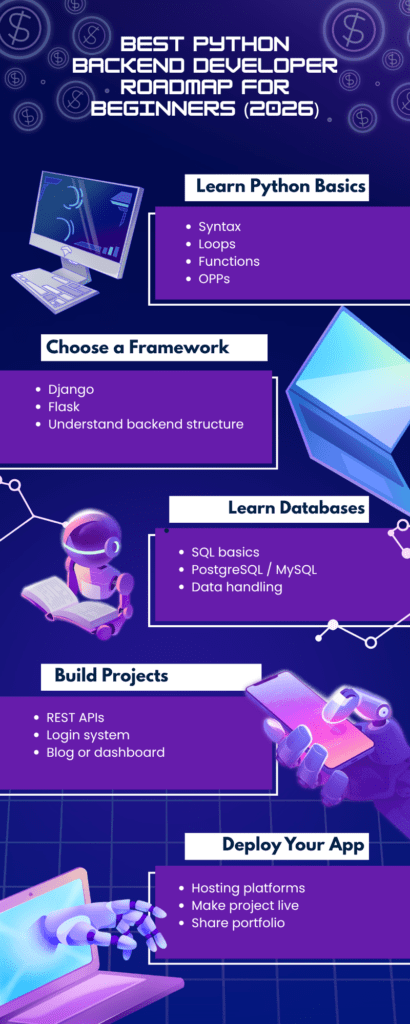
- Week 1–4: Python fundamentals — syntax, OOP, error handling, standard library.
- Week 5–8: SQL and relational databases — PostgreSQL, basic queries, schema design.
- Week 9–14: Pick Django or Flask — build two or three projects, including one with user authentication.
- Week 15–20: REST APIs and FastAPI — build a complete API project with authentication.
- Week 21–24: Docker, Git workflows, and deploying to a cloud provider.
- Month 6+: Pick up testing (pytest), Redis, message queues (Celery, RabbitMQ), and system design basics.
- Ongoing: Build projects. Contribute to open source. Read production codebases on GitHub. Learn how to host your app using platforms like cloud services.
Real-Life Examples: What Python Backend Developers Actually Build
Consider a ride-sharing platform. When you open the app and request a ride, a Python backend service receives your GPS coordinates, queries a database of available drivers, runs a matching algorithm, calculates an estimated fare, and sends back a response — all in under 200 milliseconds. The developer who built that system likely used FastAPI or Django REST Framework, PostgreSQL for storing trip records, Redis for caching driver locations, and Celery to handle asynchronous tasks like sending SMS notifications.
Or consider a SaaS startup building a project management tool. Their backend developer uses Django to manage user accounts and subscription plans, PostgreSQL to store projects and tasks, and exposes a REST API that their React frontend consumes. When a user assigns a task, a webhook fires, an email notification goes out via Celery, and the event is logged for analytics. This is a textbook Python backend architecture — and it’s built by developers who followed a path very similar to the one outlined here.
These aren’t hypothetical examples. They’re the kind of systems built by developers who started with a curiosity about Python and, over the course of a year or two, grew into engineers trusted with real infrastructure. Keep learning new technologies, follow industry trends, and improve problem-solving skills. Build multiple projects, contribute to open source, and stay patient throughout your journey to become a successful Python backend developer.
Common Mistakes to Avoid as a Python Backend Developer
- Skipping the fundamentals to chase frameworks. A lot of beginners jump straight to Django tutorials without understanding Python deeply. They get by for a while, then hit a wall when something breaks, and they don’t understand why.
- Building without deploying. Projects that only live on your local machine don’t prove much. Make deployment part of your practice from day one, and watching tutorials without practice slows progress.
- Ignoring testing. Writing tests feel slow at first. But developers who skip testing pay the price in production bugs, late-night fixes, and eroded confidence in their own code. Learn
pytestEarly jumping to frameworks without strong fundamentals creates confusion. - Learning too many things at once. The roadmap above might look like a lot, and it is. But parallelizing it all is a recipe for shallow knowledge everywhere. Go deep on one thing at a time.
- Not reading error messages carefully. Python’s error messages are actually quite helpful. Read them. The stack trace tells you exactly where things went wrong. Developers who scroll past errors and immediately Google the first phrase they see develop a harmful dependency on copy-pasting fixes they don’t understand.
Frequently Asked Questions (Python Backend Developer)
Q1. How long does it take to become a Python backend developer?
With consistent effort — say, two to four hours per day — most beginners can reach an entry-level job-ready state in eight to twelve months. That said, “ready” is a spectrum. You can land your first role without knowing everything; growth continues on the job. It typically takes 3–6 months with consistent learning and project practice.
Q2. Do I need a computer science degree to become a Python backend developer?
No. Many practicing Python backend developers are self-taught or bootcamp graduates. What matters is your ability to build working systems, solve problems, and communicate technical ideas clearly. A strong portfolio and a genuine understanding of fundamentals can outweigh a degree in most hiring contexts.
Q3. What’s the difference between Django and FastAPI, and which should I learn first?
Django is a full-featured framework that’s excellent for building complete web applications with user authentication, admin panels, and complex data models. FastAPI is lighter, faster, and purpose-built for APIs. If you’re a complete beginner, start with Django — the structure it imposes teaches you good habits. Then learn FastAPI to understand modern API design.
Q4. Is Python still relevant for backend developers in 2026?
Absolutely. Python’s relevance has only increased with the AI boom. Companies building ML-powered products overwhelmingly use Python on the backend. Frameworks like FastAPI have addressed Python’s historical performance concerns, and the language continues to rank among the most-used in Python backend developers globally. Python is widely used for backend due to its simplicity and powerful frameworks.
Q5. What projects should I include in my portfolio as a Python backend developer?
Aim for variety and depth over quantity. A solid portfolio might include: a REST API with authentication (FastAPI or DRF), a full Django web application with database integration, a deployed project accessible via a public URL, and ideally one project that solved a real problem — even a small, personal one. Bonus points for anything that includes tests, Docker setup, and a CI/CD pipeline.
Conclusion
Becoming a Python backend developer is one of the most practical and intellectually satisfying paths you can take in tech right now. The language is powerful and readable. The ecosystem is mature. The demand is real. And the learning journey, while demanding, is full of those small victories — the working endpoint, the passing test, the deployed app — that remind you why you started.
The roadmap laid out here isn’t meant to be followed mechanically. It’s a guide, not a prison. Some people move faster through databases. Others spend extra time with Django and come out knowing it deeply. That’s fine. The direction matters more than the pace.
What you should hold onto, especially in the early months, is this: every senior Python backend developer you admire was once exactly where you are — confused by error messages, unsure if they were learning the right thing, wondering if they’d ever be good enough. They got through it by building things, asking questions, and showing up consistently.
Stay consistent, practice daily, explore new tools, and keep improving your backend development skills. Focus on real-world projects to gain experience and build a strong, job-ready portfolio.
!You might be interested in reading this page as well
A Day in the Life of a UX Researcher: Tools, Techniques, and Best Practices