
Introduction to Game Development Courses
Every game developer remembers the exact moment the idea took hold. Maybe it was staying up too late finishing a level in a game that felt impossibly alive, or watching the credits roll and wondering who built all of that — the physics, the sound design, the way the world responded to every decision you made. For some people, that curiosity stays a curiosity. For others, it becomes a question that won’t leave them alone: Could I actually build something like this?
The honest answer, in 2026, is yes — and the barrier has never been lower. The tools are more accessible, the engines are more powerful, and the catalog of game development courses available online has expanded to a point where motivated learners at any level can find genuinely excellent instruction. The challenge isn’t access anymore. It’s knowing which programs are worth your limited time and energy, and which ones will leave you with a half-finished tutorial project and a vague sense of disappointment.
That’s exactly what this guide is here to solve. Whether you’re a complete beginner who’s never written a line of code, a programmer who wants to channel technical skills into something more creative, or a designer looking to add interactive development to your toolkit, the ten courses here represent the best of what’s available in 2026, evaluated honestly and matched to different learning needs.
What are Game Development Courses?
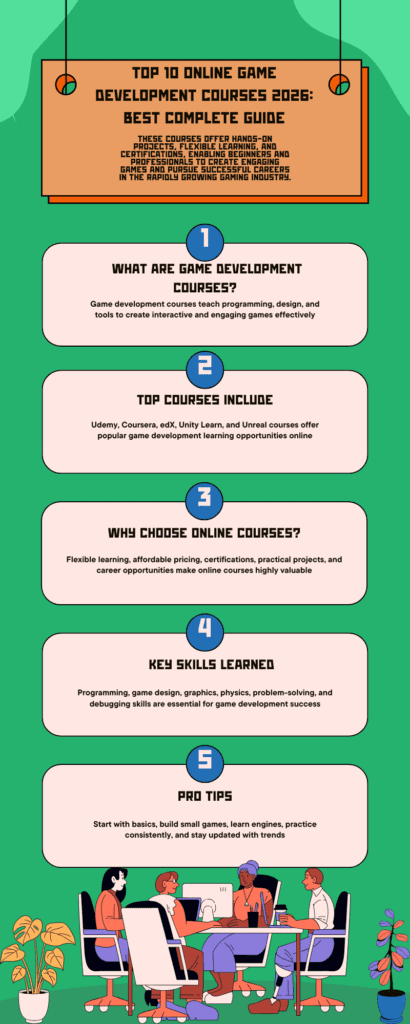
Game development courses are structured learning programs — delivered online through video instruction, interactive exercises, project-based assignments, or some combination of all three — designed to teach the skills required to design, build, and ship video games.
The scope of what “game development” covers is wider than most beginners expect. Building a game involves programming logic (how enemies behave, how physics simulate, how events trigger), visual asset creation or integration, audio design, user interface development, input handling, scene management, and eventually deployment to a platform — whether that’s a PC download, a mobile app store, a console, or a browser.
Quality game development programs teach these elements in an integrated way, typically organized around a specific game engine. Unity and Unreal Engine dominate the professional landscape. Godot, an open-source engine that uses its own Python-like language called GDScript as well as C#, has grown dramatically in popularity among indie developers. Some courses skip engines entirely and teach game development through frameworks like Pygame in Python or Phaser in JavaScript — useful for understanding fundamentals, though less directly applicable to professional production pipelines.
The best game development courses don’t just teach you to follow along with someone else’s project. They give you the conceptual framework to tackle your own ideas — the ability to look at a game mechanic you want to build and reason through how to implement it, even when the solution isn’t in any tutorial you’ve watched.
Why Game Development Courses Matter in 2026
The global games industry generates well over two hundred billion dollars annually and continues to grow. Mobile gaming, PC gaming, console gaming, VR experiences, and browser-based casual games all represent active markets with genuine demand for skilled developers. And behind almost every game — from a one-person indie project earning modest Steam revenue to a AAA blockbuster with a nine-figure budget — is someone who learned to build games, often from online resources not unlike the ones described in this guide.
The career pathways are real. Game studios at every scale hire developers, technical designers, tools engineers, and gameplay programmers. Many of these roles are increasingly remote. Beyond traditional employment, the indie game market has produced some of the decade’s most celebrated titles — games built by solo developers or tiny teams who learned their craft through exactly the kind of online programs this guide covers.
Beyond employment, there’s a dimension to game development courses learning that’s genuinely hard to replicate elsewhere: the immediate, visceral feedback of interactive creation. When you write a function that controls how a character jumps and then play the result, the connection between your code and the experience it creates is direct and emotionally satisfying in a way that building a CRUD application or analyzing a spreadsheet simply isn’t. Game development teaches programming fundamentals — loops, conditionals, object-oriented design, event handling, and data structures.
Choosing from the available game development courses in 2026 is therefore both a practical career decision and an investment in one of the most rewarding forms of creative technical work. The programs below represent the clearest, most efficient paths into that world.
Top 10 Game Development Courses in 2026
1. Unity Learn — Free, Official, and Constantly Updated
Overview and Approach
Unity’s own learning platform is the most logical starting point for anyone who wants to build games with the world’s most widely deployed game engine. Unity Learn offers structured learning paths — from absolute beginner to advanced topics — entirely free. The content is produced by Unity’s own education team and updated to match current engine versions, which matters enormously in game development courses, where outdated tutorials can cause frustrating compatibility issues.
Best For
Anyone who wants to learn Unity seriously without spending money up front. The official source for learning the engine means you’re building on the most accurate, up-to-date foundation possible.
2. GameDev.tv — The Most Comprehensive Game Development Courses Library Online
Overview and Approach
GameDev.tv, available primarily through Udemy, has built what is arguably the most thorough catalog of game development courses available on any platform. Their courses cover Unity, Unreal Engine, Godot, Blender (for 3D asset creation), and RPG development patterns — each taught with genuine depth by instructors who are working developers, not just educators.
Best For
Learners who want comprehensive, project-based instruction with a clear progression from beginner to intermediate. At Udemy’s regular discounted pricing, the cost-to-value ratio is exceptionally strong.
3. Brackeys’ YouTube Channel + Community — The Legend That Won’t Quit
Overview and Approach
Brackeys retired from active content creation in 2020, but his Unity tutorial library remains one of the most watched and recommended starting points in game development courses education a testament to how genuinely good the instruction is. The channel covers everything from setting up a Unity project for the first time to implementing pathfinding, shader effects, procedural generation, and multiplayer systems.
Coupled with the active Brackeys Discord community (which continued operating after the channel went quiet), this free resource remains a living, useful part of game development education in 2026.
Best For
Beginners who learn well from YouTube-style instruction and want to supplement a structured course with targeted video lessons on specific systems and mechanics. Brackeys works best alongside a more structured program rather than as a standalone curriculum.
4. Udemy — The Complete Unreal Engine 5 Game Development Courses
Overview and Approach
Unreal Engine 5 is the most technically powerful game engine available to independent developers, and learning it opens doors to AAA studio employment as well as high-end indie production. The best Unreal courses on Udemy — particularly those by instructors like Dragan Bozinovic and the GameDevTV team — cover the engine’s Blueprint visual scripting system, level design tools, Nanite geometry, Lumen lighting, and C++ integration.
Best For
Developers with some programming background who want to target AAA-quality production environments or aspire to work at studios that use Unreal. Also excellent for experienced Unity developers making the transition.
5. CS50’s Introduction to Game Development Courses— Academic Rigor, Free Forever
Overview and Approach
Harvard’s CS50G is one of the most respected free game development courses in existence. Taught by Colton Ogden, the course covers the fundamentals of game design and development across multiple languages and frameworks — Lua with LÖVE, JavaScript, and Unity with C# — through twelve lecture series and associated project assignments.
What distinguishes CS50G from most game development courses is its emphasis on understanding the systems that underlie game engines, rather than relying on engine magic. Students implement state machines, collision detection, procedural level generation, and animation systems from foundational principles. It’s harder than most beginner courses, but the conceptual depth it builds is durable in a way that engine-specific tutorials often aren’t.
Best For
Learners who want to understand why games work, not just how to use an engine. Particularly excellent for developers with programming experience who want a rigorous theoretical foundation alongside practical skills.
6. Coursera — Game Design and Development Specialization
Overview and Approach
Michigan State University’s five-course specialization on Coursera covers game design theory, Unity development, and capstone project work — taught by MSU faculty and structured like a university course. The program earns a certificate with university recognition, and Coursera’s partnership with academic institutions means learners in some programs can earn credit.
The curriculum is thorough without being rushed, covering game mechanics, storytelling in games, world-building, 2D and 3D development, and the business dimensions of bringing a game to market. It’s one of the few programs that integrates design thinking as seriously as technical execution.
Best For
Career-changers or professionals who want an employer-recognized credential, university-backed instruction, and a curriculum that treats game design as seriously as game programming.
7. Godot Tutorials by GDQuest — Open Source, Beautifully Produced, and Free
Overview and Approach
GDQuest has become the definitive resource for learning Godot Engine. Their free tutorials on YouTube and their open-source learning projects on GitHub cover 2D game development, 3D game development, GDScript programming, and Godot’s unique node-based architecture with a level of polish and pedagogical care that rivals paid platforms.
The team behind GDQuest is working with game developers who use Godot professionally, and their instruction reflects real-world patterns rather than simplified toy examples. Their paid courses go deeper into topics like procedural generation, shaders, and game systems design.
Best For
Developers interested in Godot — particularly those attracted by its open-source nature and zero-royalty license model- GDQuest is also excellent for developers transitioning from Unity who want to understand Godot’s different architectural philosophy.
8. Zenva Academy — Structured Paths for Unity, Unreal, and Pygame
Overview and Approach
Zenva Academy offers subscription-based access to a large catalog of game development courses spanning Unity, Unreal Engine, Phaser (for browser games), Pygame (for Python developers), and Godot. The platform is structured around mini-degree programs — curated learning paths that take learners from introductory concepts through to intermediate-level production skills.
The Pygame and Phaser content is particularly strong for developers who want to understand game mechanics at a fundamental level before committing to a full engine. Building a game loop, a collision system, or a sprite animation system from scratch in Python teaches you things that importing Unity packages never will.
Best For
Developers who want broad exposure to multiple engines and frameworks, or those coming from Python or JavaScript who want to ease into game development through familiar languages before tackling Unity or Unreal.
9. LinkedIn Learning — Game Development Courses and Unity Essential Training
Overview and Approach
LinkedIn Learning’s game development courses catalog isn’t the deepest, but it’s professionally produced, regularly updated, and — critically — included with LinkedIn Premium, which many professionals already pay for. The Unity Essential Training course and the Game Development Foundations series cover the fundamentals cleanly and efficiently, without the depth or project complexity of dedicated platforms, but with exceptional production quality.
The LinkedIn integration also means completed courses surface directly on your professional profile, which has practical value in job searches.
Best For
Professionals already subscribed to LinkedIn Premium and want to add game development skills without a separate platform investment, or those who need a structured introduction before committing to a longer program.
10. Replit’s Game Development Courses for Beginners — Browser-Based, Zero Setup, Genuinely Accessible
Overview and Approach
For learners who feel intimidated by the installation and configuration requirements of professional game engines, Replit’s browser-based development environment removes the setup barrier entirely. Their game development courses use JavaScript and Python frameworks, running entirely in the browser with no local installation required.
It’s not the path to shipping on Steam, but it is a genuinely excellent entry point for learners who want to understand game logic — player input, scoring systems, collision detection, game state — without being derailed by environment setup before they’ve written a single line of code.
Best For
Absolute beginners, younger learners, or anyone who has been stopped by the technical overhead of game engine installation before. Replit gets you building something playable on day one.
Practical Tips for Succeeding with Game Development Courses

- Pick one engine and stay with it through at least two complete projects. Engine-hopping is one of the most common ways aspiring game developers stall. Unity, Unreal, and Godot are all excellent — pick one based on your goals and commit long enough to build real fluency.
- Play your own games constantly during development. Every time you add a new mechanic, play it. The gap between what you imagined and what you built is visible in gameplay, not in code review.
- Participate in game jams early. Ludum Dare, Global Game Jam, and dozens of smaller online jams run throughout the year. Finishing a tiny, complete game under a deadline teaches you more about production and scope management than months of tutorial work.
- Learn the math you need as you need it. Vector arithmetic, trigonometry, and basic linear algebra appear constantly in game development. Don’t front-load a mathematics course — learn the specific concepts when a problem demands them.
- Read postmortems from shipped games. The Game Development Courses magazine archive and various developer blogs are full of postmortems where developers explain what went right and wrong on their projects. These are invaluable, free, and almost no one reads them.
- Start smaller than you think you need to. The most consistent mistake in game development courses is scope. Design the smallest version of your idea that would still be fun. Build that version. Then expand if there’s appetite.
- Build your own tools when the engines don’t fit. Custom editor scripts, level editors, and content pipelines separate intermediate developers from beginners. Learning to extend your engine’s toolset is a professional skill worth developing early.
Real-Life Examples: Paths From Course to Shipped Game
A graphic designer with no programming background spent six months with the GameDev.TV Unity 2D course, working through it methodically on evenings and weekends. He built every project in the curriculum, then designed his own small puzzle game using the same mechanics he’d practiced. He submitted it to a Ludum Dare jam to force himself to finish it, polished it over the following month, and published it on itch.io. The game never went viral, but it taught him the complete production pipeline — and gave him a portfolio piece that landed him a junior tools developer role at an indie studio a year later.
A computer science student who felt bored by the absence of creativity in academic coursework discovered CS50G midway through her degree. She worked through the course alongside her regular studies, implementing the assignments in full — including building a procedural dungeon generator from scratch. The experience reframed how she thought about algorithms: not as abstract academic exercises but as systems that create experiences. She graduated with a conventional CS degree and a game portfolio that distinguished her sharply from classmates who’d spent four years building to-do apps and sorting algorithms.
Both paths are replicable. Neither required extraordinary talent. Both required choosing a program that matched their starting point, finishing what they started, and building work beyond the game development courses curriculum.
Common Mistakes to Avoid in Game Development Courses
- Starting with the engine instead of a project idea. Many learners open Unity or Unreal, poke around the interface, feel overwhelmed, and quit before writing a single script. Start with a tiny, specific game idea — Pong, a simple platformer, a one-screen puzzle — and let the desire to build that specific thing motivate your engine learning.
- Following tutorials without understanding them. Tutorial games work because you copied working code. They don’t prove you understood what you built. After finishing a tutorial project, close it and try to build a similar system from memory. Where you get stuck is what you actually need to learn.
- Building a massive game as your first project. No one’s first project should be an open-world RPG with a branching narrative and procedural weather systems. Scope is the graveyard of game development courses’ ambitions. One screen. One mechanic. One level. Ship it, then build bigger.
- Ignoring game feel in favor of features. New developers add systems constantly — inventory, crafting, dialogue trees — without polishing the core feel of the game. Juice is what makes games feel good to play. Prioritize feel over features.
- Never playing games outside their comfort zone. Developers who only play one genre build games that feel derivative of what they already know. Play puzzle games, walking simulators, strategy games, and rhythm games. Each genre teaches you something different about how mechanics, pacing, and player psychology work.
Frequently Asked Questions About Game Development Courses
Q1. Which game engine should a beginner learn in 2026?
Unity remains the most practical starting point for most beginners. It has the most extensive learning resources, the largest community, and the widest deployment reach — from mobile to PC to console to VR. Godot is an excellent alternative for learners attracted to open-source tools and a more lightweight engine architecture. Unreal Engine is the right choice if your goals point specifically toward AAA studio employment or high-fidelity 3D games.
Q2. Do I need to know how to code before taking game development courses?
No, but some programming exposure accelerates the learning curve significantly. Many beginner courses teach programming fundamentals through game development courses themselves — starting with variables and conditionals in the context of game logic rather than abstract exercises. Unreal’s Blueprint visual scripting system allows beginners to build game logic without writing code at all, which can be a useful on-ramp before tackling C++.
Q3. How long does it take to make a game from scratch after completing a course?
This depends entirely on the scope of the game. A simple one-mechanic game — a Flappy Bird clone, a basic platformer, a match-three puzzle — can be built by a beginner within days of completing an introductory course. A polished, commercially viable indie game typically requires months to years of work. The important thing in the early stages is to finish small things rather than attempting large things that never ship.
Q4. Are game development courses enough to get a job at a game studio?
Courses provide the foundation; your portfolio secures the job. Studios at every level evaluate candidates based on what they’ve built — playable demos, GitHub repositories, evidence of shipped projects. A strong portfolio built through dedicated self-study and structured coursework is taken seriously by indie studios and mid-size developers. AAA studios additionally evaluate for specialized technical depth that typically requires both coursework and substantial project experience.
Q5. What are the best free game development courses available in 2026?
For most learners, Unity Learn and Harvard’s CS50G represent the best free options depending on your priorities. GDQuest is the best free resource specifically for Godot. freeCodeCamp covers browser-based game development through JavaScript. The Odin Project’s curriculum includes game-relevant JavaScript projects. The best choice depends on your target engine and learning style.
Conclusion
The path from “I want to build games” to “I built a game” is more navigable in 2026 than it has ever been. Quality game development courses exist at every price point, for every engine, for every learning style. The gap between aspiration and execution has narrowed to something that consistent effort and a well-chosen program can genuinely close.
What this guide can’t do for you is decide which game you want to build, or show up to your desk on the evenings when building something feels harder than playing something. That friction is real, and it’s the reason so many people who start game development courses don’t finish them.
But here’s the truth that experienced developers return to again and again: the first finished game is never the best. It’s often embarrassingly simple. The physics are jittery, the art is rough, and the level design is obvious. None of that matters. What matters is that it runs, it’s playable, and you built it — completely, from nothing to something through game development courses.
That first completed project changes your relationship with what’s possible. Suddenly, the RPG you’ve been daydreaming about feels less like a fantasy and more like a problem to be solved in parts. The open world, the dialogue system, the inventory — each one becomes a learnable thing, not an intimidating abstraction.
!You might be interested in reading this page as well
Essential Game Development Languages in 2026: Build Engaging and Interactive Games