
Introduction to Full-Stack Development Courses
There’s a particular kind of overwhelm that hits when you decide you want to learn web development and then open a browser to search for where to start. Within minutes, you’re drowning in acronyms — HTML, CSS, JavaScript, Node, React, MongoDB, REST APIs — and a dozen platforms all promising to make you job-ready in weeks. It’s a lot. And if you’ve been there, you know the feeling: excited one moment, completely lost the next.
The good news is that the world of full-stack development courses has matured significantly. In 2026, the best programs don’t just teach you syntax — they walk you through building real projects, explain the reasoning behind architectural decisions, and prepare you for the actual rhythm of professional development work. The gap between “I finished a course” and “I got a job” has narrowed considerably, but only if you choose the right program for your goals and learning style.
This guide cuts through the noise. Whether you’re a complete beginner, a frontend developer looking to round out your skills, or a career-changer coming from a completely different field, you’ll find a clear, honest breakdown of the ten best full-stack development courses available in 2026 — and everything you need to choose the right one.
What are Full-Stack Development Courses?
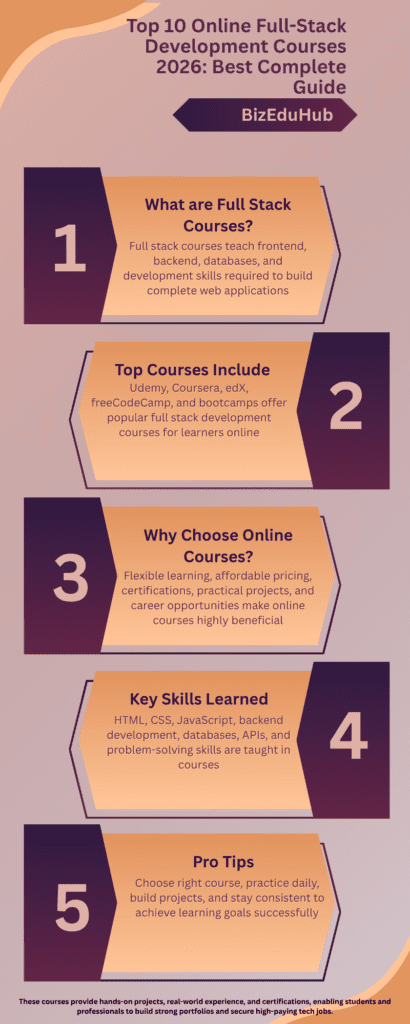
A full-stack development courses is someone who can work on both the frontend (what users see and interact with in their browser) and the backend (the servers, databases, and application logic that power the experience behind the scenes). The “stack” refers to the combination of technologies that together constitute a complete web application.
A typical modern stack might look like this: React on the frontend for building user interfaces, Node.js and Express on the backend for handling server logic and API endpoints, and MongoDB or PostgreSQL for storing data. Another common combination is the Django + React stack, where Python handles the backend, and React manages the frontend. There are dozens of possible combinations, and different full-stack development courses emphasize different stacks based on their philosophy and job market analysis.
What separates a full-stack course from a frontend or backend tutorial is scope. A good full-stack program teaches you how these layers communicate — how a form submitted on a webpage triggers a backend route, which queries a database, formats the result. That end-to-end understanding is what makes full-stack developers so valuable: they can reason about an entire system, not just one slice of it.
The best programs also introduce adjacent skills that professional developers rely on daily — version control with Git, deployment pipelines, environment configuration, testing, and basic security practices. These aren’t glamorous topics, but they’re the difference between someone who can write code in isolation and someone who can contribute meaningfully to a real development team.
Why Full-Stack Development Courses Matter in 2026
The case for learning full-stack development courses in 2026 is compelling, and the numbers back it up. Web development remains one of the most consistently in-demand skill sets in the global job market. Companies of every size — from bootstrapped startups to enterprise corporations — need developers who can build and maintain web applications.
Beyond employment, there’s a strong entrepreneurial argument for full-stack skills. If you have a product idea — a SaaS tool, a marketplace, a community platform — knowing how to build it yourself changes everything. You’re not dependent on hiring developers before you have revenue, and you can move from idea to working prototype faster than almost any other founding profile.
The rise of remote work has made this even more true. Full stack developers are among the most remote-friendly roles in tech, with opportunities spanning continents. A developer based in South Asia, Eastern Europe, or Latin America with strong full-stack skills and a solid portfolio can compete for roles with companies in the US, UK, or Australia — and earn accordingly.
Choosing from the growing catalog of full stack development courses also carries a practical financial argument. Quality online programs cost a fraction of a traditional computer science degree and, in many cases, produce outcomes that are directly comparable for web development roles. The investment-to-return ratio for a well-chosen course remains one of the best in professional education.
Top 10 Full-Stack Development Courses
1. The Odin Project — Free, Community-Driven, and Deeply Respected
Overview and Approach
The Odin Project is free, open-source, and built around the philosophy that the best way to learn is by building. It doesn’t hold your hand through every step — and that’s intentional. Students are expected to read documentation, debug their own code, and research solutions independently, much like they will on the job.
The curriculum covers HTML, CSS, JavaScript, Node.js, and React, with an optional Ruby on Rails track. Projects are substantial, and the community on Discord is active and genuinely supportive.
Best For
Self-motivated learners who don’t need the structure of a paid platform and want to build the problem-solving habits that professional developers rely on daily.
2. Full-Stack Open — University of Helsinki’s Free Masterclass
Overview and Approach
Developed by the University of Helsinki in partnership with Houston Inc., full-stack development courses Open is one of the most technically rigorous free resources in existence. The course covers React, Redux, Node.js, Express, MongoDB, GraphQL, TypeScript, and testing in depth. It reads like a university course because it is one, and it earns university credits in Finland.
Best For
Developers with some programming experience who want a thorough, academic-quality treatment of the MERN stack and modern JavaScript development practices.
3. App Brewery’s Complete Web Development Bootcamp (Udemy) — Best for Absolute Beginners
Overview and Approach
Angela Yu’s Complete Web Development Bootcamp on Udemy has earned a reputation as one of the most beginner-friendly, comprehensive web development programs available. The production quality is high, the pacing is patient, and the instructor has a genuine talent for making complex concepts feel approachable.
The course covers HTML, CSS, JavaScript, jQuery, Bootstrap, Node.js, Express, SQL, and more. It’s regularly updated to reflect changes in the ecosystem, and Udemy’s frequent discount pricing makes it exceptionally affordable.
Best For
True beginners who need a warm, guided introduction to web development before they’re ready to tackle more independent or challenging programs.
4. Codecademy Full-Stack Engineer Career Path — Structured Learning with Immediate Feedback
Overview and Approach
Codecademy’s full-stack development courses is a polished, interactive learning experience that covers HTML, CSS, JavaScript, React, Node.js, SQL, and deployment. The in-browser coding environment gives immediate feedback, which is genuinely helpful for beginners who aren’t yet comfortable setting up local development environments.
The career path format includes portfolio projects and interview preparation, making it one of the more employment-focused options on this list.
Best For
Learners who want a structured, linear curriculum with built-in accountability and don’t want to manage their own development setup in the early stages.
5. Zero to Mastery — Full-Stack Web Developer Course
Overview and Approach
Andrei Neagoie’s Zero to Mastery platform has built a loyal following for its production quality, regularly updated curriculum, and strong community. The full-stack development courses cover React, Node.js, Express, MongoDB, PostgreSQL, and deployment, with a particularly strong focus on TypeScript — a skill increasingly demanded by employers in 2026.
ZTM also includes sections on web security, performance optimization, and system design fundamentals, giving it more depth in professional readiness than many comparable programs.
Best For
Intermediate learners who want a comprehensive, modern curriculum that reflects current industry practices and goes beyond the basics into employability-focused content.
6. Scrimba Full-Stack Path — Interactive Video Learning
Overview and Approach
Scrimba has invented a genuinely novel learning format: interactive screencasts where you can pause the video, edit the instructor’s code directly, and run it — all inside the browser. It sounds like a small thing, but it changes the learning dynamic meaningfully. Instead of watching passively, you’re coding alongside.
The full-stack development courses path focuses on JavaScript, React, Node.js, and modern tooling. Scrimba’s community and weekly coding challenges keep engagement high over what can otherwise feel like a long, solo journey.
Best For
Visual learners get frustrated watching code without being able to immediately touch and modify it.
7. Coursera — Meta Full-Stack Developer Professional Certificate
Overview and Approach
Meta’s professional certificate on Coursera is taught by engineers at Meta and covers React, Python/Django, APIs, databases, version control, and security. The certificate carries genuine employer recognition, and Coursera’s partnership with universities means learners can sometimes earn academic credit.
The program is paced for working adults, with a recommended eight to ten hours per week over roughly nine months. The capstone project — a full-stack development courses application built from scratch — serves as the portfolio centerpiece.
Best For
Career-changers or working professionals who want an employer-recognized credential and a structured, longer-form program they can complete alongside existing commitments.
8. freeCodeCamp — The Non-Profit Powerhouse
Overview and Approach
freeCodeCamp remains one of the most remarkable resources in developer education — entirely free, non-profit, and backed by a vast community. Its full-stack development courses curriculum spans responsive web design, JavaScript algorithms, frontend libraries, back-end development, APIs, and database management, with certifications at each stage.
The program is self-paced, project-based, and has helped hundreds of thousands of developers land their first roles. The alumni community and alumni stories on the freeCodeCamp blog are a genuine source of motivation.
Best For
Budget-conscious learners, career-changers without much capital to invest upfront, and anyone who learns well from a project-completion model with community accountability.
9. Boot.dev — Backend-First Full-Stack Learning
Overview and Approach
Boot.dev takes an unusual and refreshing angle: it teaches backend development first, in Python and Go, before introducing frontend concepts. The philosophy is that most courses drown beginners in HTML and CSS before they understand what software actually does, and that starting with backend logic and algorithms produces more capable developers.
In 2026, Boot.dev has expanded its curriculum to include JavaScript and React, making it a legitimate full-stack development courses option for learners who want deep backend fluency before they tackle the frontend.
Best For
Developers who are tired of the surface-level approach of many web development courses and want to understand programming fundamentals before building user interfaces.
10. Springboard Full-Stack Software Engineering Bootcamp — Mentorship-Driven and Job-Guaranteed
Overview and Approach
Springboard is an online bootcamp with a meaningful differentiator: one-on-one mentorship with a working software engineer throughout the program, plus a job guarantee. The curriculum covers JavaScript, React, Python, Flask, SQL, and system design, with a capstone project and career coaching built in.
The cost is substantially higher than self-paced options, but the mentorship model and job guarantee make it a rational choice for learners who want a structured, supported experience with skin in the game from the platform itself on a full-stack development courses.
Best For
Learners who want human accountability, expert guidance, and the confidence of a financial backstop tied to employment outcomes.
Practical Tips for Getting the Most from Full-Stack Development Courses

- Choose one course and commit to finishing it. Course-hopping is the single most common reason learners plateau. Pick a program suited to your level and see it through to the final project before evaluating whether to change.
- Code along, don’t watch passively. Watching a tutorial and understanding it are not the same thing. Type every example. Break things on purpose. Figure out why they broke.
- Build projects beyond the curriculum. The projects in a full-stack development courses teach the concepts. The projects you design yourself teach you to think. Even a simple idea — a personal finance tracker, a reading list app — forces you to make architectural decisions the course never asked you to make.
- Learn Git immediately and use it for everything. Every project, no matter how small, should live in a Git repository. This habit is non-negotiable in professional development.
- Join a community. Discord servers, local meetups, developer Twitter, LinkedIn groups — isolation is the enemy of learning. Having people to ask questions to, share progress with, and be accountable to dramatically improves completion rates and learning outcomes.
- Review and refactor old code. Every few months, look back at projects you built earlier in your learning journey. You’ll see the gaps clearly, and rewriting old code with new knowledge is one of the most efficient learning activities available.
- Start applying before you feel ready. Most people wait too long. A portfolio with two or three solid, deployed full-stack development courses project is enough to get interviews. Interviews teach you what to learn next.
Real-Life Examples: Paths That Actually Worked
Consider a marketing professional who spent five years writing copy for tech companies, absorbing the vocabulary but never touching code. She enrolled in Angela Yu’s Udemy bootcamp, spent three months working through it evenings and weekends, then transitioned to The Odin Project for its project-driven curriculum. Eighteen months after starting, she accepted a junior developer role at a SaaS startup.
Or think about a recent college graduate with a business degree who couldn’t afford a traditional coding bootcamp. He used freeCodeCamp for the first six months — entirely free, entirely self-paced — and built three portfolio projects along the way. He then completed the full-stack development courses Open curriculum to deepen his React and Node knowledge.
A third scenario: a backend developer with Python skills who wanted to transition into full-stack work enrolled in the Meta Professional Certificate on Coursera. The structured curriculum filled her frontend knowledge gaps, and the Meta credential gave her resume credibility in a competitive job market. She moved from a backend-only contract role to a full-stack development courses position at a product company within eight months.
These aren’t extraordinary stories. They’re repeatable. The ingredient they share is consistency and project completion — not the prestige of any particular platform.
Common Mistakes to Avoid When Taking Full-Stack Development Courses
- Treating completion as the goal. Finishing a full-stack development courses is not the outcome — building things is. Developers who rush to complete a curriculum without genuinely absorbing and applying the material end up with a certificate and no practical ability. Slow down. Build every project.
- Skipping the fundamentals because they’re boring. HTML, CSS, and vanilla JavaScript seem unglamorous compared to React and Node. But developers who skip them encounter mysterious bugs they can’t diagnose because they don’t understand the underlying behavior.
- Never leave tutorial mode. Tutorials are training wheels. Essential at first, crippling if you never take them off. Force yourself to build original projects with no guided instructions. This is where real learning happens.
- Comparing progress to others. Social media is full of developers announcing their fifth project in three months or landing a $120,000 offer after six weeks of studying. Some of these stories are exaggerated. Many represent exceptional starting advantages.
- Neglecting soft skills. Technical ability gets you interviews. Communication, collaboration, and the ability to explain your thinking get you offers — and promotions. Many online programs ignore this. Build a habit of writing technical blog posts, documenting your projects clearly, and practicing explaining concepts out loud.
Frequently Asked Questions About Full-Stack Development Courses
Q1. How long does it take to complete a full-stack development course and get a job?
This varies significantly based on prior experience, available study time, and the specific program. For someone starting from zero and studying consistently for two to four hours per day, expect six to twelve months to reach job readiness. Career-changers with adjacent technical backgrounds often move faster. The more important variable is project quality.
Q2. Are free full-stack development courses worth it, or should I pay for a bootcamp?
Free resources like The Odin Project, Full Stack Open, and freeCodeCamp are genuinely excellent and have produced thousands of employed developers. Paid bootcamps offer structure, mentorship, and sometimes job guarantees that have real value for learners who need accountability or guided feedback. Neither is universally better through full-stack development courses.
Q3. What stack should I focus on in 2026?
The MERN stack (MongoDB, Express, React, Node.js) and the Django + React combination remain the most common choices and the most heavily represented in job listings. TypeScript proficiency is increasingly expected on top of JavaScript. If you’re unsure, pick a course that covers React on the frontend and either Node.js or Python on the backend — this combination covers the vast majority of full-stack development courses‘ job requirements.
Q4. Do I need a computer science degree to get a full-stack developer job?
No. Many working full-stack development courses are self-taught or bootcamp graduates. What matters to most employers is your ability to build things, reason about systems, write readable code, and contribute to a team. A strong portfolio demonstrating these abilities often outweighs a degree in web development hiring contexts, particularly at startups and mid-size tech companies.
Q5. What should a full-stack development portfolio include?
At minimum, two to three complete web applications that are deployed and publicly accessible, a clean GitHub profile showing consistent commit history, and a professional README for each project explaining the problem it solves, the technologies used, and how to run it locally. Bonus points for a personal website, a technical blog, or any open-source contributions.
Conclusion
The right full-stack development courses won’t just teach you to write code — they’ll change how you think about problems, how you approach complexity, and what you believe you’re capable of building. That transformation doesn’t happen overnight, and it doesn’t happen just by watching videos. It happens in the hours you spend debugging something that makes no sense at midnight, and the moment it finally works.
The ten programs covered in this guide represent the best of what’s available in 2026 across every budget, learning style, and experience level. The Odin Project and freeCodeCamp prove that cost is no barrier to quality. Full Stack Open shows what a university-grade curriculum looks like when it’s freely shared with the world. Zero to Mastery and Meta’s Coursera certificate reflect what industry-aligned, structured learning looks like at its best. And Springboard demonstrates that when a platform puts real money behind your success, the mentorship model delivers results.
Choose the full-stack development courses that fit your life. Show up consistently. Build things that are yours. The rest follows.
!You might be interested in reading this page as well
Top 10 Full-Stack Development Languages in 2026: Complete Guide for Beginners