
Introduction to Mobile App Development
It’s been living in your head for months — maybe it’s a productivity tool, a local food delivery service, or a fitness tracker that actually works the way you want it to. You’re ready to build it. And then you hit the first wall: what language do I even start with?
That confusion is real, and it’s more common than most developers admit. Mobile app development has exploded over the past decade. The tools, frameworks, and languages have evolved fast — some options that were the gold standard five years ago are now fading, and newer ones have quietly become the industry default.
This guide is built for beginners who want a clear, honest breakdown of where to start. Not a list of buzzwords. Not vague career advice. A real look at the top 10 programming languages shaping mobile app development in 2026 — what each one does well, where it falls short, and who should actually be using it.
What is Mobile App Development?
Mobile app development is the process of building software applications that run on mobile devices — smartphones, tablets, and increasingly, wearables. These apps can be native (built specifically for one platform, like iOS or Android), cross-platform (written once, deployed on both), or web-based (running inside a mobile browser but feeling like an app).
The language you choose determines a lot: how fast your app runs, how easy it is to maintain, what platform you can target, and how big a community you can lean on when you’re stuck at 2 a.m., debugging something that made no sense.
Here’s a simple way to think about it:
- Native development means writing separate codebases for iOS (typically Swift) and Android (typically Kotlin). You get the best performance and full access to device features.
- Cross-platform development means one codebase for both platforms. Languages like Dart (Flutter) and JavaScript (React Native) dominate here.
- Hybrid development sits in the middle — apps wrapped in a native shell but mostly running web code.
Each approach has a cost-benefit tradeoff. Native is expensive in time and money. Cross-platform sacrifices some performance for speed of mobile app development. Hybrid is the fastest to build, but often the most limited.
Why Mobile App Development Language Choice Matters
Choosing the wrong language early is a recoverable mistake, but it’s an expensive one. Teams have rewritten entire codebases because the initial language choice didn’t scale, didn’t have the right library support, or was simply a poor fit for the team’s skill set in mobile app development.
Here’s why this decision has real consequences:
- Performance: Swift and Kotlin produce genuinely faster apps than most cross-platform alternatives. For apps with heavy animations, real-time data, or complex graphics, this gap is visible to users.
- Hiring and maintenance: If you build in a language with a small developer community, you’ll struggle to find people to help you scale or fix things later.
- Time to market: A solo developer using Flutter can ship an MVP to both iOS and Android faster than two separate native developers working in parallel.
- Long-term ecosystem health: Languages backed by large companies with clear roadmaps (Swift by Apple, Kotlin by JetBrains and Google) are safer long-term bets than community-driven tools with uncertain futures.
The mobile app development language isn’t just a technical choice. It’s a business decision.
The Top 10 Mobile App Development Languages in 2026
1. Swift — The Gold Standard for iOS
Swift is Apple’s own language, launched in 2014 to replace Objective-C. By 2026, it will be the unambiguous default for building native iOS, iPadOS, macOS, and visionOS apps.
What makes Swift compelling for beginners is that it was designed to be learnable. The syntax is clean, the error messages are readable, and Apple’s documentation is genuinely one of the best in the industry. You will struggle less with understanding what the language is doing and more with understanding why your UI layout broke — which is a more productive kind of struggle.
Swift is not a good choice if you want to target Android. It’s also not the fastest path to cross-platform. But if you are focused exclusively on the Apple ecosystem, there is no better starting point.
Best for: iOS-first startups, developers targeting the Apple ecosystem, and anyone building for visionOS or watchOS.
2. Kotlin — Android’s Modern Native Language
Kotlin is to Android what Swift is to iOS. Google made it the official Android development language in 2017, and adoption since then has been total. Most new Android code you’ll encounter in 2026 is written in Kotlin.
Compared to its predecessor, Java, Kotlin is more concise, safer (it handles null values in a way that prevents a whole class of common crashes), and more expressive. The learning curve is reasonable for beginners, especially if you’ve had any exposure to modern languages.
Kotlin also has an interesting side feature: Kotlin Multiplatform (KMP) lets you share business logic between iOS and Android, even if the UI layers remain separate. This has matured considerably and is now a realistic production option, not just an experimental project.
Best for: Android-first apps, teams who want native Android with optional code sharing via KMP.
3. Dart (Flutter) — The Cross-Platform Powerhouse
Flutter, built by Google and using the Dart language, has been the most dramatic success story in mobile app development over the past four years. In 2026, it is the dominant cross-platform framework in terms of active usage.
Dart is a language most developers hadn’t heard of before Flutter, but it turns out to be quite pleasant to work with. It’s statically typed, object-oriented, and compiles to native ARM code — which means Flutter apps run with performance that genuinely rivals native apps in most cases.
What sets Flutter apart is that it doesn’t use native UI components at all. It draws its own widgets using its own rendering engine (Impeller, as of recent versions). This means pixel-perfect consistency across iOS, Android, web, and desktop — but it also means the app looks and feels slightly different from native apps if you’re not careful about design.
For a beginner who wants to build for both platforms without learning two separate languages, Flutter is currently the most mature and capable choice.
Best for: Beginners wanting cross-platform reach, startups building MVPs, developers who want UI consistency across devices.
4. JavaScript / TypeScript (React Native) — The Web Developer’s Gateway
React Native, built by Meta, lets you write mobile apps in JavaScript (or TypeScript, which is now the de facto standard). It uses a bridge to translate your JavaScript code into native components — so your buttons look and behave like real iOS and Android buttons, not web elements in a wrapper.
The appeal is obvious: there are more JavaScript developers in the world than developers in any other language. If you already build websites or web apps, React Native is the fastest onramp into mobile development.
TypeScript — JavaScript with static types — is now the standard for any serious React Native project. It catches errors before runtime and makes large codebases significantly easier to maintain.
React Native’s architecture has improved substantially with the New Architecture rollout (Fabric renderer + JSI), which addresses a lot of the performance concerns that dogged it in earlier years.
Best for: Web developers transitioning to mobile, teams with existing JavaScript expertise, and apps where performance requirements are moderate.
5. Java — The Legacy Workhorse That Still Ships
Java is old. The first version came out in 1995. And yet, in 2026, a significant portion of the Android codebase — including many large enterprise apps — is still written in Java.
For beginners, Java is no longer the recommended starting point for Android development. Kotlin is strictly better in almost every dimension. But Java remains relevant because the ecosystem is enormous: there are decades of libraries, tutorials, Stack Overflow answers, and courses available.
If you’re joining an existing Android team, there’s a reasonable chance that some of their codebase is Java. Understanding it isn’t optional.
Best for: Learning programming fundamentals, maintaining legacy Android codebases, and enterprise development.
6. Python (Kivy / BeeWare) — A Niche but Growing Option
Python is the world’s most popular programming language for data science, scripting, and backend development. For mobile app development, it remains a niche choice — but the tools have improved enough to be worth mentioning.
Kivy is a Python framework for building mobile apps with a custom UI toolkit. BeeWare’s Briefcase and Toga aim to let Python code run on iOS and Android with native-feeling interfaces.
Neither framework matches Flutter or React Native for production readiness in 2026. But if you are deeply embedded in the Python ecosystem — you’re a data scientist who wants to ship a mobile tool, for instance — they’re viable for simpler applications.
Best for: Python developers building lightweight mobile tools, data-heavy apps where Python’s libraries are the real asset.
7. C# (Unity / .NET MAUI) — The Game Developer’s Path
C# is the language behind Unity, which powers a dominant share of mobile games globally. If your mobile app development is actually a game — or a highly interactive experience with 3D elements — C# with Unity is a legitimate first choice.
Outside gaming, Microsoft’s .NET MAUI (Multi-platform App UI) is a cross-platform framework that lets C# developers build native mobile apps. MAUI has improved significantly and is a credible option for enterprise teams with existing .NET infrastructure.
Best for: Mobile game development, enterprise teams in the Microsoft ecosystem.
8. Rust — The Performance Specialist
Rust is not a typical mobile app development language in the sense that you won’t find many apps written entirely in Rust. But it has found a specific role: writing performance-critical components — cryptography, image processing, networking layers — that are then called from a Kotlin, Swift, or Flutter app.
For beginners, Rust’s learning curve is steep. But its memory safety guarantees and raw performance make it increasingly common in the backend of serious mobile applications. Companies like Dropbox, Discord, and Figma have used Rust for performance-sensitive mobile components.
Best for: Advanced developers optimizing specific performance-critical modules, security-sensitive applications.
9. Go (Golang) — Backend Logic for Mobile
Go occupies a similar space to Rust in the mobile world: it’s rarely the language of the app itself, but it frequently powers the backend that the app talks to. Go’s concurrency model, fast compile times, and straightforward deployment make it a popular choice for the server side of mobile products.
Some teams also use Go with frameworks like Gomobile to write shared business logic. It’s not mainstream for this, but it works.
Best for: Backend development supporting mobile apps, teams who want a single language for both client-side logic and server.
10. Kotlin Multiplatform (KMP) — The Emerging Consensus
Strictly speaking, KMP uses Kotlin — but it deserves its own entry because it represents a distinct approach to mobile app development that is gaining serious traction in 2026.
KMP lets teams write shared business logic (data models, API calls, state management) in Kotlin once, then use that code on both iOS and Android. The UI layer stays native — SwiftUI on iOS, Jetpack Compose on Android. This gives you the performance and feel of native apps with significant code sharing in the parts that matter most.
Major companies, including Netflix and VMware, have adopted KMP for production applications. For teams that want native quality without the full cost of two separate codebases, this is increasingly the answer.
Best for: Teams with strong Kotlin expertise, apps where native UI quality is non-negotiable but code reuse is still valuable.
Practical Tips for Choosing Your Mobile App Development Language

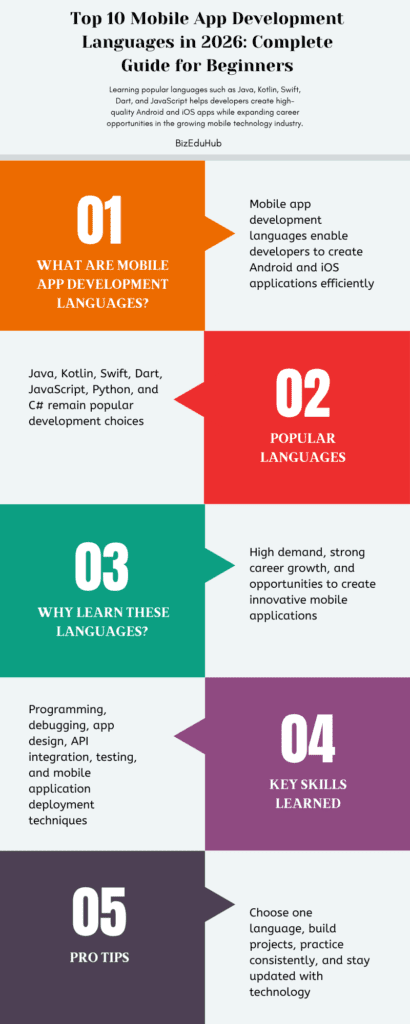
- Start with your target platform. If you know you’re building for iOS, start with Swift. If you’re building for Android, start with Kotlin. Don’t let cross-platform options distract you from learning the fundamentals.
- Don’t optimize for optionality too early. Beginners often try to learn the mobile app development language that “keeps all doors open.” That’s a trap. Pick one language, build something real with it, and the rest becomes easier.
- Community size matters more than you think. When you’re stuck — and you will be stuck — the size of the community determines how quickly you find an answer. Swift, Kotlin, JavaScript, and Dart all have enormous, active communities.
- Build something ugly and ship it. The fastest way to actually learn a mobile app development language is to finish a project. It doesn’t need to be good. It needs to be done.
- Read the actual code. Go to GitHub and find open-source apps in whatever language you’re learning. Read the code. That’s where you learn how experienced developers actually structure things.
Real-Life Examples of Mobile App Development
Airbnb’s shift away from React Native: Airbnb publicly moved away from React Native in 2018 after struggling with performance and developer experience at scale. They went back to native development. This isn’t an argument against React Native — the framework has improved dramatically since then —, but it illustrates that language and framework choice at scale involves tradeoffs that don’t show up in early prototypes.
Google’s own apps in Flutter: Google has shipped multiple production apps in Flutter, including parts of Google Pay. This is a meaningful signal: if Google trusts its own framework for real products, the maturity question is largely settled in mobile app development.
Duolingo on KMP: Duolingo has been public about using Kotlin Multiplatform to share business logic across iOS and Android. For a product of that scale, the code-sharing savings are substantial.
Common Mistakes to Avoid in Mobile App Development
- Learning the framework before the language: Too many beginners jump straight into Flutter or React Native without understanding Dart or JavaScript fundamentals. When something breaks, you won’t know where to look.
- Switching languages mid-project: Every time you switch, you restart the learning curve and abandon whatever progress you’ve made. Finish what you started.
- Ignoring official documentation: The official docs for Swift, Kotlin, and Flutter are genuinely good. Many beginners skip them for YouTube tutorials, which are often outdated by the time you find them.
- Building an app that does everything at once: Your first app should do one thing. One screen, one function, one clear purpose. Scope creep kills beginner projects.
- Measuring progress by lines of code: A working 50-line app teaches you more than a broken 500-line app. Ship things.
Frequently Asked Questions About Mobile App Development
Q1. What is the best language for mobile app development in 2026 for a complete beginner?
If you have no programming background at all, start with either Swift (for iOS) or Kotlin (for Android). Both have excellent beginner resources, strong community support, and will teach you patterns that transfer to other languages. If you’re already comfortable with JavaScript from web development, React Native is a faster entry point.
Q2. Is Flutter better than React Native in 2026?
For most new projects, Flutter has the edge in performance consistency and UI control. React Native has the advantage if your team already knows JavaScript. The gap has narrowed, and both are production-ready. Choose based on your team’s existing skills, not abstract benchmarks.
Q3. Can I build a mobile app without knowing how to code?
There are no-code tools like FlutterFlow, Adalo, and Bubble that let you build apps visually. These are legitimate for simple apps. But if you’re serious about mobile app development as a skill or career, there is no substitute for learning to write actual code.
Q4. How long does it take to learn mobile app development?
A motivated beginner can build a functional, simple app in 2–3 months of consistent practice. Getting to a level where you can ship production-quality apps typically takes 12–18 months of serious work. Anyone promising faster than that is selling you something.
Q5. Is Kotlin Multiplatform worth learning in 2026?
Yes, if you already know Kotlin and are building for both iOS and Android. It’s not the right starting point for beginners — learn native Kotlin first, then expand into KMP when the use case arises.
Conclusion
Mobile app development in 2026 is not simpler than it was five years ago — it’s more capable, more diverse, and in some ways more demanding. The choices available to developers have never been broader, which means the need for clear thinking about those choices has never been higher.
The honest answer to “which language should I learn?” is: it depends on what you’re building, for whom, and with what team. But for most beginners, the practical answer is one of three paths — Swift for Apple, Kotlin for Android, or Flutter (Dart) for cross-platform. These three cover the majority of real-world mobile app development today.
The more important lesson, though, is this: the language is a tool, not an identity. The developers who build the best apps aren’t the ones who picked the “right” language — they’re the ones who understood their problem deeply, chose a reasonable tool, and shipped something. That’s still the skill that matters most in mobile app development.
!You might be interested in reading this page as well
Top 10 Mobile App Development Courses 2026: Best Complete Guide