


Introduction to BBA in Entrepreneurship
Every year, thousands of twelfth-grade students sit at their kitchen tables, laptop open, trying to decide what to do with the next three years of their lives. Some want a steady corporate job. Some want to build something of their own. And a growing number of them are discovering that there’s actually a degree built specifically for the second group — the BBA in Entrepreneurship.
If you’ve ever watched a founder talk about their startup on stage and thought, “I want to do that too, but I don’t know where to start,” this degree exists for exactly that moment. It doesn’t promise you’ll become the next big name in business. What it does promise is a structured, practical way to learn how businesses are actually built, funded, broken, and fixed — instead of guessing your way through it.
This guide walks you through everything that matters: who can apply, what you’ll study, how much it costs, and what your life could look like after you finish. No fluff, no hype — just the real picture.

What is a BBA in Entrepreneurship?
A BBA in Entrepreneurship is a three-year undergraduate degree that combines the fundamentals of a regular Bachelor of Business Administration — accounting, marketing, finance, HR — with a specialized focus on starting and running new ventures. Think of it as a general business degree with a sharper edge, one that’s been filed down specifically for people who want to create something rather than just manage what already exists.
The difference between this and a standard BBA is subtle but important. A regular BBA teaches you to fit into existing organizational structures — how to be a good manager, a good analyst, a good team member inside a company someone else built. A BBA in Entrepreneurship teaches you those same core skills, but layers on top of it the messier, less predictable world of building something from scratch: writing a business plan that can survive scrutiny, understanding how venture capital actually works, learning what a term sheet is before you ever need one, and getting comfortable with the idea that most new businesses fail and that failure itself is data.
For example, a student in a general BBA program might spend a semester studying how Unilever manages its supply chain. A student in a BBA in Entrepreneurship program might spend that same semester building a lean canvas for a fictional (or real) startup idea, pitching it to a panel, and defending their assumptions about customer demand. Same academic rigor, very different orientation.
Why a BBA in Entrepreneurship is Important?
The real benefit is that it teaches a way of thinking. BBA in Entrepreneurship education, at its core, is about tolerance for ambiguity — the ability to make a decision when you don’t have complete information, which is basically what real business life looks like every single day. Employers have picked up on this. Recruiters increasingly value candidates who’ve been trained to think like owners rather than employees, because that mindset shows up in how someone solves problems, takes initiative, and handles setbacks.
There’s also a practical, economic reason this degree matters more now than it did a decade ago. The job market has changed. Fewer people are staying in one company for thirty years. Side businesses, freelance consulting, and small ventures have become normal income streams rather than risky side projects. A degree that teaches you how to evaluate a business opportunity, manage cash flow on a tight budget, and build a brand from nothing isn’t just useful for someone who wants to be the next unicorn founder — it’s useful for anyone who wants more control over their financial life.
And for the students who do want to build something real, this program gives them a head start that self-teaching simply can’t replicate. You get structured feedback, access to mentors and alumni networks, sometimes even seed funding through college incubators, and — just as important — a peer group of other people who are also trying to figure out how to build things. That last part matters more than people expect. Building alone is lonely. Building alongside other builders is different from BBA in Entrepreneurship.
Related Reading: How Innovation Drives Entrepreneurship Development: A Comprehensive 2026 Guide
Key Aspects of a BBA in Entrepreneurship
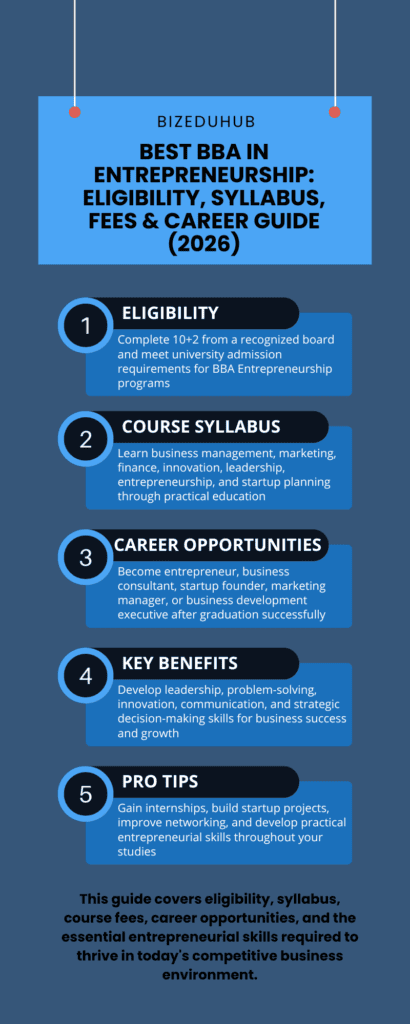
1. Eligibility Criteria
Most colleges keep the entry bar reasonably accessible, since this is an undergraduate program meant to build skills from the ground up rather than assume you already have them.
- You typically need to have completed higher secondary school (10+2) from a recognized board, in any stream — commerce, science, or arts are usually all accepted.
- A minimum aggregate score is often required, commonly somewhere between 45% and 60%, though this varies by institution and tends to be higher for more selective colleges.
- Some universities conduct their own entrance exams or group discussions and personal interviews, particularly the more reputed private institutions, since they want to gauge a candidate’s communication skills and genuine interest in business, not just their marksheet.
- A few colleges also accept scores from national-level management entrance tests, even at the undergraduate level, though this is less common than at the postgraduate stage.
If you’re someone who didn’t score exceptionally well in school but has always tinkered with small side projects, sold things online, or run a school club like a mini-business, don’t count yourself out. Many admission panels for this specific program actually weigh initiative and demonstrated interest quite heavily during interviews through BBA in Entrepreneurship.
2. Syllabus and Curriculum Structure
The three years are usually structured to build foundational business knowledge first, then narrow toward entrepreneurship-specific skills as students progress.
Year One: Building the Foundation
The first year typically covers the basics that every business student needs regardless of specialization — principles of management, financial accounting, business economics, business communication, and an introduction to entrepreneurship as a discipline. This is where you learn the vocabulary of business before you’re asked to apply it to anything real.
Year Two: Sharpening the Tools
The second year usually deepens into marketing management, business law, human resource management, and financial management, while introducing entrepreneurship-specific subjects like new venture creation, business planning, and sometimes an introduction to digital marketing or e-commerce. This is often the point where students start working on small live projects — interviewing local business owners, analyzing a real company’s marketing strategy, or drafting an early-stage business plan.
Year Three: Applying What You Know
The final year typically pushes students toward practical application — venture capital and startup financing, family business management (relevant for a large chunk of students who come from business families), strategic management, and often a capstone project where students either launch a small real venture or write and defend a comprehensive business plan in front of faculty and sometimes outside investors or alumni.
3. Skills You’ll Actually Walk Away With
Beyond the textbook subjects, a good program should leave you with a specific set of practical capabilities: reading and interpreting basic financial statements, building a pitch deck that doesn’t put investors to sleep, understanding the legal basics of registering and structuring a business, negotiating with vendors or partners, and — perhaps most underrated — learning to network without feeling fake about it.
4. Fees and Cost Considerations
Fee structures vary enormously depending on whether you’re looking at a government institution, a private university, or a top-tier business school with an entrepreneurship track.
- Government and state universities: Annual fees generally fall in a modest range, often between ₹20,000 and ₹80,000 per year, making this an accessible option for families watching their budget closely.
- Mid-tier private colleges: Expect annual fees somewhere between ₹1 lakh and ₹3 lakh, depending on location, infrastructure, and brand reputation.
- Premium private universities or specialized entrepreneurship schools: These can range from ₹3 lakh to ₹8 lakh or more per year, especially if the program includes international exposure, incubation support, or partnerships with startup accelerators.
Before you fixate on the fee number alone, it’s worth digging into what’s actually included. Some expensive programs bundle in mentorship from working entrepreneurs, seed funding competitions, dedicated incubation cells, and international immersion trips — value that a cheaper program simply won’t offer. Others charge premium fees purely for brand name with very little added substance. Always ask current students or alumni what they actually got for their money, not just what the brochure promises on the BBA in Entrepreneurship.
Practical Tips for Choosing and Succeeding in This BBA in Entrepreneurship


- Talk to at least three current students or recent graduates before you commit. Ask them what surprised them, what they wish they’d known, and whether the college’s incubation cell is active or just exists on paper.
- Check for a real incubation center, not just a room with a whiteboard and a banner. Ask how many student startups it has actually supported in the last two years and what kind of funding or mentorship they received through BBA in Entrepreneurship.
- Look at faculty backgrounds. A program taught entirely by academics with no real business experience will teach you theory, not practice. Programs with even a few faculty members who’ve built or run businesses tend to give more grounded, useful advice.
- Start a small side project during your first year, even something tiny like reselling products online or offering a freelance service. Nothing teaches entrepreneurship faster than actually doing it badly a few times.
- Don’t skip the “boring” subjects like accounting and business law because they don’t sound as exciting as “startup strategy.” Founders who understand their own balance sheets make far better decisions than founders who don’t.
- Build relationships with classmates deliberately. Some of your future co-founders, first employees, or first clients are very likely sitting in the same lecture hall as you right now.
- Use every business plan competition and pitch event the college offers, even if you’re not confident yet. The skill of pitching only improves through repetition, and rejection at this stage costs you nothing in the BBA in Entrepreneurship.
Real-Life Examples of the BBA in Entrepreneurship
Consider a student named Riya (a common scenario across many campuses, not an isolated case) who enrolled in a BBA Entrepreneurship program mostly because she didn’t want a typical desk job. In her first year, she felt completely out of her depth during a mandatory case study presentation on cash flow management — something she’d never had to think about before. By her second year, using what she learned about lean business models, she started a small tutoring service for junior students, charging a modest fee and reinvesting the profit into better study materials. It wasn’t a unicorn startup. It generated enough income to cover her personal expenses and taught her firsthand.
Compare that to another common scenario: a student who joins the same program, does well academically, but never applies anything outside the classroom. They graduate with a strong theoretical understanding of entrepreneurship but no practical scars — no experience negotiating with a difficult customer, no experience watching a small venture struggle and recover. Both students get the same degree on paper. Their actual readiness for the business world is completely different.
This is the pattern that shows up again and again across entrepreneurship programs: the degree provides the scaffolding, but the students who treat their college years as a low-risk laboratory for testing small ideas walk away with something far more valuable than the ones who treat it purely as coursework to complete a BBA in Entrepreneurship.
Also Read: Entrepreneurship Development & Innovation Institute: A Complete Overview for 2026
Common Mistakes to Avoid in the BBA in Entrepreneurship
- Choosing a college based on rankings alone, without checking program-specific strength. A university might have an excellent overall reputation but a weak, underfunded entrepreneurship track. Always research the specific program, not just the institution’s general name, BBA in Entrepreneurship.
- Expecting the degree to hand you a business idea. No program can do this for you. The coursework teaches you how to evaluate and execute ideas — you still have to bring curiosity and initiative to the table.
- Ignoring the “core business” subjects. Some students treat accounting, economics, and business law as boxes to tick rather than tools they’ll need. This almost always comes back to bite them later when they’re trying to read an actual balance sheet or negotiate a contract.
- Waiting until final year to start anything practical. Practical experience compounds. A small failed side project in year one teaches you more than a polished business plan written only in year three with zero real-world testing behind it.
- Assuming entrepreneurship only means launching a startup. Many graduates use these skills inside existing companies, family businesses, or as intrapreneurs driving new initiatives within larger organizations. Limiting your definition of success to “founding a unicorn” sets an unrealistic and discouraging bar for a BBA in Entrepreneurship.
- Underestimating the importance of networking and mentorship. Some students coast through without building relationships with faculty, alumni, or classmates, then wonder why they lack support once they graduate and actually try to build something.
Frequently Asked Questions About BBA in Entrepreneurship
Q1. Is a BBA in Entrepreneurship a good choice if I’m not sure I want to start my own business?
Yes. The core skills — financial literacy, strategic thinking, communication, and comfort with uncertainty — are valuable in almost any career path, including corporate roles, consulting, and family business management. You don’t need to commit to founding a startup to benefit from the training in the BBA in Entrepreneurship.
Q2. What career options are available after completing this degree?
Graduates commonly move into roles such as business development, startup founder or co-founder, family business management, brand or product management, consulting, or further studies through an MBA. Some also join startup ecosystems as employees in early-stage companies, which offers hands-on exposure without the full risk of founding one themselves.
Q3. How is this different from a regular BBA or a Bachelor of Commerce degree?
A regular BBA or B.Com focuses more broadly on business administration or commerce fundamentals without a specific lens on new venture creation. A BBA in Entrepreneurship keeps the same foundational subjects but adds a concentrated focus on business planning, venture financing, and practical startup exposure throughout the three years.
Q4. Do I need to already have a business idea before applying?
No. Most students enter without a clear idea, and that’s completely normal. The program is designed to help you develop the skills to evaluate, refine, or even discover viable ideas over time, not to test whether you already have one.
Q5. Is this degree worth it if I eventually want to pursue an MBA?
Generally, yes. A BBA in Entrepreneurship gives you a strong practical foundation and often makes MBA coursework feel more familiar, particularly subjects like strategy, finance, and marketing. Many students use this exact path — undergraduate specialization followed by an MBA — to build both practical experience and advanced credentials before entering the workforce or launching a venture.

Conclusion
Choosing a BBA in Entrepreneurship isn’t really about chasing a trendy degree title. It’s about deciding, early in your life, that you want to understand how businesses actually work — not just as an employee following instructions, but as someone capable of building, evaluating, and steering something of your own. The eligibility requirements are manageable, the curriculum is designed to build from fundamentals toward applied skill, and the career paths that follow are broader than most people assume.
What actually determines whether this degree serves you well isn’t the college’s brand name or the size of the fee you pay. It’s what you choose to do with the three years you’re given — the small projects you start, the mistakes you’re willing to make while the stakes are still low, and the people you choose to learn alongside. The degree gives you the room to experiment. Whether you use that room wisely is entirely BBA in Entrepreneurship.