


Introduction to SSC Exam Syllabus
Most SSC candidates fail not because they studied too little — they fail because they studied the wrong things. That is an uncomfortable truth, but it is the most useful one you will read before your exam.
Walk into any coaching centre or WhatsApp study group, and you will find people buried in thick books, working through topics that barely appear in the actual paper, while quietly ignoring the chapters that show up every single year. This happens because most candidates never sit down and properly understand the SSC exam syllabus before they start preparing. They just start studying, hoping effort alone will carry them through.
The SSC exam syllabus is not just a list of topics. It is a map. It tells you what SSC considers important, what level of difficulty to expect, and how to divide your preparation time intelligently. A candidate who understands the syllabus deeply before opening a single textbook is already ahead of the majority.
This guide breaks the 2026 syllabus down subject by subject — clearly, honestly, and with enough detail that you can build a real preparation plan around it.
What is the SSC Exam Syllabus?
The SSC exam syllabus is the official document published by the Staff Selection Commission that defines exactly which topics will be tested in each exam, at each tier, for each post category. It sounds simple. In practice, most candidates misread it in at least one of three ways:
They treat it as a checklist, not a guide. They mark topics as “done” after one reading without understanding how deeply each topic is tested. The syllabus says “Percentage” — that single word covers everything from basic percentage calculation to complex questions combining percentage with profit and loss, discount, and data interpretation.
They do not distinguish between exams. SSC runs multiple exams — CGL, CHSL, MTS, CPO, JE — and each has its own syllabus. The syllabus for SSC CGL Tier 2 is significantly harder and more detailed than SSC CHSL Tier 1. Candidates who confuse these waste months preparing at the wrong level.
They ignore the tier structure. SSC CGL, for example, has Tier 1 and Tier 2. The Tier 1 syllabus is broad and tests general competence. The Tier 2 syllabus is narrower but deeper — especially in Maths and English. Preparing for both tiers the same way is a strategic error. Here is the core SSC CGL 2026 syllabus structure at a glance:
Tier 1 (All four subjects, 25 questions each, 200 marks, 60 minutes):
- General Intelligence and Reasoning
- General Awareness
- Quantitative Aptitude
- English Language and Comprehension
Tier 2 (Detailed papers, varies by post):
- Paper 1: Mathematical Abilities + Reasoning and General Intelligence (compulsory for all)
- Paper 2: English Language and Comprehension (compulsory for all)
- Paper 3: Statistics (for JSO posts only)
- Paper 4: General Studies — Finance and Economics (for AAO posts only)
Every subject within every tier has a specific list of topics. Knowing that list — and knowing which topics within it appear most frequently — is the foundation of smart preparation.
Why Understanding the SSC Exam Syllabus Matters
Here is the practical reality: the SSC exam syllabus is large. No candidate prepares every topic to the same depth. The ones who clear the exam are the ones who made better decisions about where to invest their time. Understanding the syllabus properly gives you three things:
Prioritization. Not all topics are equal. In Quantitative Aptitude, Arithmetic (Percentage, Ratio, Profit & Loss, Time & Work, Speed-Distance-Time) contributes roughly 40–50% of questions in Tier 1. Algebra and Geometry together contribute another 25–30%. Candidates who know this spend the most time on Arithmetic. Candidates who do not know this sometimes spend weeks on Trigonometry — a topic that appears in only 2–3 questions.
Realistic scope. The General Awareness section lists topics ranging from History to Science to Current Affairs to Sports to Government Schemes. No human being can master all of this equally. The syllabus, combined with previous year paper analysis, tells you which sub-topics SSC actually tests and which ones are theoretical inclusions that rarely appear.
Tier-appropriate preparation. A candidate who knows Tier 2 Maths is far more detailed than Tier 1 will start building that depth early — not scramble after Tier 1 results are out. The syllabus tells you the full journey, not just the next step.
Skipping syllabus analysis is like starting a road trip without looking at the map. You might eventually get somewhere. You will definitely waste fuel.
Subject-Wise SSC Exam Syllabus Breakdown
1. General Intelligence and Reasoning
This section appears in both Tier 1 and Tier 2. The syllabus covers:
Verbal Reasoning:
- Analogies (Semantic and Symbolic)
- Classification
- Series (Number, Letter, Word)
- Coding-Decoding
- Blood Relations
- Direction and Distance
- Syllogisms
- Statement and Conclusions
- Alphabet and Word Tests
Non-Verbal Reasoning:
- Pattern Completion
- Figure Matrix
- Paper Folding and Cutting
- Mirror and Water Images
- Embedded Figures
- Venn Diagrams
- Dice and Cubes
What the SSC exam syllabus does not tell you
The difficulty level. Tier 1 Reasoning questions are largely straightforward — designed to test whether you understand the concept. Tier 2 Reasoning questions (Paper 1) are more complex, with multi-step logic and time pressure.
The real preparation insight here is this: Reasoning is the most learnable section. Unlike GK, it does not require memorization. Unlike Maths, it does not require calculation. It requires pattern recognition — which improves dramatically with consistent daily practice over 2–3 months.
Focus especially on: Series, Coding-Decoding, Analogies (they appear in almost every paper), and Non-Verbal Figure questions (Paper Folding, Mirror Images — many candidates skip these and leave easy marks on the table).
2. General Awareness
This is the broadest section in the syllabus and the one most candidates both over-prepare and under-prepare simultaneously — spending too much time on current affairs while ignoring high-frequency static GK.
The official syllabus lists:
- History (Ancient, Medieval, Modern India)
- Geography (Indian and World)
- Indian Polity and Constitution
- Economics (Basic concepts, Budget, Five Year Plans)
- General Science (Physics, Chemistry, Biology)
- Current Affairs (last 6–12 months)
- Static GK (Books & Authors, Awards, Sports, Important Dates, Government Schemes)
What actually appears in the paper
Based on previous year paper patterns, the high-frequency topics are:
- Modern Indian History: Freedom movement, important leaders, events from 1857–1947
- Indian Polity: Constitutional Articles, Fundamental Rights, Directive Principles, Parliament, Amendments
- Geography: Rivers, Mountains, National Parks, Climate, Soils
- Biology: Human body systems, Diseases, Nutrition, Classification
- Physics: Laws of Motion, Sound, Light, Electricity — conceptual, not calculation-heavy
- Current Affairs: National and international events from the 6 months before the exam
Ancient and Medieval History, World Geography, and Advanced Economics appear less frequently. This does not mean you skip them — it means you do not spend equal time on them.
3. Quantitative Aptitude
This section has the most detailed syllabus and the steepest learning curve for most candidates. Topics are:
Arithmetic (highest weight):
- Number System and HCF/LCM
- Simplification and Approximation
- Percentage
- Ratio and Proportion
- Average
- Profit, Loss and Discount
- Simple and Compound Interest
- Time and Work (including Pipes & Cisterns)
- Time, Speed and Distance (including Trains, Boats & Streams)
- Mixture and Alligation
Algebra:
- Basic Algebraic Identities
- Linear Equations
- Quadratic Equations (limited)
Geometry and Mensuration:
- Lines, Angles, Triangles, Circles, Quadrilaterals
- Area and Perimeter of 2D shapes
- Volume and Surface Area of 3D shapes
Trigonometry:
- Basic ratios (sin, cos, tan)
- Heights and Distances
- Trigonometric identities
Data Interpretation:
- Bar Graphs, Pie Charts, Line Graphs, Tables
- Appears in both Tier 1 and significantly more in Tier 2
Tier 1 vs Tier 2 difference
Tier 1 Maths tests whether you can solve the problem. Tier 2 Maths tests how fast you can solve it — accurately, under time pressure, with higher complexity. The Tier 2 paper is 2.5 hours with 90 questions. That is less than 2 minutes per question across Maths and Reasoning combined. Speed and accuracy, not just knowledge, determine your score.
The preparation implication: from Month 3 onward, every Maths practice session should be timed. Solving problems correctly at leisure is not enough.
4. English Language and Comprehension
The syllabus covers:
Vocabulary:
- Synonyms and Antonyms
- One-Word Substitution
- Idioms and Phrases
- Spellings
Grammar:
- Error Spotting (spotting grammatical errors in sentences)
- Sentence Improvement
- Fill in the Blanks
- Active and Passive Voice
- Direct and Indirect Speech
Reading Comprehension:
- Passage-based questions
- Cloze Test (fill blanks in a passage)
- Para Jumbles (rearranging sentences into correct order)
The real weight distribution
In Tier 1, Grammar and Vocabulary questions dominate. In Tier 2, Reading Comprehension and Cloze Test carry much more weight. Many candidates prepare Tier 1 English well and then struggle in Tier 2 because they never built strong comprehension skills.
The practical fix: start reading one structured English passage daily from Month 2 onward. Not news headlines — full editorial pieces where you have to track argument and meaning across paragraphs.
Practical Tips for Using the SSC Exam Syllabus Effectively

- Download the official SSC notification PDF for your specific exam. Read the SSC exam syllabus section yourself — do not rely on coaching notes that may be outdated or incomplete.
- Map previous year papers to the syllabus. Take any SSC CGL Tier 1 paper from the last 3 years, go question by question, and mark which syllabus topic each question came from. After doing this for 3 papers, you will have a clear frequency map of what actually appears.
- Build a topic priority list. Divide every topic into three categories: High Frequency (appears in almost every paper), Medium Frequency (appears occasionally), Low Frequency (rare). Spend your time accordingly — roughly 60% on High, 30% on Medium, 10% on Low.
- Do not treat Tier 1 and Tier 2 as separate preparation cycles. Start building Tier 2 depth from Month 3 of preparation. Waiting until after Tier 1 results — typically 6–8 weeks before Tier 2 — is not enough time.
- Revisit the syllabus every 4 weeks. As you progress, your understanding of what the syllabus actually means deepens. A monthly review helps you catch gaps you missed in the first read.
- Use the syllabus to build your mock test checklist. After every mock test, check your wrong answers against the syllabus. Are your errors concentrated in specific topic areas? That concentration tells you exactly where to focus next on the SSC exam syllabus.
Real-Life Examples of the SSC Exam Syllabus
Anjali, SSC CGL 2024 qualifier: Anjali spent her first month printing the official CGL notification, reading the syllabus three times, and then solving two years of previous papers before touching a single textbook. She used this to build a topic-by-topic priority list. She cleared Tier 1 by 14 marks above the cutoff and cited SSC exam syllabus mapping as the single most useful thing she did in her preparation.
Deepak, three-time Tier 1 failure: Deepak had been preparing for two years when he finally sat down and compared his study notes with the actual official SSC exam syllabus. He discovered he had been studying Medieval History in significant depth — a topic that rarely appears in CGL. He had ignored Data Interpretation almost entirely, which contributes 15–20 marks in Tier 1 alone. He restructured his preparation in Month 4, cleared Tier 1 in his next attempt, and credits the realignment for the shift.
Common Mistakes to Avoid in the SSC Exam Syllabus
- Preparing from unofficial or outdated SSC exam syllabus sources. SSC revises the exam pattern periodically. Always use the current official notification from ssc.gov.in, not a third-party website that may be quoting a 2021 syllabus.
- Treating all topics as equally important. They are not. Allocating equal time to every topic in the syllabus is how average candidates prepare. Smart candidates allocate time based on frequency and marks weight.
- Ignoring the negative marking implications for syllabus strategy. The SSC exam syllabus tells you what will be tested. Negative marking tells you how to approach uncertain questions. Topics where your accuracy is below 70% are topics where you should skip questions in the exam — not attempt and guess.
- Confusing the Tier 1 and Tier 2 syllabus. Tier 2 Maths goes significantly deeper into Algebra, Geometry, and Data Interpretation than Tier 1. Candidates who only prepare to Tier 1 depth are underprepared for Tier 2 even if they cleared Tier 1 comfortably.
- Skipping the Statistics and Finance papers without checking post eligibility. If you are applying for JSO (Junior Statistical Officer) posts under CGL, Paper 3 (Statistics) is compulsory and has a detailed additional syllabus. Many candidates discover this late and scramble unprepared.
Frequently Asked Questions About SSC Exam Syllabus
Q1. Is the SSC CGL 2026 syllabus different from previous years?
The core SSC exam syllabus — four subjects across Tier 1, detailed papers in Tier 2 — has remained broadly stable. However, SSC revised the exam pattern in 2023, merging what was previously Tier 3 and Tier 4 into post-specific skill tests. Always verify against the current official notification. Do not assume last year’s pattern is unchanged.
Q2. Which subject in the SSC exam syllabus is the most scoring?
Reasoning and English are generally the most scoring for candidates with decent language skills, because they are more learnable and less dependent on calculation speed. Maths has the highest potential marks ceiling but also the steepest learning curve. General Awareness is the most unpredictable — your score depends heavily on what SSC chooses to ask that year. Most toppers have strong Reasoning and English scores as their base, with Maths and GK as variables.
Q3. How do I know which topics in the SSC exam syllabus to prioritize?
Solve 3–4 previous year papers for your target exam before you start your main preparation. Map each question to its syllabus topic. Count the frequency. The topics that appear most often across multiple papers are your highest-priority topics. This analysis takes one week and saves months of misdirected effort.
Q4. Does the SSC CHSL syllabus differ significantly from SSC CGL?
Yes, in two important ways. First, CHSL Tier 1 has a lower difficulty ceiling — especially in Maths, where Trigonometry, Geometry, and higher Algebra appear less frequently. Second, CHSL does not have a Tier 2 paper equivalent to CGL’s detailed Maths and English papers. If you are preparing for both, target CGL — CHSL will be a natural subset of that preparation.
Q5. Where can I find the official SSC exam syllabus for 2026?
Go directly to ssc.gov.in. Download the official notification PDF for your specific exam (CGL, CHSL, MTS, CPO, or JE). The SSC exam syllabus is listed in the notification document itself, usually in an annexure. Do not rely on coaching websites or YouTube videos for syllabus information — they are frequently outdated or incomplete.

Conclusion
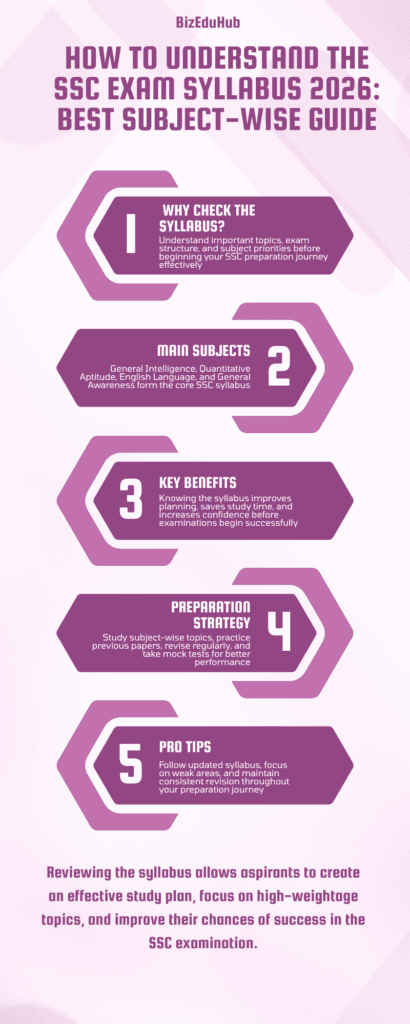
Understanding the SSC exam syllabus is not a one-hour task you complete before moving on to “actual” preparation. It is an ongoing reference point that should shape every decision you make — which topics to study, how deeply to study them, when to move from basics to practice, and where to focus when time is short.
The candidates who struggle year after year are rarely the ones who lack intelligence or discipline. They are the ones who worked hard in the wrong direction — studying what felt productive rather than what the syllabus and paper patterns actually demanded.
The 2026 SSC exam will test the same core competencies it has always tested. The SSC exam syllabus is public. The previous year papers are available. The patterns are visible if you look. There is no hidden advantage that toppers have access to that you do not.
!You might be interested in reading this page as well
How to Prepare for the SSC Exam 2026: Easy Step-by-Step Guide