


Introduction to Entrepreneurship Development & Innovation Institute
There is a particular kind of restlessness that lives in the chest of every person who has ever looked at a problem and thought, I could fix that. It is not arrogance — it is the quiet beginning of entrepreneurship. But between that restless feeling and a thriving venture, there is a gap that most people never figure out how to cross. That gap is exactly what the Entrepreneurship Development & Innovation Institute was built to bridge.
Whether you are a fresh graduate overflowing with ideas but unsure where to start, a mid-career professional considering a pivot, or a seasoned operator wanting to institutionalize innovation within your organization, the Entrepreneurship Development & Innovation Institute offers something rare: a structured yet human approach to building the entrepreneurial mindset. In 2026, as markets grow more volatile and technology reshapes entire industries at a dizzying pace, understanding what this kind of institution offers — and how to make the most of it — has never mattered more. This guide walks you through everything you need to know, from the foundational philosophy to the practical steps that can genuinely change the trajectory of your career and your business.

What Is the Entrepreneurship Development & Innovation Institute?
At its core, an Entrepreneurship Development & Innovation Institute — often abbreviated as EDII — is an organized body dedicated to cultivating entrepreneurial capacity at scale. The concept first emerged in the 1970s and 1980s in response to a growing recognition that entrepreneurship is not a talent you are simply born with. It is a skill. A practice. A discipline. And like any discipline, it can be taught, nurtured, and systematized.
The most well-known institution by this name was established in Ahmedabad, India, in 1983. Since then, the EDII model has been replicated, adapted, and evolved across dozens of countries. What ties them together is a shared mission: to create an ecosystem where innovation is not accidental but intentional, where entrepreneurs receive not just funding or mentorship in isolation, but an integrated support system that addresses knowledge, skills, networks, and mindset simultaneously.
Think of it this way. A traditional business school teaches you about entrepreneurship. An Entrepreneurship Development & Innovation Institute actually tries to make you one. The difference is as significant as the difference between reading about swimming and getting in the water. Programs at these institutes tend to involve experiential learning, live projects, market immersion, prototype development, and intensive mentorship from practitioners — not just professors.
“Entrepreneurship is not just about starting companies. It is about training a generation of people to see possibilities where others see only problems.”
These institutes also serve a broader economic function. By systematically developing entrepreneurial talent, they contribute to job creation, regional development, and the diversification of economies. In emerging markets, especially, they play a catalytic role — turning informal hustle into a structured, sustainable enterprise.
Why the Entrepreneurship Development & Innovation Institute Matters in 2026
It would be easy to assume that in the age of YouTube tutorials, startup podcasts, and online accelerators, a formal institute for entrepreneurship development feels redundant. That assumption is wrong, and understanding why requires looking at what has actually been happening in the startup ecosystem over the last few years.
Failure rates for new ventures remain stubbornly high — estimates consistently suggest that somewhere between 70 and 90 percent of startups do not survive beyond their first five years. The causes are well-documented: poor market research, undercapitalization, weak co-founder dynamics, and above all, founders who never truly understood their customer.
Beyond survival rates, 2026 has introduced new layers of complexity. The rise of generative technologies has dramatically lowered the barrier to building digital products, which sounds like good news — and it is —, but it has also created an environment of intense noise. Thousands of similar products launch every week. Differentiation, positioning, and deep customer insight have become even more critical than they were five years ago.
There is also a mental health dimension that rarely gets discussed. Entrepreneurship is isolating. The highs are extraordinary, and the lows are punishing, and most founders navigate both largely alone. The community dimension of an Entrepreneurship Development & Innovation Institute — the cohort model, the peer accountability, the shared language of struggle and resilience — provides something that no algorithm can replicate: genuine human solidarity.
How Entrepreneurship Development & Innovation Institutes Work
1. The Curriculum Philosophy: Learning by Doing
The best innovation institutes have moved decisively away from lecture-heavy models. Instead, participants spend the majority of their time working on real problems. A typical program might begin with weeks of structured market immersion — participants go out into the field, talk to potential customers, document pain points, and return with raw, unfiltered insight.
From there, cohorts work through ideation workshops, prototype development, and iterative testing cycles. Failure is not just tolerated — it is required. Institutes that genuinely understand innovation create environments where a failed prototype in week three is considered evidence of learning, not evidence of inadequacy.
2. Mentorship Networks and Industry Partnerships
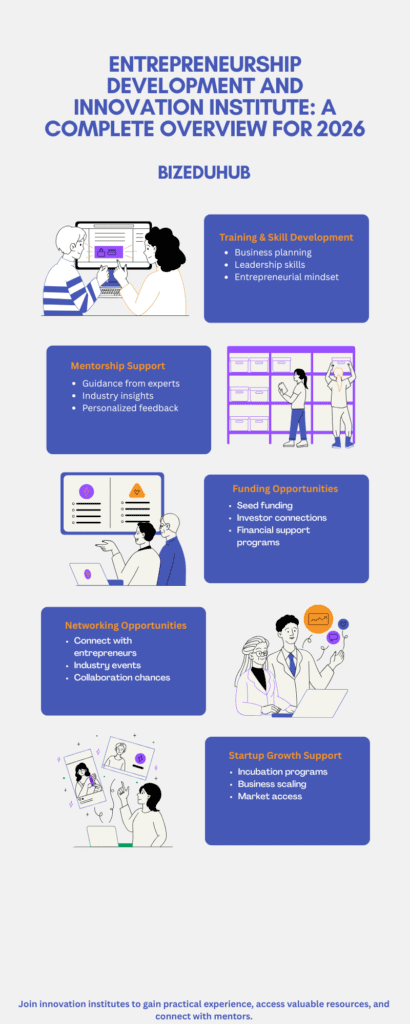
One of the most tangible advantages of attending a reputable Entrepreneurship Development & Innovation Institute is access to its mentor network. These are practitioners — founders who have exited companies, investors who have deployed capital across hundreds of deals, and corporate innovation heads who have run incubation programs from the inside.
Industry partnerships matter enormously here. Many institutes have formal relationships with corporations, government bodies, and development finance institutions. These partnerships create real pathways: pilot programs with enterprise clients, grant access for early-stage ventures, and even recruitment pipelines for participants who decide that building within an established organization suits them better than founding their own.
3. Incubation and Acceleration Programs
Many institutes operate tiered support structures. An incubation program typically supports very early-stage ideas — the kind that are still looking for product-market fit. Acceleration programs, by contrast, are designed for ventures that have demonstrated some traction and need to scale quickly. Understanding which program you need, and timing your application accordingly, is one of the most important strategic decisions a founder can make.
4. Innovation Labs and Research Centers
A distinguishing feature of the more mature institutes is their investment in physical and intellectual infrastructure. Innovation labs are spaces where entrepreneurs can prototype rapidly — equipped with fabrication tools, design software, testing environments, and increasingly, access to computing resources for ventures working in data-intensive domains. These are not just perks.
Research centers within these institutes also generate knowledge that feeds back into the curriculum. Studies on regional entrepreneurship ecosystems, sector-specific market analyses, and policy research on innovation incentives all contribute to programs that are grounded in current, local reality rather than case studies from a decade ago.
Practical Tips for Getting the Most Out of an Innovation Institute


- Apply before you are ready. Many aspiring entrepreneurs delay applying to programs because they feel their idea is not developed enough. This misunderstands the purpose of the institute. Come with a problem you are passionate about solving, not a polished pitch deck. The program will help you develop the rest.
- Treat every interaction as a learning opportunity. The formal curriculum is only part of what you gain. The conversations in the corridor, the late-night debates with cohort members, the casual lunch with a mentor — these informal exchanges are where some of the most valuable learning happens. Stay curious and stay present.
- Find a real customer in the first week. Whatever program you are in, commit to speaking with at least five potential customers within your first week. Do not ask them about your product — ask them about their problem. This habit, developed early, shapes everything that comes after.
- Build your peer relationships as deliberately as your product. The people in your cohort will be collaborators, advisors, investors, and friends for decades. Approach these relationships with the same intentionality you bring to your venture. Show up for their challenges even when you are buried in your own.
- Use the institute’s brand strategically. A credential from a reputable Entrepreneurship Development & Innovation Institute carries weight with investors, partners, and clients. Be intentional about how you present this affiliation in your communications and pitch materials.
- Request feedback relentlessly — and act on it visibly. Mentors and facilitators are most engaged with participants who demonstrate that feedback actually changes their behavior. You do not have to implement every suggestion, but you must show that you have genuinely considered it and explain your reasoning when you diverge.
Real-Life Examples of Entrepreneurship Development & Innovation Institutes
1. The Textile Entrepreneur from Gujarat
Consider the story of a young woman from a weaving community in Gujarat who enrolled in an EDII program with nothing more than a skilled pair of hands, a family workshop, and a vague sense that the global market for handloom textiles was larger than the local traders she had always sold through. Over twelve months, she learned to read export data, understand buyer personas in Western markets, develop her brand identity, and use digital platforms to build direct relationships with retail buyers.
2. A Corporate Intrapreneurship Initiative
Not every success story involves a solo founder. A mid-sized logistics company sent a team of three middle managers to an innovation institute’s corporate program with a mandate to develop new service lines. The structured design-thinking methodology they learned led them to identify a significant inefficiency in last-mile delivery documentation that was costing their clients hours per week. They prototyped a lightweight digital solution, tested it with three pilot clients, and returned to the company with enough evidence to secure internal funding.
3. Youth Entrepreneurship at Scale
Some of the most transformative work happening in entrepreneurship development institutes today involves young people who have never had access to formal business education. In several African countries, institutes running EDII-modeled programs for youth aged 18 to 25 are producing measurably different outcomes: participants are significantly more likely to start income-generating activities, demonstrate stronger financial management behaviors, and report higher confidence in their capacity to influence their own economic futures.
Common Mistakes to Avoid in Innovation Institutes
1. Treating the institute as a credential factory
The certificate matters far less than the capability you build while earning it. Participants who focus primarily on completing the program and collecting the credential typically emerge with neither. The people who get the most out of innovation institutes are the ones obsessively focused on solving a real problem — the credential is a pleasant side effect.
2. Isolating yourself from your cohort
It is tempting to keep your idea close to your chest, particularly if you are in a competitive mindset. This is a mistake. Innovation is fundamentally collaborative, and the peer feedback you receive during an intensive program is far more valuable than the imaginary first-mover advantage you protect by staying silent. Share generously. You will get back tenfold.
3. Waiting for the perfect idea
Many aspiring entrepreneurs delay participation in programs because they are waiting for the right idea to crystallize. The Entrepreneurship Development & Innovation Institute approach consistently shows that ideas emerge from engagement, not from waiting. The process of talking to customers, working through frameworks, and sitting in a room full of equally restless people has a way of generating clarity that solitary reflection rarely achieves.
4. Neglecting post-program alumni networks
The program ends, but the network does not — or at least, it should not. Many participants let their alumni connections go dormant within months of graduation, which is a significant waste. Stay actively engaged with your alumni community. Attend events, make introductions, share resources. Networks decay when they are not maintained, and an entrepreneurship alumni community is one of the most valuable assets you can hold.
5. Dismissing mentors whose industry differs from yours
A common error among participants is seeking mentorship only from people who have built businesses in the same sector. This severely limits the quality of insight you receive. Some of the most useful mentors are those who bring frameworks from adjacent industries. The principles of customer development that work in consumer goods translate remarkably well to B2B software — the mentor who built a fast-moving consumer goods brand might ask you a question about distribution that your sector-specialist mentor would never think to raise.
Frequently Asked Questions About Entrepreneurship Development & Innovation Institutes
Q1. What is the Entrepreneurship Development & Innovation Institute, and who is it for?
The Entrepreneurship Development & Innovation Institute is an institution dedicated to developing entrepreneurial skills, mindset, and innovation capacity through structured programs, mentorship, and ecosystem support. It is designed for a broad range of participants: aspiring founders, early-stage entrepreneurs, corporate professionals seeking to develop intrapreneurial capabilities, development practitioners working on economic inclusion, and educators looking to bring entrepreneurship into their own teaching contexts.
Q2. How does an innovation institute differ from a traditional business school?
The most significant difference lies in methodology and purpose. Business schools primarily prepare students to manage and lead within existing organizations, using case study analysis, financial modeling, and strategic frameworks. Innovation institutes, by contrast, are built around the process of creating new organizations and new value under conditions of uncertainty.
Q3. What kinds of programs does the Entrepreneurship Development & Innovation Institute typically offer?
Programs vary by institution, but most well-established EDII models offer a spectrum of engagements: short entrepreneurship orientation workshops for people new to the field; certificate programs of several weeks focused on specific sectors or skills; full-length entrepreneurship development programs lasting three to twelve months; specialized programs for women entrepreneurs, youth, rural communities, or technology ventures; incubation and acceleration services for ventures at early and growth stages; and executive-level programs for corporate innovation teams.
Q4. How do I know if an Entrepreneurship Development & Innovation Institute program is right for me right now?
The simplest indicator is this: do you have a problem you care deeply about solving, but lack the structured knowledge, network, or methodology to pursue it effectively? If yes, a program is probably right for you now. The more nuanced consideration is timing. If you are in the middle of a crisis — a financial emergency, a major personal disruption — the intense demands of a program may not serve you well.
Q5. What outcomes can participants realistically expect from these programs?
Expectations should be honest and calibrated. An innovation institute will not hand you a successful business. What it will do — if you engage fully — is dramatically increase your likelihood of building one by equipping you with validated frameworks, a network of peers and mentors, and the disciplined habits of a practiced entrepreneur.

Conclusion
There is something quietly radical about the idea at the heart of every Entrepreneurship Development & Innovation Institute: that the capacity to create, to build, to solve problems at scale is not the exclusive domain of the brilliant few who happened to grow up in the right environment or attend the right university. It is a learnable, teachable, and developable human capability — and it deserves the same kind of institutional support that we extend to medicine, law, and engineering.
In 2026, with its particular combination of technological disruption, economic uncertainty, and genuinely urgent global challenges, that idea matters more than ever. The entrepreneurs who will build meaningful companies over the next decade are not all in well-resourced startup hubs. Many of them are sitting right now in smaller cities, in emerging markets, in rural communities — with problems they can already see clearly and ideas that are not yet fully formed. What they need is the right structure, the right community, and the right methodology to take the next step.
If you are one of those people — restless, curious, and just a little bit convinced that you could fix something worth fixing — then an Entrepreneurship Development & Innovation Institute might be the most important decision you make this year. Not because it will do the work for you, but because it will teach you how to do the work that actually matters. That is a rare and valuable gift. Do not let hesitation rob you of it.
!You might be interested in reading this page as well
Top 10 Finance Tips for Beginners to Build a Strong Financial Foundation