


Introduction to Digital Marketing
A few years ago, a friend of mine — a baker with genuinely extraordinary talent — was running a small cake business almost entirely by word of mouth. Her cakes were stunning, her clients were devoted, and her order book was perpetually half-empty. One afternoon over coffee, she told me she felt invisible. People who would have loved her work simply had no way of finding it. She had heard people talk about digital marketing but dismissed it as something for tech companies and corporations, not a one-woman bakery in a mid-sized city.
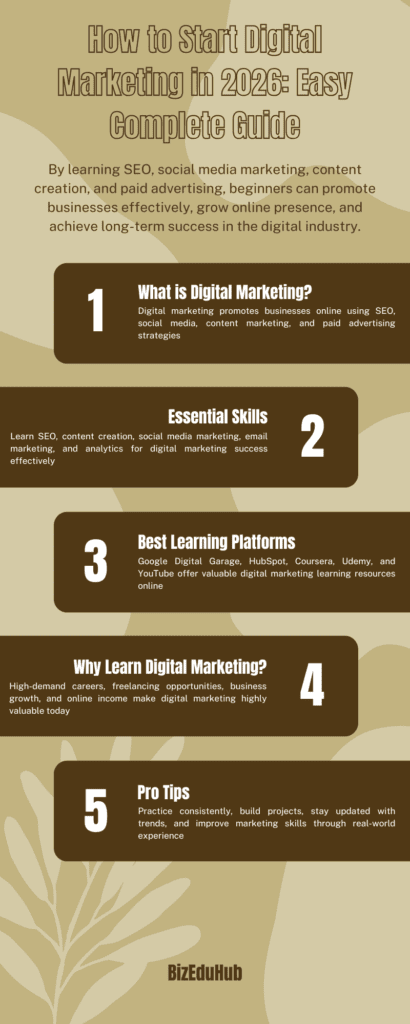
The truth is that digital marketing is not a single thing. It is an ecosystem of tools, channels, and strategies that, taken together, give any person or business the ability to reach the right audience at the right time — regardless of budget, industry, or starting point. In 2026, understanding how this ecosystem works is not a competitive advantage reserved for specialists. It is foundational knowledge for anyone who wants to build something online, grow a career, or take their business beyond the reach of its immediate neighborhood. This guide is written for that person: curious, capable, and ready to stop feeling left behind.
What is Digital Marketing?
At its simplest, digital marketing is the practice of promoting products, services, or ideas using internet-connected platforms and devices. But that definition, while accurate, undersells what it actually represents. Digital marketing is the modern version of something humans have always done: find the people who need what you offer, and communicate your value to them clearly enough that they choose you.
What makes the digital version transformative is scale, precision, and measurability. A billboard reaches everyone who drives past it, whether or not they are remotely interested in what it advertises. A well-targeted online ad reaches only people who have demonstrated genuine interest in the relevant topic — and you can track exactly how many of them clicked, visited your website, and ultimately purchased. This combination of reach and accountability is what separates modern online marketing from its predecessors.
The field encompasses a wide range of disciplines. Search engine optimization (SEO) helps your website appear when people search for relevant topics on Google. Social media marketing builds relationships and visibility on platforms like Instagram, LinkedIn, and TikTok. Email marketing nurtures relationships with people who have already shown interest in what you do. Paid advertising accelerates visibility through targeted placements. These channels work independently, and they work considerably better when they work together in digital marketing.
Why Digital Marketing Matters More Than Ever in 2026
There is a version of this conversation that gets tired quickly — the one that simply points to statistics about internet usage and declares digital marketing important. Those statistics are real and significant, but the more honest argument is experiential: in 2026, the overwhelming majority of purchasing decisions — whether for a handmade candle, a legal service, or a SaaS subscription — begin with some form of online research. They are. The question is whether they can find you when they look.
For individuals building careers, online marketing literacy has become table stakes. Copywriters who understand content strategy command higher rates. Project managers who understand digital campaign workflows are more valuable to their teams. Entrepreneurs who understand how to acquire customers online can build genuinely scalable businesses, not just locally sustainable ones. The skills transfer across roles, industries, and career trajectories in ways that few other disciplines do.
And practically speaking, the cost barriers to entry have never been lower. You can publish a blog post, run a small social campaign, or build an email list with tools that cost nothing or close to it. What has historically separated those who succeed at online marketing from those who do not is not budget — it is understanding. This guide is designed to provide an understanding of digital marketing.
“The best marketing doesn’t feel like marketing. It feels like the answer to a question someone was already asking.”
The Core Channels of Digital Marketing
1. Search Engine Optimization (SEO)
SEO is the practice of making your website and content more likely to appear in search engine results when people search for relevant topics. It is one of the most powerful long-term strategies in the digital marketing toolkit because it generates traffic without ongoing advertising spend. Unlike paid ads, which stop the moment you stop funding them, well-executed SEO compounds over time — an article you write today may generate consistent traffic for years.
The fundamentals of SEO in 2026 have not shifted dramatically from what they were five years ago: create genuinely useful content that answers real questions, build a technically sound website that loads quickly, and earn credibility by having other reputable sites link to yours. The sophistication lies in the execution — keyword research, content structure, technical audits, and link-building strategies each require a real understanding to implement well. But the underlying principle is simple: earn Google’s trust by being genuinely useful to the people searching on it.
2. Social Media Marketing
Organic Social
Organic social media — the posts, stories, and videos you publish without paying to promote them — is one of the most accessible entry points into online marketing. It requires no budget, only time and consistency. The trade-off is that organic reach on most major platforms has declined steadily as those platforms push brands toward paid promotion. That said, for personal brands, niche businesses, and anyone willing to create genuinely engaging content, organic social media still offers a meaningful opportunity — particularly on platforms like LinkedIn for professional audiences and TikTok for consumer-facing brands willing to invest in short video.
Paid Social
Paid social advertising — running promoted posts or targeted ad campaigns on platforms like Meta, LinkedIn, or TikTok — offers the ability to reach very specific audiences with speed and scale that organic content rarely matches. The targeting capabilities available on these platforms are extraordinary: you can reach people based on their job title, their interests, their recent purchasing behavior, or their similarity to your existing customers. Even modest budgets, when deployed with precision and clear intent, can produce meaningful results.
3. Email Marketing
Email marketing remains one of the highest-return strategies in the entire digital marketing landscape. Unlike social media followers, your email list belongs to you — no platform algorithm can prevent your message from reaching the people who have explicitly asked to hear from you. For businesses and personal brands alike, building an email list of engaged subscribers is one of the most durable assets you can develop.
Effective email marketing goes well beyond sending promotional blasts. The most successful email programs treat the inbox as a relationship space — delivering genuine value through educational content, exclusive insights, or thoughtful storytelling, with commercial messages woven in naturally rather than front-loaded as the primary reason for every send.
4. Content Marketing
Content marketing is the practice of creating valuable, relevant material — articles, videos, podcasts, guides, infographics — that attracts and builds trust with your target audience over time. It is the long game of digital marketing: slower to produce results than paid advertising, but significantly more durable and often more cost-effective at scale. The bakery owner I mentioned at the start of this piece built her online following primarily through content — specifically, short videos documenting her creative process that accumulated thousands of followers who became a warm audience for her order announcements.
How to Start Digital Marketing: A Step-by-Step Approach


1. Define your goal with specificity
Vague goals produce vague results. “Grow my online presence” is not a strategy. “Generate 50 email subscribers per month from organic blog traffic within six months” is. Every decision that follows — which channel to prioritize, what content to create, how to measure success — becomes clearer when your goal is concrete and time-bound.
2. Identify and understand your target audience.
Spend genuine time thinking about who you are trying to reach. What are their real concerns, questions, and frustrations? Where do they spend time online? What kind of content do they engage with? The more precisely you can answer these questions, the more effectively every piece of digital marketing you produce will resonate with the people you need to reach.
3. Choose one or two channels to start.
The number of available channels can feel paralyzing. Resist the temptation to be everywhere at once. Choose the one or two channels where your target audience is most active and where you can realistically produce consistent output. Master those before expanding.
4. Build a simple content plan.
Consistency matters more than perfection. A simple editorial calendar — even a spreadsheet tracking what you will publish, on which channel, and when — dramatically increases the likelihood that your output will be regular rather than sporadic. Aim for sustainability: a schedule you can maintain for six months with realistic effort, not one that requires heroic effort for four weeks before collapsing.
5. Set up your measurement infrastructure.
Before you publish your first piece of content or run your first campaign, set up Google Analytics or an equivalent tool on your website. Connect Google Search Console. Know your baseline metrics. You cannot improve what you do not measure, and measurement data gathered from day one gives you a far more complete picture than data that begins months after your activity has started.
6. Execute, measure, and iterate.
Publish your content, run your campaigns, and then pay close attention to what happens. Which pieces generated the most traffic? Which emails had the highest open rates? Which social posts got shared? Let the data guide your next decisions. The best digital marketers are not the ones with the most creative ideas — they are the ones who consistently learn from what the numbers tell them and adjust accordingly.
Real-Life Examples: Digital Marketing in Action
Case Study — The Baker Who Found Her Audience
Amara’s story is worth telling in full. She started by posting short process videos on Instagram — nothing elaborate, just her hands at work, music in the background, the occasional finished creation in natural light. She posted three times a week for four months before she saw meaningful growth. In month five, one video showing a technically complex sugar-work technique was shared widely within cake-decorating communities. Her follower count tripled in two weeks. More importantly, her inquiry rate — people reaching out to order — jumped by 80% in the following month and held at that level. She had not changed her product. She had made it visible to the people who would value it most.
Case Study — B2B SaaS Company, First-Year Content Strategy
A small project management software company decided to invest its limited marketing budget entirely in SEO-driven content rather than paid advertising. Over twelve months, they published one long-form, deeply researched article per week — each targeting a specific question their ideal customers were searching for. By month eight, organic search had become their largest source of free trial sign-ups, surpassing both referrals and social media. By month twelve, their content library was generating thousands of monthly visitors at zero ongoing cost. The initial investment in quality content had created a compounding asset that continued delivering returns indefinitely.
Common Digital Marketing Mistakes to Avoid
- Trying to be on every platform simultaneously. Spreading your effort across six channels with no depth is less effective than going deep on two channels and building a genuine presence there. Channel proliferation is the enemy of consistent quality.
- Prioritizing vanity metrics over business outcomes. A post with ten thousand likes that generates zero conversions is not a success. Always connect your marketing metrics back to business objectives — sales, leads, subscriptions, sign-ups — rather than measuring activity as an end in itself.
- Producing content without a clear audience in mind. Content created for “everyone” typically resonates with no one. Every piece you publish should be written for a specific person with a specific problem, question, or interest. The narrower your focus, the more powerfully your content connects with the right readers
- Abandoning strategies before they have time to work. Digital marketing — particularly SEO and content marketing — requires sustained commitment before results emerge. Most beginners quit too soon, just before the compounding returns begin. Give your strategy a genuine six-to-twelve-month runway before reassessing its fundamental direction.
- Neglecting the conversion experience. Driving traffic to a website that is slow, confusing, or unconvincing is expensive and demoralizing. Your landing pages, contact forms, and calls to action deserve as much attention as the campaigns driving people toward them. Traffic without conversion infrastructure is effort wasted.
- Copying competitors without understanding context. What works for a well-funded competitor with an established audience and domain authority will not necessarily work for a brand-new entrant. Understand the principles behind what you observe, and apply them in a way that is appropriate to your actual stage and resources.
Frequently Asked Questions About Digital Marketing
Q1. Can I learn digital marketing with no prior experience?
Absolutely. Digital marketing is one of the few professional fields where self-taught practitioners routinely reach high levels of competence and career success. Platforms like Google’s free Skillshop, HubSpot Academy, and Meta Blueprint offer structured learning at no cost. The most effective learning approach combines structured study with hands-on practice — run a small campaign, build a blog, grow a social account for a personal project — so that abstract concepts become concrete skills through direct experience.
Q2. How long does it take to see results from digital marketing?
It depends significantly on which channel you are focusing on and what results you are measuring. Paid advertising can generate traffic and leads within hours of launching. SEO and content marketing typically require three to six months before meaningful organic traffic materializes, and six to twelve months before significant business impact is evident. Email marketing results depend on list size and quality — a small but engaged list can outperform a large unengaged one almost immediately. The consistent thread across channels is that patience and consistency produce disproportionate long-term returns.
Q3. What is the best digital marketing channel for small businesses?
There is no universal answer, because the best channel depends on where your specific customers spend their time and what type of content you can realistically produce consistently. That said, email marketing tends to offer the highest return on investment for most small businesses because it reaches an audience that has already opted in, costs very little to maintain, and is unaffected by platform algorithm changes. SEO is equally powerful for businesses whose customers search actively for their category of products or services. Starting with one of these two and adding social media once a baseline is established is a sensible approach for most small business owners.
Q4. Do I need a large budget to start digital marketing?
No — and this is one of the most genuinely democratizing aspects of the field. SEO, content marketing, email marketing, and organic social media all require primarily time and skill, not budget. A small business or individual can build a meaningful online presence over six to twelve months with minimal financial investment if they are willing to invest genuine effort in learning and creating. Paid advertising amplifies what is already working, so the most cost-effective approach is usually to establish an organic foundation first, identify what resonates, and then selectively use paid promotion to accelerate the channels that have already demonstrated results.
Q5. What digital marketing skills are most valuable to learn first?
Start with copywriting — the ability to write clearly and persuasively for a specific audience is the skill that underlies every other digital marketing discipline. From there, SEO fundamentals and content strategy give you the ability to create material that generates organic traffic over time. Email marketing mechanics — list building, segmentation, campaign structure — are highly practical and immediately applicable for anyone building a business or personal brand. Analytics literacy, meaning the ability to interpret data from tools like Google Analytics and understand what it is telling you, rounds out a strong foundational skill set that serves you well across every channel.

Conclusion
Amara’s cake business is thriving now. She has a waitlist for custom orders, a following that grew organically through consistent and genuine content, and a business that no longer depends on knowing the right people in a small city. None of it happened overnight, and none of it required a marketing degree or a large budget. It required understanding the basic principles of digital marketing well enough to apply them with consistency — and the patience to let compounding do its work.
That same path is available to anyone reading this. The tools exist. The educational resources are abundant and largely free. The channels are accessible to anyone with an internet connection and something genuine to offer. What separates those who build meaningful online presence from those who talk about it indefinitely is usually not resources or talent. It is the willingness to begin — imperfectly, simply, and specifically — and to stay consistent long enough for the results to become visible.
Start with one goal. Choose one channel. Create something useful for one specific type of person. Measure what happens. Adjust and repeat. That is the whole framework, and everything else in this guide is an elaboration on those five steps. The most sophisticated digital marketing strategies in the world are built on exactly this foundation — they are simply executed at a greater scale and with greater precision. The foundation is the same, and you can start building it today.
!You might be interested in reading this page as well
Top 10 Online Digital Marketing Courses 2026: Best Complete Guide
The baker story resonates because it’s the exact same problem I see with SaaS founders who think SEO is too complex for their budget. One thing the guide undersells: in 2026, AI search assistants mediate a growing share of those initial queries, so optimizing for conversational answers rather than just ranked snippets matters more than most guides admit. We’ve documented the system we use to adapt to this shift.