


Introduction to Entrepreneurship Development
Most people who start a business are chasing something. Sometimes it is financial freedom. Sometimes it is the need to prove that a better solution exists. And sometimes — more often than we talk about — it is simply an idea that will not leave them alone, the kind that shows up uninvited at 2 a.m. and refuses to be quiet. That restless, insistent energy is where innovation begins. And innovation, in turn, is what makes entrepreneurship development not just possible but genuinely transformational.
For too long, we have treated entrepreneurship as a personality type — something you either have or you do not. The evidence, however, tells a different story. When people are given the right frameworks for thinking innovatively, the right support structures, and access to environments that take their ideas seriously, the capacity for entrepreneurial growth emerges reliably. That is the relationship this guide explores: how innovation acts as the engine of entrepreneurship development, and what that means practically for anyone who wants to build something meaningful in 2026. Whether you are at the very beginning or somewhere in the messy middle, what follows is written for you.
What Is Entrepreneurship Development?
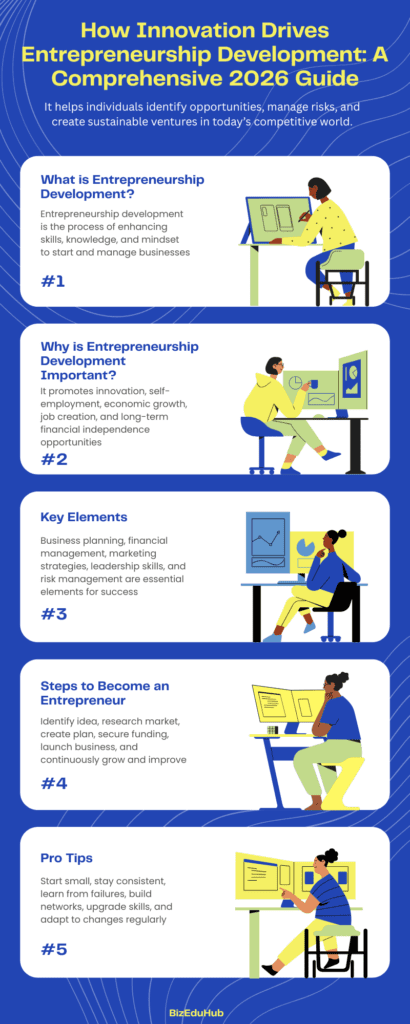
Entrepreneurship development is the deliberate process of cultivating the knowledge, skills, attitudes, and support systems that enable individuals to create and grow successful ventures. The word “deliberate” matters here. Entrepreneurship development is not simply what happens when a talented person stumbles into the right opportunity — it is what happens when education, mentorship, institutional backing, and lived experience converge in a way that turns potential into execution.
At its most practical level, entrepreneurship development encompasses everything from early-stage ideation programs and startup incubators to government-backed small business training initiatives and corporate innovation labs. It is the scaffolding that helps a first-generation founder in a rural district and a serial tech entrepreneur in a metropolitan hub navigate fundamentally different challenges using some of the same underlying principles.
What makes this concept particularly compelling in 2026 is that the definition has meaningfully expanded. A decade ago, entrepreneurship development largely focused on business fundamentals: how to write a plan, how to register a company, and how to manage cash flow. Those things still matter. But today’s most effective development frameworks also address mindset resilience, design thinking, customer empathy, and the capacity to operate in conditions of radical uncertainty.
“The goal of entrepreneurship development is not to manufacture founders. It is to create the conditions in which the founder of anyone can finally breathe.”
Innovation is not a stage in the entrepreneurial journey. It is the current that runs through every stage. A founder who understands how to use innovation as a repeatable process — not a lightning bolt of inspiration, but a disciplined practice of observing, questioning, testing, and refining — is fundamentally better equipped at every turn.
Why Entrepreneurship Development Matters More Than Ever
There is a tempting assumption that entrepreneurship has become easier. Technology is cheaper. Distribution channels are democratized. You can reach a global market from a small apartment with a decent internet connection and enough stubbornness. All of that is true. And yet the meaningful measure of entrepreneurial success — building something that lasts, that creates real value, that sustains employment and generates stable revenue — remains as difficult as ever. In some respects, it is harder.
The noise problem is real. Barriers to entry have fallen across nearly every digital sector, which means that the market is flooded with competing products, competing voices, and competing claims. The founders who break through are not necessarily the most talented or the best-funded. They are the ones who understood their customer more deeply, who iterated faster, who built something specific enough to matter to a defined group of people.
There is also an equity dimension that deserves honest attention. Entrepreneurship, historically, has not been an equal opportunity endeavor. Access to capital, networks, and the social permission to be taken seriously as a builder have been unevenly distributed in ways that have little to do with talent or ambition.
At the macro level, the stakes are high. In economies where formal employment cannot absorb the growing working-age population, entrepreneurship is not optional — it is necessary. Supporting the development of entrepreneurs is, in a very practical sense, an investment in economic stability, community resilience, and generational mobility.
Key Aspects: How Innovation and Entrepreneurship Development Intersect
1. Innovation as a Practice, Not a Gift
The most persistent myth in entrepreneurship culture is that innovation is something you either possess or lack — an innate creative spark that cannot be manufactured. The research does not support this. Across disciplines from behavioral economics to organizational psychology, the evidence consistently shows that innovative thinking follows identifiable patterns, responds to structured methodologies, and can be developed through deliberate practice over time.
Design thinking, for instance, is a methodology now taught in schools, corporations, and development programs on every continent. Its power lies not in magic but in discipline: it requires you to suspend your assumptions, immerse yourself in the experience of the person you are trying to help, generate possibilities without premature judgment, and test at a scale small enough to be informative before it becomes expensive.
2. The Role of Failure in Building Entrepreneurial Capacity
One of the most counterintuitive insights from research on entrepreneurship development is that carefully designed failure experiences accelerate growth more reliably than carefully designed success experiences. The keyword is “carefully designed.” We are not talking about throwing people into situations without support and watching them drown.
This is where many conventional business education programs fall short. They are structured to minimize the appearance of failure, which also minimizes the experience of learning. The best entrepreneurship development programs flip this entirely. They expect iteration. They reward pivot decisions that are grounded in evidence. They treat a failed prototype as a data point, not a verdict.
Building a Culture of Psychological Safety
None of this works without psychological safety — the felt sense that it is acceptable to take a risk, to be wrong, to voice an unconventional idea without facing ridicule or punishment. Building this kind of safety within a cohort, a mentoring relationship, or an organizational team is one of the most important and underappreciated aspects of effective entrepreneurship development.
3. Technology as an Enabler of Entrepreneurial Growth
In 2026, the technological landscape available to early-stage entrepreneurs is extraordinary. Low-code and no-code platforms allow non-technical founders to build functional products in days rather than months. Global freelance networks mean that a founder can access specialist expertise on demand. Payment infrastructure that once required banking relationships and compliance teams is now available as a plug-in.
The entrepreneurial leaders who are navigating this landscape most effectively are not necessarily the ones with the deepest technical knowledge. They are the ones who understand how to ask the right questions, identify the right tools for a specific problem, and move quickly enough to learn before the window closes. Technology does not replace entrepreneurial judgment — it amplifies it, for better and for worse.
Practical Tips for Accelerating Your Entrepreneurship Development


- Commit to weekly customer conversations. Not surveys. Not focus groups. Real conversations with real people about their real problems. Block two hours every week for this practice and protect it as if it were a board meeting. The intelligence you gather will outperform any market research report you can buy.
- Keep an innovation journal. A physical notebook, a voice memo app, a simple document — the format is irrelevant. What matters is developing the habit of capturing observations, questions, and half-formed ideas as they arise. Many of the best entrepreneurial insights begin as a slightly irritating question that lingers.
- Find at least one mentor who has failed instructively. Mentors who have only succeeded tend to offer wisdom that is difficult to calibrate — it is hard to know which elements of their success were skill and which were circumstance. Mentors who have failed, learned, and rebuilt often offer more transferable insight because they can name specifically what they got wrong.
- Set a “smallest viable experiment” standard. Before committing significant resources to any new direction, ask: What is the smallest version of this I could test to get meaningful feedback? Shrinking the experiment shrinks the cost of being wrong, which means you can run more experiments and learn faster.
- Study adjacent industries deliberately. Some of the most valuable innovations in any sector come from importing a principle that is already working somewhere else. A founder building in healthcare who studies supply chain management practices may discover a logistics insight that no one in their sector has thought to apply.
- Invest in your communication skills as seriously as your technical skills. The most innovative idea in the world stalls if it cannot be communicated compellingly to customers, investors, and team members. Writing, presenting, listening, and storytelling are not soft skills — they are core entrepreneurial competencies that reward sustained development.
Real-Life Examples of Entrepreneurship Development
1. The Pharmacy Graduate Who Reimagined Rural Healthcare Access
In a district where the nearest well-stocked pharmacy was a two-hour journey by motorbike, a pharmacy graduate decided that the distribution problem was more important than the product problem. She enrolled in a regional entrepreneurship development program not because she lacked technical knowledge — she had plenty — but because she recognized that she did not know how to build a business. Over six months, she learned to map a supply chain, build relationships with community health workers, and design a subscription model that brought essential medicines to doorsteps on a predictable schedule.
2. A School Principal Who Became a Social Enterprise Founder
After eighteen years in education, a school principal in a low-income urban area noticed that the students who dropped out in ninth and tenth grade were not academically incapable — they were economically pressured. Their families needed income. He attended a weekend entrepreneurship development workshop without any intention of starting a company. He left with a business concept: a micro-apprenticeship platform that connected secondary school students with local businesses for paid weekend learning experiences.
3. The Fintech Team That Listened Before They Built
A team of three engineers with strong technical backgrounds and an initial idea for a digital lending platform made an unusual decision before writing a single line of code: they spent three months doing nothing but customer interviews. They talked to informal traders, market women, motorcycle taxi operators, and small shopkeepers — people who technically qualified as their target market but whose actual financial lives they had never experienced. What they discovered dismantled their original concept entirely. Their customers did not primarily need credit.
Common Mistakes to Avoid in Your Entrepreneurship Development Journey
1. Confusing motion with progress
Early-stage entrepreneurs are often extraordinarily busy. They are building websites, designing logos, attending networking events, reading business books, and taking online courses. Much of this activity is valuable. Some of it is avoidance. The most important work in entrepreneurship development — talking to customers, testing assumptions, making uncomfortable decisions — is often the work that gets postponed in favor of things that feel productive but carry less emotional risk.
2. Seeking validation instead of information
There is a meaningful difference between going to a customer to find out if your idea is good and going to a customer to understand their experience. The first conversation is about reassurance. The second is about learning. Entrepreneurs who are emotionally attached to a specific solution tend to ask questions in ways that confirm what they already believe. This produces a false sense of validation that can be more damaging than honest negative feedback.
3. Underestimating the time horizon
Startup culture has a complicated relationship with speed. Move fast and break things is a catchy principle, but it has been misapplied by a generation of founders who equate haste with ambition. Genuine entrepreneurship development takes time — not because people are slow learners, but because real market understanding, real team chemistry, and real product refinement cannot be compressed beyond a certain point.
4. Building for an imaginary customer
Many founders carry a vivid mental picture of the person they are building for. This person has a clear problem, a willingness to pay, and a deep appreciation for exactly the solution the founder wants to provide. The trouble is that this person often exists primarily in the founder’s imagination. Entrepreneurship development requires the uncomfortable discipline of repeatedly checking your assumptions about who your customer actually is against the evidence of who is showing up, what they are doing, and what they are willing to pay for.
5. Neglecting the team dimension
Founders who are deep in product development, fundraising, or customer acquisition often let team culture become an afterthought. This is a mistake with compounding consequences. The way a founding team communicates, resolves disagreements, makes decisions, and holds each other accountable shapes everything downstream — the product, the customer experience, and the ability to attract and retain talent.
Frequently Asked Questions About Entrepreneurship Development
Q1. What is the difference between entrepreneurship development and entrepreneurship education?
Entrepreneurship education refers broadly to the teaching of concepts, frameworks, and knowledge related to starting and running ventures. Entrepreneurship development is a broader and more holistic category that includes education but also encompasses mentorship, access to networks, experiential learning opportunities, psychological support, and the provision of resources like incubation space or seed funding.
Q2. How does innovation specifically contribute to entrepreneurship development?
Innovation contributes in several distinct ways. First, it provides a methodology — design thinking, lean experimentation, user research — that gives entrepreneurs a repeatable process for creating and refining solutions rather than relying on intuition alone. Second, it builds the tolerance for ambiguity that entrepreneurship demands: people who regularly practice innovative thinking become more comfortable operating in uncertain conditions.
Q3. Can entrepreneurship development happen outside formal programs?
Absolutely, and for most of human history, it did. People learned to run businesses by watching family members, by working in local enterprises, by making mistakes with small amounts of money, and adjusting. Formal programs are valuable because they accelerate this learning, provide access to networks and knowledge that informal routes may not, and create structured environments where feedback is abundant and failure is survivable.
Q4. What personal qualities support strong entrepreneurship development?
Research on this question has evolved considerably. Earlier models emphasized traits like risk tolerance, independence, and high achievement motivation as prerequisites for entrepreneurial success. More recent work suggests that the qualities most predictive of development are cognitive flexibility (the ability to change your mind when evidence demands it), learning orientation (treating setbacks as information rather than verdicts), and social intelligence (the ability to build trust, read situations, and communicate across differences).
Q5. How should someone evaluate the quality of an entrepreneurship development program?
Several factors are worth examining closely. Look at the faculty and mentor composition: are these practitioners with real operational experience, or primarily academics? Examine the curriculum methodology: is the emphasis on experiential learning and live market engagement, or is it primarily lecture-based? Ask about alumni outcomes: not just the headline success stories, but the distribution of what happened to participants two and five years after completing the program.

Conclusion
There is a version of entrepreneurship development that is bureaucratic, box-ticking, and largely disconnected from the realities of building a business in a complicated world. And then there is the version worth pursuing: the kind rooted in genuine curiosity about human problems, disciplined practice of innovative thinking, and the courage to keep going when the path is unclear. The difference between these two versions is not a matter of resources or geography. It is a matter of philosophy.
In 2026, the case for taking entrepreneurship development seriously — as an individual, as an institution, and as a society — is stronger than it has ever been. The problems worth solving are large and urgent. The tools available to those willing to work on them are powerful and increasingly accessible. And the knowledge of how to support entrepreneurial growth, how to combine innovation with practical capability-building, how to create environments where human potential actually gets expressed rather than quietly suppressed — that knowledge exists. It is being applied in programs, institutes, and communities around the world, and it is working.
What this guide hopes to leave you with is not a to-do list but a perspective. Entrepreneurship development is not a destination you arrive at once and stay at forever. It is an ongoing practice of learning, building, failing, learning again, and building better. Innovation is not the spark that makes this journey begin — it is the discipline that keeps it moving. If you carry that understanding into whatever you are building next, you are already further along than you think.
!You might be interested in reading this page as well
Piyush Goyal’s Startup Revolution: Why India’s Entrepreneurs Are Excited in 2026