


Introduction to Online Course for Science Students
Science has always been hard to teach well. Not because the content is impossibly complex — though some of it certainly is — but because science is fundamentally a way of thinking, and translating that into a screen-based learning experience takes real intention. Anyone who’s sat through a boring chemistry lecture or tried to understand cell biology from a static PDF knows exactly what’s missing: engagement, curiosity, and the feeling that someone on the other side genuinely wants you to understand.
That’s what makes building a great online course for science students both challenging and deeply rewarding. Whether you’re a biology teacher moving your curriculum online, a research scientist who wants to share what you know, or an edtech entrepreneur targeting the STEM education space, the opportunity in 2026 is larger than it’s ever been. Science education online has moved well past recorded lectures and multiple-choice quizzes. Learners now expect interactive simulations, visual explanations, and structured problem-solving — and the tools to deliver all of that have never been more accessible.
What is an Online Course for Science Students?
An online course for science students is a structured digital learning program built specifically around the needs, habits, and expectations of learners pursuing scientific subjects — whether that’s physics, chemistry, biology, environmental science, data science, neuroscience, or any adjacent field. It’s more than a collection of recorded videos. Done well, it’s a complete learning environment that guides a student from confusion to competence through a deliberate sequence of instruction, practice, feedback, and application.
What distinguishes a science-focused course from a general online course is the nature of the content itself. Science requires layered understanding — you can’t fully grasp thermodynamics without first understanding energy, and you can’t understand energy without some grounding in mechanics. This means course design matters enormously. A well-built science course respects that learning hierarchy and builds upward from it. A poorly designed one drops students into the deep end with no foundation and then wonders why completion rates are low.
Concrete examples help clarify the range here. An online course for science students might be a 12-week organic chemistry program for pre-med undergraduates, a self-paced introduction to genetics for curious non-specialists, a practical data analysis course built for biology researchers, or a high school physics program designed to replace or supplement classroom instruction. Each has different audiences, pacing, and depth — but all share the same fundamental challenge: making rigorous content genuinely learnable in an online course for science students.
Why an Online Course for Science Students Matters in 2026
The demand side of this equation is undeniable. STEM fields are experiencing some of the strongest job growth of any sector globally. According to the U.S. Bureau of Labor Statistics, employment in science and engineering occupations is projected to grow at nearly double the rate of all other occupations through 2030. At the same time, access to quality science education remains deeply unequal — concentrated in well-funded schools, wealthy neighborhoods, and certain countries. Online science courses don’t fully close that gap, but they meaningfully widen access through online course for science students.
From a creator’s perspective, the opportunity is substantial. Parents of high-school students are actively looking for rigorous supplements to classroom science instruction. Undergraduates need better resources than their textbooks provide. Working professionals in scientific fields often need to upskill rapidly — in computational methods, lab techniques, or emerging research areas — without returning to university. All of these people are searching, right now, for well-designed online learning experiences.
There’s also something worth saying about what happens when a great science teacher reaches the internet. In a physical classroom, a gifted chemistry teacher might reach 150 students a year. Online, that same teacher’s course can reach 150,000 — with no incremental effort per student after the course is built. The leverage is extraordinary, and the impact on how many young people develop a real relationship with science is hard to overstate in an online course for science students.
Key Aspects: How to Build Your Online Course for Science Students Step by Step
1. Defining Your Niche and Audience
The single most common mistake in course creation — across any subject — is trying to teach everything to everyone. Science is especially vulnerable to this because the subject matter is so vast. Before you record a single video or write a single lesson, you need to answer two questions with real specificity: What exactly will this course teach? And who, specifically, is it for?
“A biology course” is not a niche. “A molecular biology course for undergraduates struggling with their first semester of cell biology” is a niche. “A physics course” tells you nothing about the student. “A Newtonian mechanics crash course for high school students preparing for their AP Physics exam” tells you everything — the level, the audience, the goal, and the timeline.
Identifying the Knowledge Gap You’re Filling
Once you know your audience, figure out what’s already out there. Search for your topic on Udemy, Coursera, YouTube, and Khan Academy. Look at the reviews on existing courses — especially the critical ones. What are students saying is missing? Too fast? Not enough practice problems? Too theoretical? Too shallow? Those review sections are a gold mine of unmet needs, and building directly toward them is the fastest path to an online course for science students that fills a genuine gap rather than duplicating what already exists.
2. Structuring Your Course Curriculum
Science content follows a natural hierarchy, and your curriculum should reflect it. Start with prerequisites — what does a student need to know before your course begins? Be explicit about this, both for your own clarity and for your students’. Then map out the core concepts in the order they need to be understood.
A practical framework: divide your course into modules (usually four to eight), each focused on one major concept or skill. Within each module, structure the content as: introduce the concept, explain it clearly, demonstrate it in action, have the student practice it, and then show how it connects to what comes next. This cycle — introduce, explain, demonstrate, practice, connect — works reliably across virtually all science subjects.
Building in Active Learning
Passive video watching produces notoriously poor retention, and this is especially true for science, where the concepts require genuine mental engagement to stick. Every module in a well-designed science course should include some form of active learning: problem sets, lab simulations, data interpretation exercises, concept mapping, or case studies. The goal is to make students do something with the knowledge before moving on, not just absorb it.
Several platforms now offer integrations with virtual lab simulations — tools like Labster, PhET Interactive Simulations (free, from the University of Colorado), and Visible Body for anatomy — that can dramatically enhance the practical dimension of an online course for science students without requiring physical equipment. In 2026, incorporating at least one of these isn’t a differentiator anymore; it’s close to an expectation.
3. Choosing Your Platform and Tech Stack
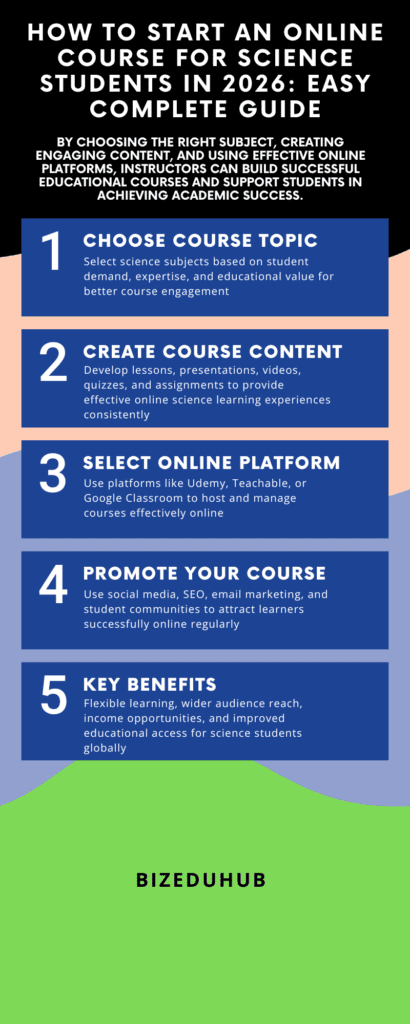
Platform choice depends on what you prioritize. If you want maximum simplicity and access to an existing marketplace of learners, Udemy or Skillshare are reasonable starting points — though they offer limited control over pricing and branding. If you want full ownership, pricing control, and direct relationships with your students, Teachable, Thinkific, or Kajabi give you those options at a slightly higher technical overhead.
For an online course for science students specifically, look for platforms that support PDF downloads (for problem sets and reference sheets), embedded quizzes, video hosting with good playback quality, and ideally some form of community or discussion feature. Students working through difficult material need somewhere to ask questions, and a course without any interaction channel is a significant disadvantage compared to one that facilitates dialogue.
Recording and Producing Your Content
You don’t need a professional studio. What you do need is decent audio, decent lighting, and a clear delivery style. A USB microphone, a ring light, and a neutral background are sufficient to produce video that feels professional enough. The bigger investment is in your explanation clarity — how you break down a complex concept, what analogies you use, whether your worked examples are genuinely illuminating or just technically correct.
For science, on-screen drawing tools and digital whiteboards (Notability, GoodNotes, Jamboard, or a drawing tablet with screen recording) are often more effective than standard slide presentations. Seeing concepts emerge in real time — a diagram being drawn, an equation being derived step by step — is closer to how good in-person teaching works, and it translates well to the screen.
Practical Steps to Launch Your Online Course for Science Students


- Validate before you build. Before creating the full online course for science students, post about your planned topic on relevant Reddit communities (r/learnscience, r/biology, r/Physics), LinkedIn, or science-focused Facebook groups. Ask whether people would pay for it and what they’d most want it to cover. Even ten responses will sharpen your thinking dramatically.
- Write your full curriculum outline first. Map every module and lesson on paper or a whiteboard before recording anything. This forces you to confront gaps in your own plan before they become expensive to fix.
- Record a pilot module. Build out one complete module — including video, exercises, and any supporting materials — before committing to the whole course. Watch it yourself, show it to someone in your target audience, and collect honest feedback.
- Price deliberately. Research comparable courses in your niche. Science courses at intermediate and advanced levels consistently command higher prices than general courses because the audience is more motivated and the content is more specialized. Don’t reflexively underprice just because free content exists.
- Build your audience before launch. Start an email list, a YouTube channel, or a social media presence in your subject area at least a month before your course goes live. A launch to an existing audience — even a small one of a few hundred people — dramatically outperforms a launch to nobody.
- Launch to a beta cohort first. Offer your online course for science students to a small group at a reduced price before the full launch. This generates real testimonials, surfaces any content gaps, and gives you the confidence of knowing real students have completed it successfully.
- Iterate based on feedback. The first version of your course will not be the best. Build a feedback loop — post-course surveys, completion rate analysis, student questions — and update the content regularly.
Real-Life Examples of an Online Course for Science Students
Dr. Jubilee Evans, a university-level organic chemistry professor in Ohio, grew frustrated watching students fail their first exams semester after semester despite putting in real effort. She recognized that the gap wasn’t intelligence — it was the lack of quality bridging content between high school chemistry and university-level organic chemistry. She built a focused, six-week course called “Orgo Fundamentals” on Teachable, priced it at $97, promoted it through a small chemistry-focused Instagram account and a few Reddit threads, and enrolled 340 students in her first launch. Three years later, it’s her primary income source and has helped over 4,000 students.
Or consider Rahul Mehta, a computational biologist in Bangalore who built a course on Python for biologists — not a general Python course, but one built entirely around biology use cases: analyzing DNA sequences, working with genomic datasets, visualizing protein structures. By targeting biology researchers specifically rather than aspiring programmers generally, his course found an audience that felt truly seen by it. The specificity of the problem he was solving — “I know biology, but I can’t code” — made marketing almost effortless in an online course for science students.
Common Mistakes to Avoid in an Online Course for Science Students
- Making the course too long. There’s a persistent belief that longer means more valuable. In practice, the opposite is often true. Every piece of content that isn’t directly serving your students’ learning goal is diluting the course’s focus and increasing the likelihood they don’t finish. Cut ruthlessly. If it doesn’t need to be there, it shouldn’t be.
- Skipping the curriculum design phase. Many first-time online course for science students dive straight into recording based on a rough mental outline. This almost always produces a course that meanders, repeats itself, and leaves learners disoriented. A few hours spent on a thorough curriculum map before you touch the recording software will save weeks of re-editing later.
- Ignoring completion rates. Low course completion is the most honest signal that something isn’t working. If students are dropping out at module three, that module has a problem — whether it’s a difficulty spike, a pacing issue, or content that feels disconnected from what they wanted to learn. Track completion data and treat it as diagnostic information rather than something to ignore.
- Underestimating the importance of audio quality. People will forgive mediocre video. They will not forgive bad audio. A video with slightly low resolution but crisp, clear sound feels professional. A video with beautiful visuals and muffled, echoey audio feels amateurish and distracting. Audio quality is the single highest-leverage production investment you can make.
- Building in isolation. Science education benefits enormously from community — students asking each other questions, comparing approaches, catching each other’s errors. A course with no community component leaves a significant amount of learning value on the table. Even a simple discussion board or a dedicated Discord channel can transform the experience from solitary to collaborative in an online course for science students.
Frequently Asked Questions: Online Course for Science Students
Q1. Do I need a teaching qualification to create an online course for science students?
No formal qualification is required, though demonstrated expertise matters enormously. What earns student trust is a combination of credible knowledge, clear explanations, and a track record of helping people understand difficult material. A PhD or teaching credential can signal credibility, but plenty of successful science course creators built their audiences on the strength of their content quality and genuine subject mastery alone.
Q2. How long should an online science course be?
The right length is exactly as long as it needs to be to achieve the stated learning outcome — and not a single lesson longer. In practice, most well-designed online course for science students fall between four and twelve weeks of content at two to four hours per week. Self-paced courses can be structured the same way; learners simply work through them on their own timeline. Avoid padding the course to hit an arbitrary hour count. Students notice, and they don’t appreciate it.
Q3. What subjects work best for an online course for science students?
Almost any science subject can work online, but some have a stronger natural demand than others. In 2026, courses in data science for biologists, neuroscience fundamentals, environmental science, AP exam preparation (physics, chemistry, biology), and medical school prerequisite subjects all have demonstrated strong markets. Interdisciplinary courses — science plus statistics, biology plus programming — tend to have particularly motivated audiences because they fill gaps that neither traditional science education nor tech education fully address.
Q4. How should I price my science course?
Price based on the transformation the course delivers, not the hours of video it contains. An online course for science students that reliably helps pre-med students pass their biochemistry qualifier is worth considerably more than one that simply covers the same content without that outcome focus. Research competitor pricing, consider your audience’s budget, and don’t reflexively start at the lowest price point. Underpricing signals low value, which reduces conversion rates as much as overpricing does.
Q5. Which platform is best for hosting an online course for science students?
For most creators starting, Teachable or Thinkific offer the best balance of ease, control, and features. Udemy works well if you want built-in marketplace traffic, but offers less pricing control. For creators who want to build a full membership community around their science content, Kajabi is worth the higher price. If your course involves heavy interactive simulations or custom assessments, you may need to look at more technical solutions or platform integrations with tools like PhET or Labster.

Conclusion
Building a strong online course for science students isn’t a project you finish and walk away from — it’s something you build, launch, learn from, and improve over time. The first version will be imperfect. That’s not a reason to delay; it’s a reason to start. Every course that has helped thousands of students began as something rougher, smaller, and less polished than what it eventually became.
What the best online course for science students shares isn’t production quality or platform choice or even the credentials of their creator. It’s a genuine commitment to the learner’s understanding — a course designed not to impress but to actually work, to take someone from confused to capable through a sequence of experiences that respect both the difficulty of the subject and the intelligence of the student.
In 2026, the tools are there. The audience is there. The need for better science education at every level has never been more urgent. The only remaining variable is whether you decide to build something that meets it. If you’ve read this far, you’re probably already closer to that decision than you realize. The next step isn’t another article. It’s opening a document and writing down the first version of your course outline.
!You might be interested in reading this page as well
Top 10 Free Online Courses to Enhance Your Skills in 2026