


Introduction to Entrance Exams
There’s a moment every science student knows — the one that comes right after the class 12th board exam hall empties for the last time. You walk out into the sunlight, and instead of relief, you feel a strange kind of weight. Because you know that the real race hasn’t ended. In fact, for most of you, it’s only just beginning.
The options are many, the stakes feel enormous, and everyone around you seems to have an opinion — your parents, your teachers, that one neighbour who always compares you to their son who “cracked NEET in the first attempt.” In the middle of all that noise, what you actually need is clarity. You need to understand which entrance exams actually matter, what they test, and how to prepare for them in a way that’s realistic, structured, and genuinely effective.
This guide is written for you — the student who’s serious, a little anxious, and hungry for a real roadmap. Whether your goal is medicine, engineering, pure sciences, or something in between, this is your honest, practical, step-by-step preparation guide for the most important entrance exams of your academic life in 2026.
What Are Entrance Exams After 12th Science?
Entrance exams are competitive tests conducted by universities, government bodies, or national agencies to select students for admission into undergraduate programmes. Unlike board exams, which evaluate what you’ve studied over two years in a relatively structured format, entrance exams test your speed, accuracy, conceptual depth, and ability to apply knowledge under pressure.
For students of the science stream, there are two broad categories of entrance exams: those for engineering and those for medicine, with a growing cluster of options for students pursuing pure sciences, research, or niche fields like design, law, and architecture.
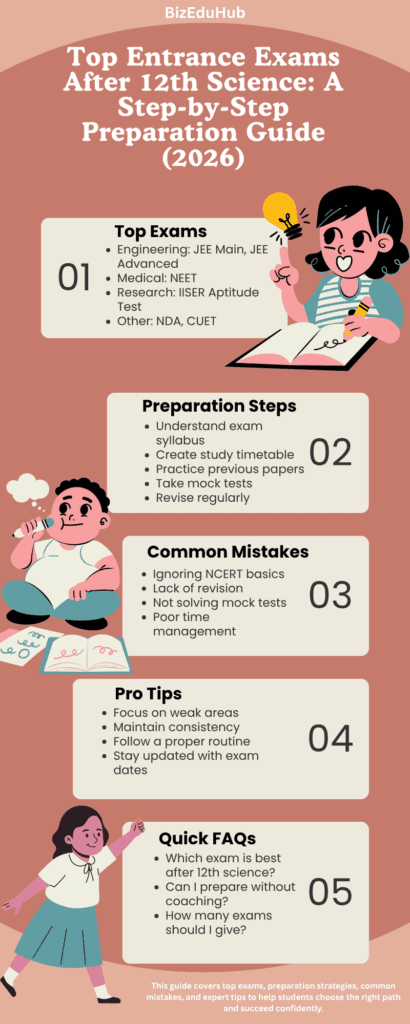
JEE Main and JEE Advanced are the gateway to India’s top engineering colleges, including the IITs, NITs, and IIITs. Clearing JEE Advanced opens the doors to the IITs — still regarded as the most prestigious engineering institutions in the country.
NEET-UG (National Eligibility cum Entrance Test) is the single national exam for admission to MBBS, BDS, AYUSH, and nursing programmes across India. Since 2020, it has replaced all state-level medical entrance tests, making it the sole qualifying exam for government and private medical colleges alike.
Beyond these two giants, there are exams like BITSAT (for BITS Pilani campuses), VITEEE (VIT University), MHT CET (Maharashtra), KCET (Karnataka), WBJEE (West Bengal), COMEDK, and international-level tests like SAT or CUET for those considering global or central universities. Specialised fields have their own doors: NATA for architecture, UCEED/NID for design, and KVPY/IISER Aptitude Test for research-oriented students.
The point is this — “entrance exams” is not a monolithic term. It’s an ecosystem, and knowing which part of it you’re navigating changes everything about how you prepare.
Why Entrance Exams Are Important
Here’s the truth that often gets lost in all the coaching-centre advertisements and rank-or-ruin narratives: entrance exams are important, but not because they define your worth. They’re important because they open specific doors — and some of those doors, once missed, require you to find a different route entirely.
Consider the IITs. There is no other way to get there except through JEE Advanced. The curriculum, the peer group, the research exposure, the campus culture, the placement ecosystem — it’s a package that cannot be replicated by simply “doing well in boards.” The same logic applies to government medical colleges, where NEET rank determines whether you pay ₹30,000 per year or ₹30 lakh per year for the same MBBS degree. The financial stakes alone make exam preparation a serious investment.
But entrance exams serve another purpose that rarely gets acknowledged — they train you. The kind of disciplined, consistent preparation that cracking a competitive exam demands builds habits that serve students for years after. Students who have seriously prepared for JEE or NEET often report that they find college coursework comparatively manageable — not because it’s easy, but because they’ve already learned how to study efficiently, handle pressure, and persist through difficulty.
There’s also the confidence factor. Getting into a programme you worked hard for — really worked for, through struggle and revision and failed mock tests and eventual breakthrough — creates a kind of self-belief that’s difficult to manufacture any other way. The process has value beyond the rank.
Key Aspects: Understanding the Top Entrance Exams in 2026
1. Engineering Entrance Exams
JEE Main 2026
JEE Main is conducted twice a year — in January and April — by the NTA. It consists of three papers: Paper 1 for B.E./B. Tech aspirants, Paper 2A for B.Arch, and Paper 2B for B.Planning. For most engineering aspirants, Paper 1 is what matters. It tests Physics, Chemistry, and Mathematics across 90 questions, with a mix of multiple-choice and numerical answer-type questions.
Scoring well in JEE Main qualifies you for NITs, IIITs, GFTIs, and gives you a shot at JEE Advanced. The NTA Percentile system means your score is ranked relative to all candidates in the session, not on absolute marks — a nuance that matters enormously when interpreting mock test results.
JEE Advanced 2026
Only the top 2.5 lakh JEE Main qualifiers are eligible for JEE Advanced, which is conducted by the IITs on a rotational basis. The format here is significantly more demanding — multiple question types, partial marking, negative marking in certain sections, and a level of problem complexity that requires conceptual mastery, not just formula recall. Two papers of three hours each are held on the same day, testing Physics, Chemistry, and Mathematics.
BITSAT, VITEEE, and State CETs
BITSAT is the entrance test for BITS Pilani, Goa, and Hyderabad campuses — highly sought-after private engineering institutions. It’s an online, time-pressured exam that rewards speed and accuracy, with additional questions for those who answer all 130 within the allotted time.
State-level CETs like MHT CET, KCET, WBJEE, and COMEDK serve as entry points to hundreds of state colleges and often require separate preparation strategies, especially since their syllabi sometimes include state board content.
2. Medical Entrance Exams
NEET-UG 2026
NEET-UG is India’s single national medical entrance exam. Offered in offline (pen-and-paper) mode, it covers Physics, Chemistry, and Biology (Botany + Zoology) across 200 questions (180 to be answered). The total marks are 720, and scoring 650+ is generally considered competitive for government medical colleges.
NEET preparation is unique in that it demands enormous breadth — especially in Biology, where NCERT textbooks are considered gospel. No coaching material, however elaborate, replaces the NCERT line-by-line study that NEET expects.
3. Science Research and Other Streams
IISER Aptitude Test and KVPY
For students drawn to pure sciences — physics, chemistry, biology, mathematics — the IISER Aptitude Test (IAT) is the gateway to the Indian Institutes of Science Education and Research. These institutions offer BS-MS dual-degree programmes with a heavy emphasis on research. The exam tests all four sciences and demands genuine conceptual understanding.
KVPY (Kishore Vaigyanik Protsahan Yojana), now restructured under the INSPIRE Fellowship, was designed specifically to identify students with a flair for research. Although its format has evolved in recent years, the spirit remains the same — rewarding curiosity and depth over rote learning.
CUET, NATA, and Design Exams
The Common University Entrance Test (CUET) has emerged as a significant option for students seeking admission to central universities across the country. For science students interested in B.Sc programmes in Delhi University, BHU, JNU, and similar institutions, CUET is the new common pathway.
NATA (National Aptitude Test in Architecture) is mandatory for B.Arch programmes at most architecture colleges. It evaluates drawing ability, aesthetic sensitivity, and mathematical aptitude — a unique combination that rewards students with both analytical and creative skills.
Step-by-Step Preparation Guide for Entrance Exams After 12th Science


Preparing for entrance exams is not about studying more hours — it’s about studying the right things in the right order. Here is a realistic, battle-tested approach:
- Choose Your Target Exam First — Don’t prepare for everything at once. Identify your primary exam (JEE or NEET) and secondary exams (state CETs, BITSAT) and build your schedule around that hierarchy.
- Master NCERT Completely — Whether it’s JEE or NEET, the NCERT textbooks are the foundation. For NEET, the Biology NCERT is nearly the entire exam. For JEE, Chemistry NCERT is gold. Read them cover to cover before diving into advanced material.
- Build a Chapter-by-Chapter Study Plan — Don’t study randomly. Create a subject-wise plan that covers every chapter systematically, with revision cycles built in. Use a 70-20-10 time split: 70% learning new chapters, 20% revision, 10% mock tests.
- Solve PYQs (Previous Year Questions) Obsessively — Past papers reveal patterns, favourite topics, and question styles. Solving 10 years of JEE or NEET previous year papers is more valuable than any single coaching module.
- Take Full Mock Tests Weekly from September 2025 Onwards — Simulated exam conditions build exam temperament. Analyse every mistake after each mock — not just what you got wrong, but why you got it wrong.
- Identify Weak Topics and Attack Them Consistently — Most students avoid what they’re bad at. Successful students do the opposite. Spend 30 minutes every day on your weakest topic.
- Revise Formulas and Concepts Daily — Keep a formula notebook. Review it every morning for 15 minutes. Retention of key concepts and equations is the invisible backbone of exam performance.
- Maintain Physical Health and Sleep — Students consistently underestimate this. Sleep deprivation kills retention. Aim for 7–8 hours every night. Exercise at least three times a week. Your brain is hardware — treat it accordingly.
Real-Life Examples of Students Preparing for Entrance Exams After 12th Science
Consider Ananya from Pune, who appeared for NEET 2024. She spent the first six months reading every coaching module she could find — thick volumes from three different institutes — and barely touched her NCERT. In her first mock test, she scored 420 out of 720. Panicked, she sought advice from a senior who had cleared NEET the previous year.
The advice was simple: put the coaching material aside temporarily and read Biology NCERT from cover to cover, underlining every line. She spent six weeks doing just that, then returned to mock tests. Her score jumped to 560. She then spent the remaining months solving previous year questions and doing weekly full-length mocks. She ended up scoring 638 — enough for a government medical seat in Maharashtra.
Or take Rahul from Jaipur, a JEE aspirant who had been averaging around 85 percentile in JEE Main mocks. His strength was Mathematics, but Physics consistently let him down — particularly Electrostatics and Waves. Instead of avoiding these chapters, he dedicated 45 minutes every single day for two months exclusively to those topics — solving basic problems first, then graduated to JEE-level difficulty. By January 2025, his Physics percentile had climbed from 72 to 91. He cleared JEE Advanced that year.
These aren’t extraordinary stories. They’re ordinary students who made smart, consistent choices.
Common Mistakes to Avoid in Entrance Exams After 12th Science Preparation
- Studying without a plan. Random, topic-hopping study feels productive but rarely is. Without a structured chapter-wise plan with built-in revision, students often have uneven preparation with glaring gaps in certain areas.
- Ignoring NCERT. Especially for NEET, this is almost always fatal. NCERT is not a supplement — it is the primary text. Advanced books should come after NCERT, not instead of it.
- Over-relying on a single resource. No single book, coaching institute, or YouTube channel has all the answers. A well-rounded approach — NCERT, one standard reference book per subject, and a steady diet of PYQs — beats the “collect everything” approach every time.
- Not analysing mock tests. Taking mock tests without reviewing them in detail is like practising cricket without watching your own replays. The analysis — identifying error patterns, understanding conceptual gaps — is where the actual learning happens.
- Comparing yourself to your peers constantly. Social comparison is the thief of focus. What your classmate scored in a mock test is irrelevant to your own preparation trajectory. Stay in your lane.
- Neglecting mental health. Burnout is real, and it sets in faster than most students expect. Build rest days into your schedule. Have hobbies. Talk to someone when the pressure gets heavy. A student who is mentally rested learns more in three hours than a burnt-out student learns in eight.
Frequently Asked Questions About Entrance Exams After 12th Science
Q1. How early should I start preparing for entrance exams after 12th Science?
Ideally, preparation for major entrance exams like JEE or NEET should begin in Class 11 itself, since the syllabus is spread across both years. However, if you’re starting in Class 12 or even after your boards, it’s still possible to prepare effectively — especially for NEET, where a focused eight-to-ten-month window with the right strategy can yield strong results. The key is quality and consistency, not just duration.
Q2. Can I prepare for multiple entrance exams simultaneously?
Yes, but strategically. JEE Main and BITSAT share significant syllabus overlap, so preparing for one naturally aids the other. NEET and some state medical CETs are similar. However, trying to prepare simultaneously for JEE and NEET — which have very different Biology vs. Mathematics emphases — without a clear priority is usually counterproductive. Pick your primary exam and align everything else to it.
Q3. How important are coaching institutes for cracking entrance exams?
Coaching institutes can provide structure, pacing, and access to good study material — valuable things, especially early in preparation. But they are not necessary for success. Many students crack JEE and NEET through self-study, online resources, and disciplined PYQ practice. If coaching works for your learning style and budget, use it. If it doesn’t, don’t feel compelled to join one just because everyone else has.
Q4. What is the role of mock tests in entrance exam preparation?
Mock tests are arguably the most important preparation tool available. They simulate real exam conditions, reveal time management issues, expose weak areas, and build the psychological resilience needed on exam day. Taking one full-length mock test per week from six months before the exam, followed by thorough analysis, is a non-negotiable part of effective preparation.
Q5. Is it okay to drop a year and re-attempt entrance exams?
Dropping a year — sometimes called a “dropper year” — is a significant decision and should be made thoughtfully. A drop year works well when a student has a clear strategy, improved study habits, and genuine motivation to improve. It does not work well when the reason for poor performance in the first attempt was a lack of focus or unclear goals, because the same habits tend to repeat. Speak honestly with yourself and your family, and seek guidance before making this decision.

Conclusion
At the end of it all, the entrance exams you face after 12th Science are not the finish line — they’re the first serious gate in a long, meaningful journey. The way you approach them will teach you things about yourself: your capacity for discipline, your ability to handle failure gracefully, your resilience when things don’t go according to plan.
Crack JEE Advanced, and you’ll have earned something that goes beyond a rank. Qualify NEET with a competitive score, and you’ll understand what it means to truly master a subject. Even if the first attempt doesn’t go as you hoped, the student who prepares honestly and reflects clearly on what went wrong is already ahead of the one who blames circumstances and moves on without learning.
The top entrance exams in India are demanding by design — not to break students, but to identify those who are genuinely ready for the rigours of professional education in medicine, engineering, or research. Your job is not to fear that design, but to understand it, respect it, and prepare for it with everything you have.
Start where you are. Use what you have. Know your target. Build your plan. Show up every day.
That’s not just how you clear entrance exams. That’s how you build a life.
!You might be interested in reading this page as well
How to Choose the Right Career Path: Evaluating Interests, Skills, and Market Trends