
Introduction to Bharath Institute Courses 2026
There comes a point in every student’s life when the question stops being “what do I want to study?” and becomes something far more layered: “what kind of life do I want to build, and which course will actually help me build it?” That shift — from subject preference to life design — is where choosing a university programme becomes genuinely meaningful, and also genuinely daunting. The options are vast, the pressure is real, and the consequences of the choice extend far beyond graduation day.
If you are standing at that crossroads right now, and Bharath Institute of Higher Education and Research is on your list of institutions, this guide is written specifically for you. The Bharath Institute courses 2026 landscape is broader and more compelling than many prospective students realise, spanning medicine, engineering, law, management, architecture, and the arts — all under one roof at one of Chennai’s most established deemed universities.
This is not a catalogue. It is a genuine attempt to help you understand which programmes at BIHER are worth your serious consideration, why they stand out, and how to make a choice you will feel confident about for years to come.

What are Bharath Institute Courses 2026?
To answer this properly, it helps to understand the institutional architecture that makes the BIHER course portfolio what it is today. Bharath Institute of Higher Education and Research — established in 1984 and granted deemed university status by the UGC — has grown over four decades from a primarily engineering-focused institution into a genuinely multidisciplinary university. In 2026, its course offerings span undergraduate, postgraduate, doctoral, and diploma levels across more than a dozen schools and faculties.
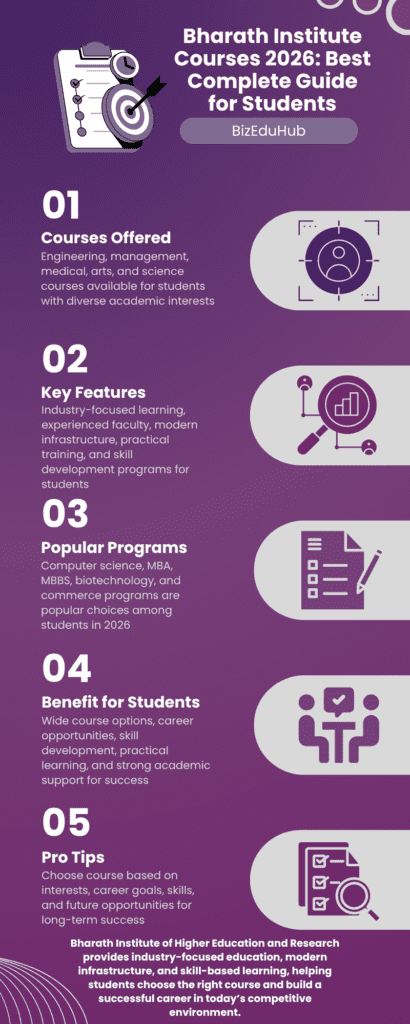
When people refer to Bharath Institute courses 2026, they are broadly referring to the full range of academic programmes currently active across the university’s constituent colleges and departments. These include technical programmes in engineering and computer science, clinical programmes in medicine, dentistry, nursing, and physiotherapy, professional programmes in law and management, creative programmes in architecture and design, and foundational programmes in arts and sciences.
What makes this portfolio notable is not just its breadth — many large universities offer a wide range — but the depth of infrastructure supporting each area. The engineering programmes are backed by laboratories and industry partnerships. The medical programmes are supported by affiliated hospitals providing clinical training. The law school operates legal aid clinics. The management school runs live industry projects. Each programme is, in other words, designed to connect academic learning to real professional contexts — a feature that distinguishes BIHER from institutions where the curriculum exists largely on paper.
For a student trying to evaluate Bharath Institute courses 2026, the key questions are not just “which subjects are offered?” but “what does the learning experience actually involve?” and “where have graduates of this programme gone?” These are the questions this guide will help you explore.
Why Your Bharath Institute Courses 2026 Matter More Than You Think
There is a tendency among students and families to focus heavily on the institution’s brand — its ranking, its reputation, its name recognition — and pay relatively little attention to the specific programme within that institution. This is a mistake, and it is worth addressing directly. Two programmes at the same university can differ enormously in faculty quality, industry connections, placement record, and genuine learning experience.
The Bharath Institute courses 2026 portfolio is not uniformly excellent across every discipline — no large university’s portfolio is. Some programmes have stronger faculty depth, more active research cultures, and better placement outcomes than others. Understanding which programmes represent BIHER’s genuine strengths — and aligning your choice with those strengths where possible.
There is also the question of how your programme choice interacts with the city context. Chennai is a significant professional hub across several sectors: information technology, healthcare, manufacturing, automotive, banking, and legal services. BIHER’s location in this environment means that students in programmes with strong local industry relevance — technology, medicine, law, management — benefit from a proximity to employers that students in institutions located in smaller cities do not enjoy.
Finally, in Bharath Institute Courses 2026, the higher education landscape in India is actively evolving under the New Education Policy framework. Universities are restructuring programmes to incorporate greater flexibility, interdisciplinary exposure, and competency-based assessment. BIHER has been among the institutions proactively adapting its programme structures to align with these changes. Students entering in 2026 will benefit from curricula that are more current, more flexible, and more attuned to employer expectations than those of even a few years ago.
Key Programmes Worth Serious Consideration at Bharath Institute Courses 2026
1. Engineering and Technology
B.E. / B.Tech in Computer Science and Engineering
If there is one programme at BIHER that consistently draws the strongest placement interest from recruiters, it is Computer Science and Engineering. The programme combines foundational theoretical education in algorithms, data structures, and computer architecture with applied learning in areas including software development, cybersecurity, machine learning applications, and cloud computing.
What distinguishes the CSE programme at Bharath Institute Courses 2026 from the generic version available at dozens of institutions is the active integration of industry collaboration into the curriculum. Students work on live projects in partnership with technology companies, and the university’s placement cell has cultivated relationships with a broad range of IT employers — from mid-size product companies to larger service organisations — who recruit regularly from the campus.
The four-year programme includes laboratory work, mini-projects in every semester, a major project in the final year, and an industry internship component. Students who engage seriously with all of these components — not just the classroom elements — graduate with a portfolio of real work that supports their employment prospects considerably.
B.E. in Electronics and Communication Engineering
Electronics and Communication Engineering at Bharath Institute Courses 2026 has a long-standing reputation built over the institution’s engineering history. The programme is well-suited to students interested in embedded systems, signal processing, telecommunications, and the expanding Internet of Things sector. Faculty in this department include researchers with active publication records, which creates a research-oriented environment that benefits students considering postgraduate study.
B.E. in Mechanical Engineering
Mechanical Engineering remains one of BIHER’s foundational programmes, with strong laboratory infrastructure and connections to Chennai’s substantial manufacturing and automotive industry base. For students interested in design, production, thermal engineering, or aerospace applications, this programme provides both academic depth and practical exposure.
2. Medical and Allied Health Sciences
MBBS — Bachelor of Medicine and Bachelor of Surgery
The MBBS programme at Bharath Institute Courses 2026, offered through the affiliated Sree Balaji Medical College and Hospital, is one of the institution’s flagship offerings and carries significant weight in the university’s overall reputation. The programme follows the curriculum prescribed by the National Medical Commission and spans five and a half years, including a compulsory rotating internship.
What makes this programme particularly valuable is the integrated clinical exposure model. Students do not wait until the final years to encounter patients. Clinical postings begin from the second year, progressively deepening as students advance through the programme. The hospital provides exposure to a wide range of cases across specialities, and the teaching faculty includes practising clinicians with active professional expertise alongside academic staff.
Admission to this programme is through NEET, and competition for seats is significant. Students who secure admission, however, enter one of the more clinically robust MBBS environments available in Tamil Nadu.
B.Sc. Nursing
The nursing programme at BIHER has grown in both stature and demand over the past several years, reflecting the broader expansion of India’s healthcare sector and the increasing global demand for qualified Indian nursing professionals. The four-year programme combines academic instruction in clinical nursing with hands-on hospital practice, preparing graduates for both domestic healthcare employment and, for those who pursue licensure pathways, international opportunities.
B.Sc. Physiotherapy and Allied Health Programmes
Bharath Institute Courses 2026 offers a range of allied health programmes, including physiotherapy, medical laboratory technology, radiology, and pharmacy. These programmes are growing in relevance as India’s healthcare system expands and the demand for trained paramedical and allied health professionals outpaces supply. Students in these programmes benefit from the same integrated clinical environment that supports the MBBS programme.
3. Law
B.A. LL.B. and B.B.A. LL.B. — Five-Year Integrated Law Programmes
The School of Law at Bharath Institute Courses 2026 has been quietly building a solid reputation through a combination of experienced faculty, moot court culture, and legal aid clinic activity. The five-year integrated programmes — combining either arts or business administration with legal education — are well-suited to students who want to enter the legal profession directly after undergraduate study without the detour of a separate law entrance qualification route.
The programme’s location in Chennai is a genuine advantage for law students. The city is home to the Madras High Court, one of India’s oldest and most active higher courts, and the legal profession in the city has depth and breadth across corporate law, litigation, intellectual property, and public interest law. Students who build connections through internships, moots, and the university’s legal aid activities have access to a legal professional ecosystem that smaller law school locations simply cannot match.
4. Management
BBA and MBA Programmes
The management programmes at Bharath Institute Courses 2026 — at both undergraduate and postgraduate levels — are designed with a strong industry orientation. The MBA programme in particular has evolved considerably in recent years, incorporating live case studies, industry mentorship, and a placement process that engages recruiters from banking, consulting, retail, logistics, and technology sectors.
For students who combine an engineering or science background with an MBA from BIHER, the dual-qualification pathway creates a profile that is genuinely competitive in the contemporary job market, particularly in technology management, operations, and product roles.
5. Architecture
B.Arch — Bachelor of Architecture
Architecture at Bharath Institute Courses 2026 is a five-year programme that combines studio-based design education with technical instruction in structural engineering, construction materials, environmental design, and urban planning. The programme is recognised by the Council of Architecture, and graduates are eligible for licensure as registered architects.
Chennai’s built environment — its mix of heritage structures, contemporary commercial development, and ongoing urban expansion — provides an active laboratory for architecture students, and the university has facilitated live project exposure through design studios that engage with real sites and real briefs.
Practical Tips for Choosing the Right Bharath Institute Courses 2026

- Attend open days and department-specific information sessions before making a final decision. These events give you direct access to faculty, current students, and placement representatives who can provide programme-specific insights that general brochures do not.
- Research placement outcomes by programme, not just institution. Ask specifically: which companies recruited from this department last year, and at what salary levels? This data is available from the placement cell upon direct inquiry.
- Factor in your intended postgraduate or career pathway. If you plan to pursue a master’s degree or doctoral programme, choose an undergraduate programme with a strong research culture and faculty who can support you in that direction.
- Consider the interdisciplinary options available under NEP-aligned restructuring. Bharath Institute Courses 2026 allow for greater elective flexibility than in previous years. Discuss with your department advisor how you can use this flexibility to build a profile that reflects your genuine range of interests.
- Visit the facilities relevant to your programme — laboratories, hospitals, studios, moot courts — not just the general campus. The quality of programme-specific infrastructure varies and is more telling than general campus aesthetics.
- Speak honestly with yourself about what kind of learner you are. Programmes with significant project-based, clinical, or studio components reward students who engage actively with learning beyond the classroom. If that is your style, these programmes will bring out your best.
Real-Life Examples: Stories From Bharath Institute Courses 2026
Deepa enrolled in BIHER’s B.Sc. Physiotherapy programme after spending a year watching her grandmother recover from a stroke, guided by a physiotherapist whose patience and skill she found quietly extraordinary. She did not want to study medicine in its broadest sense — she wanted that specific discipline, that specific relationship between practitioner and patient. At Bharath Institute Courses 2026, the clinical posting model placed her in the hospital rehabilitation ward by her second year. By her third year, she had worked with more patients than many graduates of programmes without integrated clinical exposure see in their entire coursework.
Raghav came to the MBA programme at Bharath Institute Courses 2026 with a background in mechanical engineering from a different institution. He had spent two years working in a manufacturing firm and realised that his technical competence was not being matched by managerial understanding. The MBA’s industry project requirement placed him with a Chennai-based logistics company for a semester-long engagement. The problem he worked on — redesigning a regional distribution model — became his dissertation and, ultimately, a recommendation that the company partially implemented.
Common Mistakes Students Make When Choosing Bharath Institute Courses 2026
- Following peer pressure rather than personal interest and aptitude. The most common source of later dissatisfaction among university students is not a poor programme but a programme chosen because a friend was joining it or because it sounded impressive rather than because it genuinely aligned with the student’s strengths and goals.
- Choosing a programme based on outdated information. Curricula, faculty rosters, and placement records change from year to year. Information from a sibling who graduated three years ago, or a review written before recent programme restructuring, may not accurately reflect the current reality of the programme.
- Ignoring the practical learning components of clinical and technical programmes. Students sometimes choose medical or engineering programmes with a preference for the academic elements and resistance to the practical ones. In these disciplines, the practical components are not supplementary — they are where professional competence is actually built at Bharath Institute Courses 2026.
- Underestimating the importance of the first year. The first year of any university programme is when foundational habits are formed, faculty relationships are established, and the orientation toward learning is set. Students who coast through Year 1 typically find it increasingly difficult to accelerate in subsequent years.
- Choosing based on rankings alone without investigating programme fit. Rankings reflect institutional performance in aggregate. They do not tell you whether the specific programme you are considering is the best fit for your specific learning style, career goals, and personal circumstances.
Frequently Asked Questions About Bharath Institute Courses 2026
Q1. What are the most popular Bharath Institute courses in 2026?
The most consistently in-demand programmes at Bharath Institute Courses 2026 include Computer Science and Engineering, MBBS, and B.Sc. Nursing, B.A. LL.B., and MBA. Demand for allied health sciences programmes, including physiotherapy and medical laboratory technology, has also grown significantly in recent years, reflecting broader sector growth in Indian healthcare.
Q2. How do I apply for Bharath Institute courses 2026?
Applications are submitted through the BIHER official admissions portal. Different programmes have different eligibility requirements and entrance pathways — engineering programmes use JEE scores, medical programmes require NEET qualification, and law and management programmes have their own entrance requirements. Check the official BIHER website for programme-specific admission criteria and application deadlines.
Q3. Are there scholarships available for students joining Bharath Institute Courses 2026?
Bharath Institute Courses 2026 offers merit-based scholarships for students with strong qualifying examination scores, as well as provisions for students with financial need. Central and state government scholarship schemes are also applicable to eligible students. Contact the admissions office directly for current scholarship availability and application procedures.
Q4. How strong is Bharath Institute’s placement support across different programmes in 2026?
Placement support varies by programme. Engineering and technology programmes — particularly Computer Science — have historically strong placement records with a broad range of technology recruiters. Medical and allied health programmes have high employment rates driven by sector demand. Management and law programmes benefit from Chennai’s professional ecosystem.
Q5. Can I change my course after joining BIHER?
Under the flexible framework introduced in alignment with NEP 2020, some provisions exist for students to adjust their programme choices, particularly in the early stages of their studies. However, this varies significantly by programme and is subject to availability and eligibility conditions. Students with concerns about their programme choice should speak with their academic advisor as early as possible rather than waiting until the situation becomes more difficult to resolve.
Conclusion
Choosing a course is, in the end, choosing a version of yourself — the one you intend to become over the next four or five years and the professional life that follows. That is a decision that deserves more than a hasty scroll through a university’s website or a conversation based on someone else’s experience from years ago.
The Bharath Institute courses 2026 portfolio offers genuine options across a range of disciplines — some of them among the most professionally relevant and practically grounded programmes available in South India. Whether you are drawn to the clinical depth of the medical and allied health programmes, the technical rigour of engineering, the professional breadth of law and management, or the creative demands of architecture, BIHER has built infrastructure and institutional experience that can support your ambitions — provided you choose thoughtfully and engage fully.
The students who thrive at BIHER are, almost without exception, the ones who arrive with a genuine sense of purpose in their programme choice and a willingness to engage beyond the minimum. They use the clinical postings, the industry projects, the moot courts, and the research centres. They build relationships with faculty. They take the internship seriously. They treat the university not as a place where education happens to them, but as a community they actively participate in.
That posture — engaged, intentional, and self-directed — is available to you regardless of which programme you choose. The Bharath Institute courses 2026 landscape gives you the raw material. What you build with it is entirely up to you.
!You might be interested in reading this page as well
Why Bharath Institute of Higher Education and Research is a Top Choice for Students in 2026