
Introduction to Government Startup
There’s a moment every entrepreneur knows — that inflection point where a good idea collides with the cold reality of limited capital, regulatory confusion, and the sheer weight of building something from nothing. For most of India’s startup founders, especially those coming from families without business backgrounds or financial safety nets, that moment can feel isolating. The dream is vivid; the path forward is murky. And yet, something has quietly but profoundly changed in India over the last several years — a shift that is making that path clearer, more accessible, and far less lonely.
Government startup support in India has matured from a collection of well-intentioned but poorly executed schemes into a genuinely functional ecosystem. In 2026, the range of government startup programs available to Indian entrepreneurs — spanning funding, mentorship, regulatory relief, market access, and infrastructure — represents one of the most comprehensive public-sector commitments to entrepreneurship anywhere in the developing world. Whether you’re a first-generation founder in Coimbatore building a cleantech solution or a second-career entrepreneur in Lucknow launching a healthcare platform, understanding what’s available to you — and how to access it — could be the most strategically important thing you do this year.
What is a Government Startup Scheme?
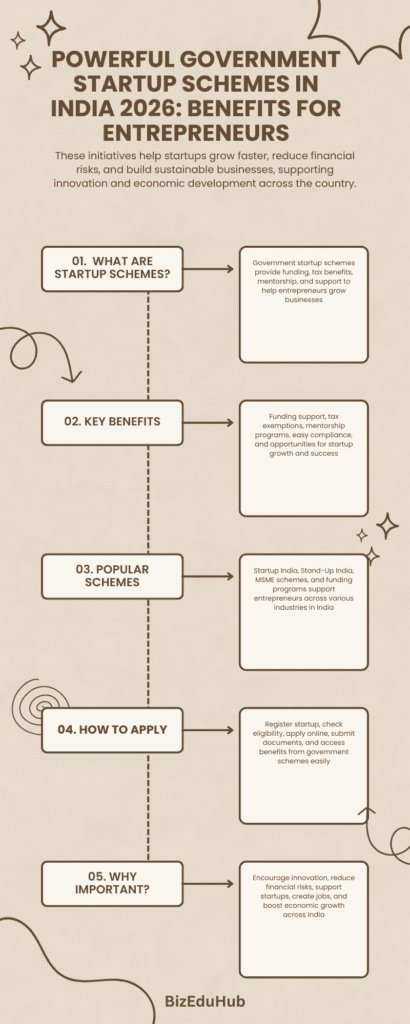
A government startup scheme is a structured program initiated and funded — fully or partially — by central or state government bodies with the explicit purpose of supporting early-stage businesses. These schemes operate across a wide spectrum: some provide direct financial grants or concessional loans, others offer tax relief, market access, incubation support, or IP assistance. What they share is a policy mandate to reduce the risk and friction of early-stage entrepreneurship and to accelerate the growth of innovation-driven businesses.
India’s government startup ecosystem is anchored by the Startup India initiative launched in 2016, but it has grown far beyond that single program. Today, the architecture includes central government flagship schemes, ministry-specific programs targeting sectors like agriculture, defense, space, and healthcare, and an expanding layer of state-level initiatives that complement and extend what’s available nationally.
To make this concrete: consider a young engineer in Nagpur who wants to build a drone-based crop monitoring service for farmers. Through government startup channels, she can potentially access seed funding through the Startup India Seed Fund Scheme, get her company recognized by DPIIT for tax and compliance benefits, apply for a government procurement contract through the GeM portal, and access a state-level incubator that provides subsidized lab space and mentorship.
Why Government Startup Schemes Matter More Than Ever in 2026
The honest answer to why these schemes matter is also, in some ways, uncomfortable: private capital in India is still deeply skewed toward founders with elite educational backgrounds, urban addresses, and existing professional networks. The data on venture capital distribution makes this clear. A first-generation entrepreneur from a tier-3 city, building a solution for a problem that affects rural India but doesn’t generate the kind of metrics that excite a Mumbai or Bengaluru VC, faces a structurally different fundraising environment than a founder with an IIT degree and a Koramangala postal code.
Government startup programs exist, in part, to correct for this structural imbalance. They represent capital and support that doesn’t require a warm introduction or a track record of previous exits. They create access where market mechanisms have failed to do so. For founders who are building genuinely innovative solutions but lack the traditional fundraising profile, these programs aren’t peripheral support — they are often the primary path to getting off the ground.
Beyond the equity argument, there’s a purely practical one. Compliance costs, regulatory burdens, and the sheer administrative overhead of running a small business in India can consume a disproportionate share of an early-stage team’s time and energy. Government startup recognition — particularly DPIIT recognition under Startup India — directly reduces this burden through compliance self-certifications, expedited processes, and legal protections that would otherwise be unavailable to young companies.
There is also the market access dimension. India’s public procurement market is enormous, and startups have historically been locked out of it by experience requirements and financial thresholds that made no sense for early-stage companies. Policy changes driven by the government startup agenda have progressively dismantled those barriers, opening government tenders to recognized startups in ways that create a genuine first-revenue pathway.
Key Aspects of Government Startup Schemes: A Deep Dive for Entrepreneurs
1. Startup India and DPIIT Recognition: The Foundation of Every Government Startup Journey
The starting point for any entrepreneur engaging with India’s government startup ecosystem is the Startup India program, administered through the Department for Promotion of Industry and Internal Trade. DPIIT recognition is the gateway credential — it’s what unlocks most of the downstream benefits across both central and state-level programs.
To qualify, a company must be incorporated, less than ten years old (or less than fifteen years in biotech), and must be working toward innovation, improvement of existing products or services, or significant scalability with high potential for employment or wealth creation. The application process is digital and relatively straightforward, and the benefits are substantial — from tax exemptions under Section 80-IAC to compliance self-certification for labor and environmental laws during the early years.
What DPIIT Recognition Actually Unlocks for Your Business
Beyond the compliance relief, DPIIT-recognized startups gain access to a network of over nine hundred incubators and accelerators empaneled by the government, eligibility for the Startup India Seed Fund Scheme, priority access to government procurement through policy mandates, and fast-track intellectual property filing with fee reductions and expedited examination. For a resource-constrained early-stage team, this bundle of benefits compresses what might otherwise be years of operational overhead into a manageable baseline.
2. The Startup India Seed Fund Scheme: Capital When You Need It Most
One of the most impactful government startup funding programs operating in 2026 is the Startup India Seed Fund Scheme, which provides financial assistance to startups for proof-of-concept, prototype development, product trials, market entry, and commercialization. The scheme channels funds through DPIIT-recognized incubators, which evaluate and disburse grants of up to twenty lakh rupees and loans of up to fifty lakh rupees to eligible startups.
This scheme specifically addresses the funding gap that exists before startups are ready for angel or venture capital — a stage where most private investors won’t engage but where the capital needs are real and critical. For founders who are pre-revenue or early-revenue, this scheme can be the difference between reaching a fundable milestone and running out of runway before they ever have the chance to prove their idea.
How to Navigate the Incubator Channel
The Seed Fund Scheme doesn’t give money directly to startups — it flows through empaneled incubators, which conduct their own evaluation and disbursal processes. This intermediary layer serves an important function: incubators typically provide mentorship, peer community, and operational support alongside the funding, which makes the capital more effective than a raw cash transfer would be. Understanding which incubators are empaneled in your sector and geography — and building a relationship with them before you need funding — is one of the most consistently underutilized strategies among eligible founders.
3. Atal Innovation Mission: Government Startup Infrastructure at National Scale
The Atal Innovation Mission, operated by NITI Aayog, represents India’s most ambitious government startup infrastructure program. Through its Atal Incubation Centres and Atal Tinkering Labs, the mission has created a physical and programmatic innovation infrastructure that now extends into schools, colleges, and communities across the country.
For entrepreneurs, the Atal Incubation Centres are particularly relevant. These centres provide subsidized space, shared equipment, mentorship networks, and — critically — connections to corporate and investor partners. In 2026, the AIM network has expanded meaningfully to cover tier-2 and tier-3 cities, which means the infrastructure support that was once concentrated in metro areas is increasingly accessible to founders building in smaller cities and towns.
4. Fund of Funds for Startups: Deepening India’s Domestic Investor Pipeline
The Fund of Funds for Startups, operated through SIDBI, addresses a systemic challenge in India’s startup funding landscape: the dependence on foreign venture capital. The FFS doesn’t invest directly in startups — instead, it invests in Alternative Investment Funds that are then mandated to deploy a significant portion of that capital into Indian startups.
By 2026, this mechanism will have materially increased the pool of domestic capital available to early and growth-stage companies and will have contributed to the emergence of a more geographically and sectorally diverse investor community. For founders, understanding which AIFs have received FFS support — and approaching those funds directly — is a concrete strategy for accessing this capital without relying solely on foreign investors.
5. State-Level Government Startup Schemes: The Most Overlooked Layer
This is perhaps the most underutilized part of India’s government startup architecture. Nearly every Indian state now operates its own startup policy and associated schemes — and in many cases, state-level programs offer benefits that match or exceed what’s available at the central level, with the added advantage of a more accessible administration and a clearer alignment with local market needs.
States like Karnataka, Telangana, Kerala, Rajasthan, Maharashtra, and Uttar Pradesh have developed particularly robust state startup policies, with dedicated funds, sector-specific programs, and government procurement preferences for locally recognized startups. A founder who invests time in understanding their state’s specific startup program often discovers a layer of support that their competitors haven’t accessed — which is, in practical terms, a meaningful competitive edge.
Practical Steps to Access Government Startup Schemes in 2026

Knowing that these schemes exist is one thing. Actually, navigating the process to access them is another. Here is a clear, actionable sequence that works:
- Start with DPIIT recognition. Register your company through the Startup India portal. This is foundational — most other government startup benefits flow from this recognition. Do it early; there’s no good reason to delay.
- Identify your state’s startup policy. Search for your state government’s dedicated startup or industry department and download the current startup policy document. Note the specific schemes, eligibility criteria, and application windows that apply to your company.
- Map your funding stage to the right scheme. Pre-prototype? Look at the Seed Fund Scheme through empaneled incubators. Post-traction but pre-institutional funding? Explore state-level startup funds and SIDBI direct schemes. Deep tech or sector-specific? Identify ministry-level programs for your sector — defense, agri, space, and health all have dedicated programs.
- Apply for the GeM portal. Government e-Marketplace registration gives you access to public procurement opportunities. Even if you’re not ready to bid for large contracts, being registered and visible on GeM builds government-customer credibility.
- File your patents through the fast-track startup route. Startup India’s expedited patent examination program significantly reduces the time and cost of protecting your innovations. Do this before competitors can replicate your solution.
- Connect with an empaneled incubator before you need funding. Relationships built before the pitch are always stronger than relationships that begin at the funding application stage. Visit, attend events, and build genuine connections with incubator program managers.
- Track scheme cycles proactively. Many government startup programs operate on application windows. Monitor the Startup India portal, your state startup portal, and relevant ministry websites regularly for new scheme announcements.
Real-Life Examples: Government Startup Schemes That Changed the Trajectory
The story of an agri-tech startup founded by two brothers from a farming family in rural Punjab illustrates what’s genuinely possible. Neither had an engineering degree — one had studied commerce, the other had worked in agricultural sales. Their idea was a mobile platform connecting small farmers directly with bulk buyers, cutting out the layers of intermediaries that compressed farmer margins into near-irrelevance.
Private investors weren’t interested — the market didn’t look big enough on paper, and the founders didn’t have the right profiles. But they got DPIIT recognition, were accepted into an Atal Incubation Centre in Chandigarh, and received a seed grant through the Startup India Seed Fund Scheme. Eighteen months later, they had a working product, their first hundred farmer-users, and enough traction to earn a meeting with a domestic VC fund that had received FFS backing. The government startup pathway didn’t make their company successful — their hard work and genuine product insight did that. But it gave them the runway to get to a point where the market could evaluate them fairly.
A second example involves a woman entrepreneur in Jaipur who built a platform for rural artisans to sell directly to urban consumers. She accessed her state’s women-founder-specific startup scheme, which provided both funding and dedicated mentorship, and used the GeM portal to land her first institutional buyer — a government agency procuring handicrafts for official gifting. That first institutional contract gave her both revenue and a credibility signal that proved invaluable in subsequent private-sector conversations.
These aren’t outlier stories reserved for exceptional people. They’re representative of what becomes possible when founders engage seriously with the government startup support architecture that’s been built for exactly this purpose.
Common Mistakes to Avoid When Applying for Government Startup Schemes
- Applying Without Understanding Eligibility in Detail: Government schemes have specific eligibility criteria, and applications that don’t precisely meet them are typically rejected — often without detailed feedback that would help you understand why. Read eligibility requirements carefully, verify that your company’s age, incorporation structure, sector, and development stage match what the scheme requires, and only apply where you genuinely qualify.
- Treating Applications as One-Time Events: Many founders apply for a scheme once, don’t hear back immediately, and move on with a sense of closure. Government startup application processes often have longer timelines than private funding processes, and appropriate follow-up through official channels matters.
- Ignoring State-Level Programs in Favor of Central Ones: Central government schemes receive the most attention and media coverage. But state-level programs often have lower application competition, faster disbursement timelines, and more targeted sector focus.
- Underestimating the Importance of Documentation Quality: Government applications are documentation-intensive, and quality matters enormously. Founders who approach these applications informally — submitting incomplete financials, vague project descriptions, or missing compliance certificates — are not competitive.
- Confusing Recognition with Funding: DPIIT recognition under Startup India is a credential, not a funding event. Many first-time founders complete the recognition process and then wait expectantly for capital to materialize.
Frequently Asked Questions About Government Startup Schemes in India
Q1. What is the most important government startup scheme for a first-time founder in 2026?
For most first-time founders, the starting point is DPIIT recognition under the Startup India program — it’s the foundational credential that makes you eligible for most other schemes. Once recognized, the Startup India Seed Fund Scheme is typically the most relevant funding pathway for early-stage companies, providing grants and loans through empaneled incubators for proof-of-concept development, prototype building, and early market entry.
Q2. Can startups from tier-2 and tier-3 cities access the same government startup benefits as metro-based founders?
Yes — and in 2026, the infrastructure to support this access has improved considerably. The DPIIT recognition process is entirely digital and geography-neutral. The Atal Innovation Mission has expanded its incubator network into smaller cities. Many states have specific schemes targeting startups outside their state capitals.
Q3. How long does the DPIIT recognition process take?
The online application through the Startup India portal typically takes two to four weeks for processing, provided all documentation is in order. The process requires careful preparation — company incorporation documents, a clear description of the innovative element of your business, and basic financial information. Having all documents organized before beginning the application significantly reduces processing friction and time.
Q4.Are there specific government startup schemes for women entrepreneurs?
Yes. Several central and state-level programs have dedicated provisions or standalone schemes for women founders. The Stand-Up India scheme, operated through banks with government backing, specifically targets women entrepreneurs and SC/ST founders for loans in the ten lakh to one crore rupee range. Several states — including Maharashtra, Telangana, and Kerala — have women-specific startup funds and incubation programs. The WEP (Women Entrepreneurship Platform) under NITI Aayog also connects women founders to mentorship, funding, and market access programs across the country.
Q5. What is the difference between a government startup grant and a government startup loan?
A grant is non-repayable funding — it’s given to your startup without an expectation of repayment, typically for specific purposes like prototype development or proof-of-concept validation. A loan is capital that must be repaid, usually at concessional interest rates significantly below market rates. Most government startup schemes offer a combination of both mechanisms: grants for the earliest, highest-risk stages, and concessional loans for slightly later stages when enough product or business is de-risking to justify a repayable structure.
Conclusion
There is something genuinely meaningful about the fact that in 2026, a young entrepreneur in a small Indian town — without family wealth, elite credentials, or a powerful professional network — has access to a more comprehensive set of government startup support tools than at any point in the country’s history. That’s not a small achievement. It reflects a policy commitment built incrementally over a decade of reforms, refinements, and genuine learning about what early-stage entrepreneurs actually need.
But the support only works for those who engage with it actively and intelligently. The government startup ecosystem rewards founders who are proactive, well-informed, and persistent — who understand the programs available to them, invest real time in applications and incubator relationships, and treat public support as a complement to their own effort rather than a replacement for it.
If you’re building something in India right now, the environment is working in your favor in ways it hasn’t before. The government startup schemes are real, accessible, and increasingly well-designed. The infrastructure is growing. The domestic capital pools are deepening. What remains — as it always has — is the work: the daily commitment to building something genuinely valuable for the people you’re trying to serve.
Start with the DPIIT recognition. Learn your state’s programs thoroughly. Build relationships with empaneled incubators before you need them urgently. Engage with the schemes section of every relevant portal, and treat those application windows as the opportunities they are. And then — with the wind of India’s government startup ecosystem at your back — go build something worth all of it.
!You might be interested in reading this page as well
Piyush Goyal’s Startup Powerful Strategy: How India is Transforming Entrepreneurs in 2026