
Introduction to Digital Marketing Courses
There is a specific kind of frustration that comes from wanting to learn something badly enough that you spend three hours researching courses instead of actually starting one. I know because I lived it. Two years ago, I found myself with a genuine desire to build real marketing skills, a browser full of tabs, and absolutely no clarity on where to begin. The phrase “digital marketing courses” returned millions of results, each claiming to be the most comprehensive, most practical, most career-transforming option available. The noise was deafening. What I needed — and what most people searching for the same thing need — was not more options. It was a clear, honest guide to the options that actually matter.
This article is the guide I wish had existed then. It covers what online marketing education actually is, why it has become genuinely important rather than just professionally fashionable, and the ten courses that consistently produce real results for real people in 2026. Whether you are a complete beginner trying to break into a competitive field, a small business owner who wants to stop outsourcing everything and understand the fundamentals, or a marketing professional looking to fill specific gaps in your skill set, there is a course on this list built for your exact situation. Let us get into it.
What are Digital Marketing Courses?
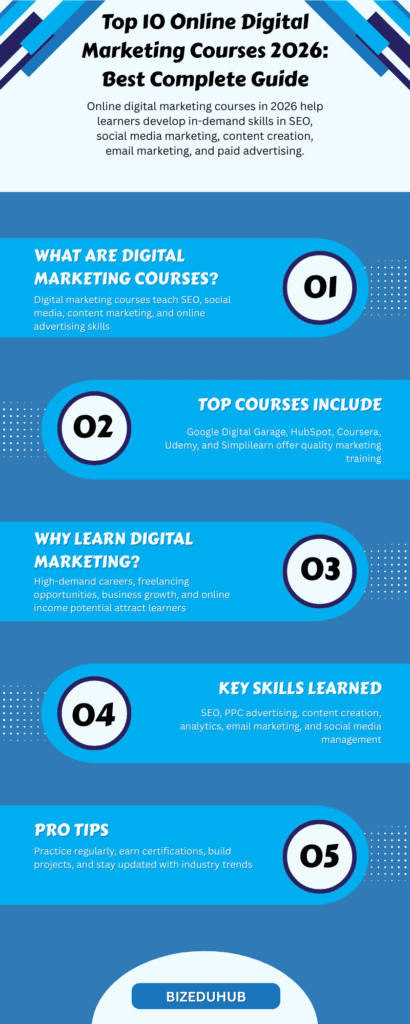
Online digital marketing courses are structured learning programs designed to teach the skills, strategies, and tools involved in promoting products, services, or brands through digital channels. They range from broad introductory programs that cover the entire marketing landscape — SEO, social media, email, content, paid advertising, and analytics — to highly specialized training focused on a single discipline or platform.
The best courses do more than deliver information. They are built around practical application: exercises that require you to actually run campaigns, write real copy, audit actual websites, and interpret real data. Theory without application produces professionals who can explain what a conversion funnel is but cannot build one. The digital marketing courses worth your time and money are those designed to close the gap between knowing and doing.
Formats vary considerably. Some programs are self-paced video libraries you work through at your own speed. Others are cohort-based, with live sessions, peer collaboration, and instructor feedback. Many offer industry-recognized certifications upon completion, which carry genuine weight with employers and clients in certain sectors. The right format depends less on what sounds appealing and more on how you actually learn best and what your schedule can accommodate.
Why Digital Marketing Courses Are Worth Your Investment in 2026
The case for formal learning in this field used to require some defending. A few years ago, a reasonable person could argue that everything worth knowing about digital marketing courses was freely available online — scattered across blog posts, YouTube tutorials, and forum threads — and that structured courses were simply convenient packaging for information you could assemble yourself for free. That argument has aged poorly.
The field has matured and grown more complex simultaneously. The platforms have deepened. The tools have multiplied. The standards employers and clients hold professionals to have risen substantially. Self-assembled knowledge from scattered sources tends to produce a patchwork understanding — strong in the areas you happen to have encountered, full of gaps in areas you did not know you were missing. A well-structured course provides systematic coverage of a discipline, ensures your foundational knowledge is actually solid, and — critically — teaches you how the pieces connect.
For career-changers, the credential aspect matters for a different reason: it provides a credible signal of commitment and baseline competence to employers who cannot yet evaluate your track record. For existing professionals, targeted coursework in areas like programmatic advertising, conversion rate optimization, or marketing analytics represents some of the highest-return professional development available. The skills transfer immediately to the work in front of you, digital marketing courses.
The Top 10 Digital Marketing Courses in 2026
The following courses were evaluated on five criteria: curriculum depth and relevance, quality of instruction, practical application requirements, credential value, and value for money. They are listed in order of overall strength, though the right choice for you will depend on your specific goals, background, and budget.
01. Google Digital Marketing & E-commerce Certificate
Designed for complete beginners, this seven-course certificate program covers everything from the fundamentals of digital marketing courses to email campaigns, SEO, and e-commerce analytics. Google’s involvement means the curriculum is genuinely aligned with the tools most marketers use daily. It is self-paced, takes roughly six months at ten hours per week, and is available at a low monthly subscription cost. The credential carries real recognition, particularly in entry-level hiring contexts. For those starting from zero, this is the most logical first step.
02. HubSpot Digital Marketing Certification
HubSpot’s free certification is one of the most widely recognized credentials in inbound marketing. The curriculum is particularly strong on content strategy, email marketing, and the relationship between marketing and sales — areas that many competing courses treat superficially. The material is updated regularly to reflect current best practices, and the certification is genuinely respected by hiring managers in B2B marketing roles. The price — completely free — makes it an obvious addition to any marketer’s credential portfolio regardless of experience level.
03. Meta Social Media Marketing Professional Certificate
For anyone whose focus is social media marketing — particularly paid advertising on Facebook and Instagram — this certificate program from Meta is the most authoritative training available. Six courses cover content creation, community management, advertising strategy, and analytics within Meta’s ecosystem. The practical components require you to build and analyze actual campaigns, which means by the time you finish, you have done the work rather than just watched it being described. Particularly valuable for e-commerce marketers and anyone managing social ad spend professionally.
04. SEMrush SEO Toolkit Course & Certification
SEO-specific training from one of the most widely used SEO platforms in the world. The curriculum covers keyword research, technical SEO, on-page optimization, link building, and competitive analysis — all demonstrated within SEMrush’s own toolset. Free to access with a SEMrush account, this digital marketing courses is particularly strong for those who want to move beyond conceptual SEO knowledge into the practical, tool-based execution that agencies and in-house teams actually rely on. The accompanying certification is recognized within the SEO community as a mark of genuine tool proficiency.
05. Digital Marketing Specialization
For those who want academic rigor alongside practical application, Illinois’s seven-course specialization offers the most academically grounded marketing education on this list. Taught by university faculty, the curriculum covers digital marketing analytics, search engine optimization, social media strategy, and marketing in digital environments with a depth that professional certification programs rarely match. The capstone project requires developing and presenting a complete digital marketing strategy. Best suited for professionals who want both credentials and conceptual depth, or those considering an eventual MBA with a marketing concentration.
06. Content Marketing Certification
Content marketing is one of the most under-served disciplines in broad digital marketing programs — covered in two or three modules where it deserves an entire curriculum. This certification fills that gap, covering content strategy, editorial planning, long-form writing, distribution, and content performance measurement with the specificity those topics require. Particularly recommended for writers, journalists, and communications professionals transitioning into marketing roles, as well as for in-house marketers seeking to improve the quality and strategic coherence of their content output.
07. Google Analytics 4 Certification
Analytics literacy is the skill that separates marketers who guess from marketers who know — and it is consistently among the most in-demand capabilities employers list in marketing job descriptions. Google’s free GA4 certification teaches you to navigate the platform, set up tracking, interpret reports, understand attribution, and draw actionable conclusions from data. Free, thorough, and directly applicable to daily marketing work, this certification deserves a place in every digital marketer’s credential portfolio regardless of specialization. A non-negotiable addition for anyone who manages a website or runs online campaigns.
08. Email Marketing Mastery
Despite being one of the highest-ROI channels in digital marketing courses, email is frequently taught as an afterthought in broad marketing programs. This course corrects that by going deep on list-building strategy, segmentation, automation workflows, deliverability, copywriting for email, A/B testing, and performance analysis. The practical exercises require building actual email sequences, which means you leave with transferable work product in addition to knowledge. Particularly valuable for e-commerce marketers, newsletter operators, and anyone whose business depends on direct customer communication.
09. Paid Search & Google Ads Certification
For marketers who manage or intend to manage paid search campaigns, Google’s own certification remains the most authoritative credential available. The curriculum covers campaign structure, keyword strategy, ad copywriting, bidding strategy, Quality Score optimization, and performance measurement in detail, which third-party courses rarely match. The certification must be renewed annually, which has the useful side effect of keeping practitioners current with platform changes. Free, highly respected by employers, and directly applicable to one of the most in-demand skills in performance marketing.
10. Digital Marketing Institute Professional Diploma
The most comprehensive and formally structured option on this list, DMI’s Professional Diploma covers the full digital marketing courses landscape across modules on strategy, social media, SEO, PPC, email, content, and analytics. The curriculum is developed in collaboration with industry partners and updated regularly. The credential is internationally recognized and respected — particularly in agency environments and corporate marketing teams. The investment is higher than most alternatives on this list, but for those serious about marketing as a long-term career, it represents the most thorough foundation available online.
How to Choose and Get the Most From Your Digital Marketing Courses

Selecting the right online marketing program is only the first decision. What you do with it afterward determines whether the investment generates returns or sits on your resume as a credential that never translates into actual capability. Here is how to approach both decisions well.
- Match the course to your specific goal, not general interest: If you want to run paid social campaigns for a small business, the Meta certification is a more direct investment than a broad seven-course diploma. If you want an entry-level marketing job, a recognized comprehensive certificate carries more weight. Be specific about what you are trying to achieve before selecting a program.
- Schedule study time as fixed appointments, not intentions: Self-paced digital marketing courses fail most learners, not because the content is poor but because “I’ll study when I have time” translates in practice to never studying. Block the time in your calendar before you begin, treat it as non-negotiable, and protect it with the same discipline you would a client meeting.
- Apply concepts immediately, even on a small scale: The fastest path from knowing to doing is doing. As you progress through your course, find a way to apply each new concept in practice — run a small Google Ads campaign with a modest budget, write an SEO-optimized blog post, build a simple email sequence.
- Build a portfolio as you study: Document the work you create during your course. Campaign results, content pieces, strategic plans, and data analyses become portfolio evidence that credentials alone cannot provide. When a prospective employer or client asks what you have done, you want to show them something real.
- Combine two or three complementary courses rather than one exhaustive program: The most well-rounded digital marketers tend to have depth in one or two specific channels and solid literacy across the others. A combination like Google’s Digital Marketing Courses Certificate, plus the GA4 certification, plus HubSpot’s content certification, gives you a broader and more demonstrably applied skill set than any single program.
- Join communities of fellow learners and practitioners: Marketing forums, LinkedIn groups, and platform-specific communities provide something no course can: a real-time perspective on what is actually working in the market, answers to the specific questions that arise in your specific work, and professional relationships that often lead to opportunities.
- Honest Assessment: No course, regardless of prestige or cost, turns an uncommitted learner into a capable marketer. The certificate is evidence that you started and finished. What you do with the knowledge in between — and afterward — is entirely up to you. Treat the course as the beginning of your education, not the end of it.
Real Stories: What Happens When You Actually Commit to Digital Marketing Courses
Case Study — Career Change at 34
Marcus had spent nine years in retail management before deciding he wanted to move into digital marketing. He had no formal marketing education, no portfolio, and a deep skepticism that anyone would hire him over recent graduates with dedicated degrees. He completed three free certifications over four months — HubSpot’s Digital Marketing Courses certificate, Google Analytics 4, and Google’s Search Ads certification — while simultaneously running a small blog about retail operations as a practical project. By the time he started applying for junior marketing roles, he had three credentials, a demonstrated analytics skill set, and a portfolio of content that showed he could actually execute, not just theorize. He received two offers within six weeks of his first application.
Case Study — Small Business Owner Reclaims Her Budget
Priya ran a boutique skincare brand and had been paying a marketing agency a significant monthly retainer for two years without fully understanding what they were doing or whether it was working. She completed Google’s Digital Marketing Courses and E-commerce Certificate to get literate enough to evaluate her own marketing investment. Three months into the course, she realized her agency had been running generic campaigns with no meaningful audience segmentation, and her email list had never been properly segmented despite months of requests. She renegotiated her agency agreement from an informed position, took the email program in-house, and within four months had improved her email revenue by 45% using skills she had learned from a self-paced online course.
Common Mistakes People Make When Choosing Digital Marketing Courses
- Chasing the most expensive option under the assumption that cost equals quality: Some of the most effective digital marketing courses on this list is completely free. Google, HubSpot, and Meta offer certifications that are taken seriously by the industry precisely because those organizations have an incentive to train marketers well on their own platforms. Price is not a reliable signal of educational quality in this field.
- Enrolling in multiple courses simultaneously: Depth of learning in one program nearly always outperforms shallow engagement across several. Attempting two or three courses at once tends to produce fragmented attention, incomplete retention, and a collection of unfinished certifications. Finish one before beginning the next.
- Prioritizing certification over competence: The certificate is the outcome of learning, not the goal of it. Learners who rush through content to reach the certification exam without genuinely absorbing the material end up with a credential that overstates their actual capability — which creates problems the first time a client or employer asks them to demonstrate it.
- Choosing a course based on production value rather than curriculum quality: Polished video production and a celebrity instructor are not substitutes for rigorous, current, and practically applied content. Before enrolling in any paid course, review the curriculum outline carefully and look for recent student reviews that speak specifically to the quality of what is taught, not just the presentation.
- Stopping at the certification and never continuing to learn: Digital marketing courses evolve at a pace that makes any single course’s content partially outdated within one to two years. The professionals who stay ahead are the ones who treat their education as ongoing — reading industry publications, following platform changes, testing new tactics, and updating their knowledge through short-form learning continuously.
Frequently Asked Questions About Digital Marketing Courses
Q1. Are free digital marketing courses worth taking, or do I need to invest in paid programs?
Free digital marketing courses from established platforms — particularly Google, HubSpot, and Meta — are absolutely worth taking and are taken seriously by employers in the industry. They cover the fundamentals thoroughly, offer recognized certifications, and are updated regularly to reflect current platform capabilities. Paid programs offer advantages in depth, instructor access, peer community, and sometimes academic credit, but they are not inherently superior in educational quality.
Q2. How long does it take to complete a digital marketing courses?
It varies significantly by program. Short professional certifications like HubSpot’s content certification can be completed in four to six hours. Google’s multi-course certificate program is designed for approximately six months at ten hours per week. The Digital Marketing Institute’s Professional Diploma typically requires four to six months of part-time study. Self-paced formats mean your actual completion time will depend on how consistently you study. As a rough benchmark, plan for a minimum of twenty to thirty focused hours for a single-topic certification and three to six months.
Q3. Which digital marketing courses are best for getting a job in 2026?
For entry-level job seekers with no prior marketing experience, the Google Digital Marketing and E-commerce Certificate is the strongest single credential in terms of employer recognition, curriculum breadth, and practical application. Combining it with the HubSpot Digital Marketing Courses Certification and a Google Analytics 4 Certification creates a credential package that signals genuine preparation across the three areas most commonly tested in entry-level marketing hiring: overall marketing literacy, inbound strategy, and analytics.
Q4. Do I need a background in technology to take digital marketing courses?
No technical background is required for the vast majority of digital marketing programs. The field involves using platforms and tools rather than building them, and the learning curve on most marketing tools is genuinely accessible to non-technical learners. You will encounter some technical concepts in SEO and analytics, but these are explained from first principles in good beginner courses.
Q5. Can digital marketing courses help someone running their own small business?
They can be transformative. Small business owners who understand digital marketing courses are better positioned to evaluate agency work, make informed decisions about budget allocation, build sustainable in-house capabilities, and avoid the common experience of paying for marketing activity without understanding whether it is generating real returns. Even a single focused course — Google’s certificate or HubSpot’s inbound certification — gives a business owner enough literacy to ask the right questions, identify weak execution, and understand what good results actually look like in their industry context.
Conclusion
Two years after that overwhelming afternoon of open browser tabs, I can tell you that the decision to invest in structured learning was one of the better professional choices I made — not because the certificates themselves opened doors, but because the genuine understanding they produced changed how I worked and what I was capable of demonstrating to the people I wanted to work with. That is the real return on digital marketing courses: not the credential that lives on your LinkedIn profile, but the competence that shows up in your work.
The ten programs on this list represent the best available options for 2026 across every budget, experience level, and professional goal. Some of them are free. Some require a real financial commitment. All of them require something that money cannot buy: the sustained effort to actually learn, practice, and apply what they teach. That part is yours to provide, and it will determine everything about what you get from them.
Start with the digital marketing courses that match your current situation most precisely. Finish it. Apply what you learn. Then choose the next one. The digital marketing professionals who stand out in 2026 are not the ones with the longest credential list — they are the ones who kept learning and kept applying long after most people stopped. That path is open to anyone willing to take the first step.
!You might be interested in reading this page as well
How to Start Digital Marketing in 2026: Easy Complete Guide