
Introduction to Remote Operations Jobs
There is a moment that many people working in a traditional office have quietly experienced — staring out a window during a long commute or sitting through a meeting that could have been an email — and thinking: there has to be a better way to work. For a growing number of professionals in 2026, that better way has a name. It lives in the expanding universe of remote operations jobs: roles that carry genuine responsibility, competitive pay, and the freedom to work from anywhere on earth with a reliable internet connection.
Remote operations jobs are not just about flexibility, though the flexibility is real, and it matters. These are substantive careers that sit at the nerve center of how modern organizations actually function. They keep supply chains moving, customer experiences intact, distributed teams coordinated, and systems running smoothly — all without requiring the people doing this work to be physically present in any particular building. In 2026, as remote-first and hybrid workplaces have become the default rather than the exception in many industries, understanding which operations roles pay well, what they require, and how to land one has never been more practically useful. This guide covers all of it, honestly and in detail.

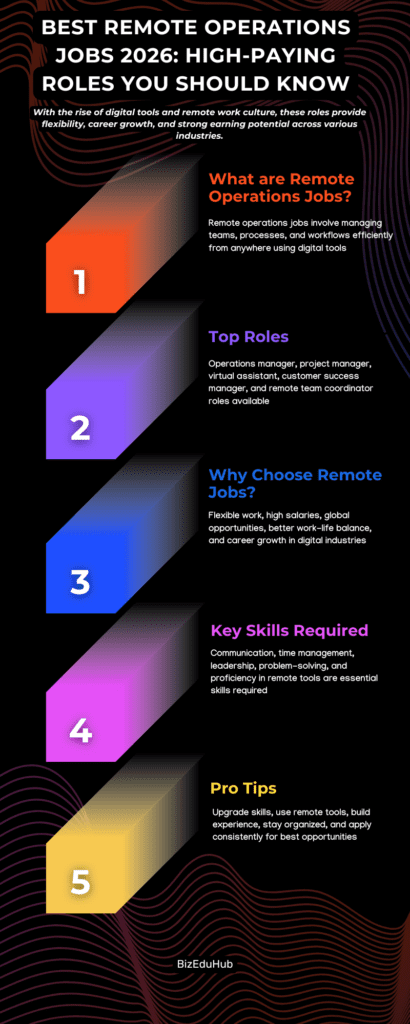
What are Remote Operations Jobs?
Operations, in the broadest sense, refer to the work of keeping an organization running. It is the infrastructure beneath the visible surface of any business — the processes, systems, logistics, workflows, and coordination that determine whether a company delivers on its promises to customers, manages its resources intelligently, and scales without collapsing under its own complexity. Operations is not glamorous in the way that sales or product development can be, but it is indispensable. And increasingly, it is remote.
Remote operations jobs are roles within this broad category that can be performed entirely outside a physical workplace. They span an enormous range: a revenue operations analyst working from a beach town in Portugal, a supply chain coordinator managing vendor relationships from a home office in Nairobi, a customer experience operations manager keeping a global support team aligned from a converted barn in rural Vermont. The work varies widely. The common denominator is that it requires strong systems thinking, clear communication, and the ability to drive outcomes without the built-in visibility of an office environment.
It is worth distinguishing remote operations jobs from general remote work. Not every job that can be done remotely involves operations. But operations roles that have successfully transitioned to remote settings tend to share certain characteristics: they are process-oriented, they depend on digital tools and documented systems, and they involve coordination across multiple teams or functions. These are not jobs where you simply execute a defined task in isolation. They require judgment, initiative, and the capacity to hold a complex, multi-stakeholder picture in your head while making decisions that affect the whole organization.
Examples of roles in this category include operations manager, business operations analyst, logistics coordinator, revenue operations specialist, customer operations lead, process improvement manager, supply chain analyst, and technical operations engineer. Each of these carries distinct responsibilities, but all of them share the fundamental characteristic of keeping systems — human, technological, or logistical — running at their best.
Why Remote Operations Jobs Are Worth Pursuing in 2026
The practical argument for pursuing remote operations jobs in 2026 begins with compensation. Operations has historically been among the more well-compensated functional areas in business, and the remote versions of these roles have not taken a pay cut to accommodate location independence. In fact, at many organizations — particularly technology companies, logistics platforms, and professional services firms — strong remote operations talent commands a premium, because the organizations that have moved fastest on remote work are also, in many cases, the ones growing most aggressively and competing hardest for people who can keep their operations functioning at scale.
Beyond compensation, the career trajectory for operations professionals is genuinely compelling. Operations experience is one of the clearest pathways to executive leadership. CEOs, COOs, and general managers disproportionately come from operations backgrounds, because operations gives you a functional understanding of the entire business that is hard to develop within any single department. Someone who has spent five years running operations for a distributed team understands finance, technology, people management, customer experience, and process design in a way that makes them exceptionally valuable at senior levels.
The lifestyle argument deserves honest treatment as well. The freedom to choose where you live — or where you work from day to day — is not a trivial benefit. For people with families in locations that are not traditional employment hubs, for individuals with health conditions that make commuting difficult, for those who simply find that they do their best work in environments they control, remote operations careers offer something that a better title at a local company often cannot: a genuine quality of life alongside professional ambition. The two do not have to trade against each other.
There is also a structural argument. As automation handles more of the routine, rules-based work within organizations, the remote operations jobs that remain and grow are precisely those that require complex judgment, cross-functional coordination, and adaptive problem-solving. These are the roles where human expertise is genuinely irreplaceable, which means they are also the roles least likely to disappear as technology evolves. Investing in an operations career in 2026 is, in many respects, investing in professional durability.
Key Remote Operations Jobs and What They Pay
1. The Highest-Paying Remote Operations Roles in 2026
Salaries in operations vary significantly by industry, company size, and level of responsibility. The following roles consistently appear at the higher end of the remote operations compensation spectrum. Figures reflect mid-to-senior level positions at technology, e-commerce, and professional services companies, where a remote-first culture is most established.
- Revenue Operations Manager ($110,000 – $165,000): Aligns sales, marketing, and customer success data and processes. High strategic value, high demand at SaaS companies.
- Supply Chain Operations Analyst ($85,000 – $135,000): Optimizes sourcing, inventory, and logistics workflows. The booming sector post-pandemic, with global talent demand.
- Technical Operations Engineer ($120,000 – $180,000): Manages infrastructure reliability and incident response. A hybrid technical and operational skill set commands premium pay.
- Business Operations Lead ($95,000 – $150,000): Drives cross-functional planning and process improvement. Often a stepping stone to COO at scaling companies.
- Customer Operations Manager ($80,000 – $125,000): Oversees support workflows, tooling, and team performance across distributed service teams.
- Logistics Coordinator ($70,000 – $105,000): Manages carrier relationships, freight optimization, and delivery operations for e-commerce and manufacturing.
2. What Skills Are Actually Required?
The skills required for remote operations jobs can be grouped into three categories, and understanding the distinction matters when you are assessing your own readiness or planning a transition into the field.
Hard Skills
Process documentation and optimization, data analysis using tools like SQL, Excel, or Looker, project management methodologies such as Agile or OKRs, proficiency with workflow and collaboration platforms like Notion, Asana, Jira, or Monday.com, and for technical operations roles, infrastructure knowledge across cloud platforms. These are learnable skills with clear development pathways. Most can be developed through a combination of online courses, certifications, and deliberate practice in entry-level roles.
Soft Skills That Distinguish the Best Operators
Written communication that is precise and actionable — because in a remote environment, your words do a disproportionate share of the work your physical presence would do in an office. Structured thinking under pressure: the ability to remain analytically clear when something breaks, and multiple stakeholders are demanding answers simultaneously. Proactive communication, which means surfacing problems before they become crises and keeping stakeholders informed without being asked.
3. The Remote-Specific Layer of Operations Work
One thing that is worth addressing directly: remote operations jobs work is not simply office operations work conducted from a different physical location. Working effectively across time zones, maintaining team cohesion without the social fabric of a shared physical space, documenting decisions and processes with enough clarity that someone who joins the company six months later can understand the context, and managing your own energy and focus without the natural rhythm of an office environment — these are genuine skills that require conscious development.
Practical Steps to Land a Remote Operations Jobs

- Build a portfolio of documented process improvements. Remote Operations Jobs is a show-don’t-tell field. Before you apply for roles, collect concrete examples of times you identified an inefficiency, designed a fix, and measured the result. Even informal examples from previous roles are valuable.
- Get certified in at least one operations methodology. Project Management Professional (PMP), Six Sigma Green Belt, Lean Operations, or a RevOps-specific certification all signal structured thinking to hiring managers. The certification matters less than the demonstrated fluency.
- Learn at least one operations analytics tool to proficiency. SQL is the single highest-return technical skill for operations professionals who are not in engineering. If you can write queries to pull and manipulate data, you become dramatically more self-sufficient and valuable. Spend four to six weeks building genuine SQL fluency before your next job search cycle.
- Target remote-first companies, not remote-tolerant ones. There is a meaningful difference between a company that allows remote work and a company that was built for remote work. The latter has invested in the documentation culture, async communication practices, and distributed team management infrastructure that make remote operations genuinely functional.
- Write a cover letter that demonstrates operational thinking. Most cover letters are generic. An operations cover letter that clearly identifies a specific challenge the hiring company faces and articulates how your experience positions you to address it stands out immediately.
- Network inside operations communities, not just on job boards. The best remote operations jobs are frequently filled through internal referrals or professional networks before they hit job boards. Communities like Operations Nation, RevOps Co-op, and various Slack communities for operations professionals are active, welcoming, and disproportionately attended by people who are either hiring or know someone who is.
Real-Life Case Studies: Remote Operations Jobs
1. From In-Person Office Manager to Remote Operations Lead
A woman who had spent seven years as an office manager at a mid-sized law firm found herself at a crossroads when the firm downsized during a restructuring. She had always run the firm’s internal operations with quiet efficiency — managing vendors, coordinating schedules across twenty-five staff members, building systems that everyone used and no one thought about until they broke. But her skills had no obvious label on a resume, and she was not sure how to translate them for a remote market. She spent three months documenting her process improvements from the law firm in quantifiable terms, completed a project management certification, learned the basics of Notion and Asana, and began networking in operations communities online.
2. The Supply Chain Analyst Who Went Global Without Leaving His City
A logistics professional in a mid-sized city in Southeast Asia had spent four years working for a domestic freight company. The work was competent and stable, but the ceiling was visible. He began studying for a supply chain analytics certification in his evenings, developed genuine SQL proficiency over six months, and started applying to e-commerce companies with global operations. He was hired by a European marketplace startup as a remote supply chain analyst. Within eighteen months, he had been promoted to senior analyst and was managing vendor relationships across three continents, entirely from his home city through remote operations jobs.
3. The Marketing Coordinator Who Discovered Revenue Operations
Revenue operations did not exist as a widely recognized field when she started her career in marketing coordination. But she had always been the person on her team who cared disproportionately about data quality, CRM hygiene, and the question of why marketing campaigns with strong engagement metrics seemed to produce disappointing pipeline results. When RevOps began emerging as a formal function around five years ago, she recognized it immediately as the work she had already been doing informally. She leaned in, built fluency in Salesforce and HubSpot, and began positioning herself deliberately for RevOps roles.
Common Mistakes to Avoid When Pursuing Remote Operations Jobs
- Underestimating the importance of async communication skills: Many candidates for remote operations roles have strong verbal communication skills developed in office environments. What they have not necessarily developed is the discipline to write clearly, concisely, and completely enough that a colleague in a different time zone can read a message and take action without needing a follow-up clarification.
- Applying to roles without researching the company’s remote culture: Not all remote jobs are created equal. Some companies have genuinely built their culture, tools, and management practices around distributed work. Others have simply allowed employees to work from home without changing anything about how they operate.
- Treating all remote operations job titles as equivalent: Remote Operations Jobs is a broad category, and titles are used inconsistently across companies. An “operations manager” at a fifty-person startup may have more strategic responsibility and upward trajectory than a “senior operations director” at a large company where the role is primarily administrative.
- Neglecting time zone management in the interview process: If you are applying for remote operations jobs at companies headquartered in a different time zone, how you handle scheduling, response times, and availability during the interview process is itself a signal about how you will handle these things on the job.
- Ignoring professional development after landing the role: The operations landscape is evolving quickly. New tools emerge, new methodologies gain traction, and the expectations for what a strong operations professional can do with data and automation are rising every year.
Frequently Asked Questions About Remote Operations Jobs
Q1. What qualifications do you need for remote operations jobs?
Requirements vary by role and seniority, but most remote operations jobs require a combination of relevant experience, demonstrated process and project management skills, and proficiency with digital operations tools. For analyst-level roles, a bachelor’s degree in business, operations, supply chain, or a related field is commonly listed as a preference, though many companies have moved away from treating degree requirements as hard filters. At mid-to-senior levels, track record and demonstrable impact matter more than credentials.
Q2. Are remote operations jobs truly location-independent, or are there geographic restrictions?
The honest answer is: it depends on the company and the role. Many remote operations jobs are genuinely location-independent, particularly at technology companies and global enterprises that have fully distributed workforces. However, some companies restrict remote hiring to specific countries or regions, either due to legal and tax compliance requirements, time zone coverage needs, or compensation structuring considerations.
Q3. How do remote operations jobs’ salaries compare to in-office equivalents?
At companies that have fully embraced remote work, salaries for operations roles are typically competitive with or equal to their in-office equivalents. Some companies use location-adjusted pay scales, meaning that someone in a lower cost-of-living area may earn somewhat less than a counterpart in a major metropolitan center doing the same work. Others pay a single market rate regardless of location. Both approaches are common, and neither is inherently unfair — they reflect different philosophies about how to value work.
Q4. What industries hire the most remote operations job professionals?
Technology and software companies, particularly those in the SaaS segment, have the highest concentration of remote operations roles and the most mature remote work cultures. E-commerce and logistics companies have significantly expanded their remote operations jobs, hiring as global supply chains have become more complex and more digital. Professional services firms — consulting, financial services, legal technology — have followed, particularly for roles involving process improvement and project management. Healthcare technology is an emerging and fast-growing area for remote operations talent.
Q5. How do you stand out in a crowded field of remote operations job candidates?
The candidates who consistently stand out in remote operations jobs hiring do several things differently. They demonstrate systems thinking in their application materials by describing not just what they did but how they designed the process around it. They communicate with unusual clarity and efficiency, which signals remote-readiness immediately. They have taken the time to understand the specific company they are applying to — its operational challenges, its growth stage, its competitive environment.
Conclusion
There is a tendency to treat the remote work conversation as either utopian enthusiasm or cynical backlash, depending on who is doing the talking. The reality is more practical and more interesting than either extreme suggests. Remote operations jobs represent a genuine professional opportunity: meaningful work, strong compensation, and the kind of location independence that fundamentally changes what life can look like alongside a career. These are not perks attached to a compromised role. They are the terms of a new arrangement that benefits companies and workers alike when it is designed and executed thoughtfully.
The path into this space is more accessible than it might appear from the outside. Operations experience translates across industries. The core skills — structured thinking, clear communication, process discipline, data fluency — can be deliberately developed by anyone willing to invest the time. The market is large, the demand is sustained, and the compensation reflects that. What it requires is intentionality: knowing which roles align with your skills and trajectory, understanding what the best remote-first companies actually look like from the inside, and positioning yourself in a way that makes your operational thinking visible to the people who are hiring for it.
If you are reading this because you are somewhere in the middle of figuring out your next career move, consider this: remote operations jobs are not a niche or a trend. They are the structural reality of how a significant and growing portion of the global economy is being managed. The professionals who understand this early — and who build accordingly — are the ones who will look back in five years and realize they made one of the best decisions they could have made in 2026.
!You might be interested in reading this page as well
Remote Operations Strategies in 2026: Effective Management Guide for Teams