
Introduction to MBA Finance Specializations
There’s a particular kind of anxiety that comes with choosing a graduate business program. You’ve already decided an MBA is worth the investment — the tuition, the two years, the opportunity cost of stepping off the career ladder temporarily. But then comes the harder question: which direction do you actually want to go?
For most people drawn to finance, the answer isn’t immediately obvious. “Finance” covers an enormous amount of territory — from the high-stakes world of investment banking to the quiet rigor of corporate treasury management to the increasingly critical field of financial risk analysis. Choosing the wrong MBA finance specializations doesn’t ruin your career, but choosing the right one can accelerate it in ways that feel almost unfair compared to those who went in without a clear focus.
This guide is built for people standing exactly at that crossroads in 2026 — whether you’re a working professional considering a part-time program, a recent graduate eyeing a full-time MBA, or someone thinking about pivoting from a non-finance background entirely. We’ll walk through the most valuable MBA finance specializations available today, what they lead to, and how to figure out which one actually fits where you want to go.

What are MBA Finance Specializations?
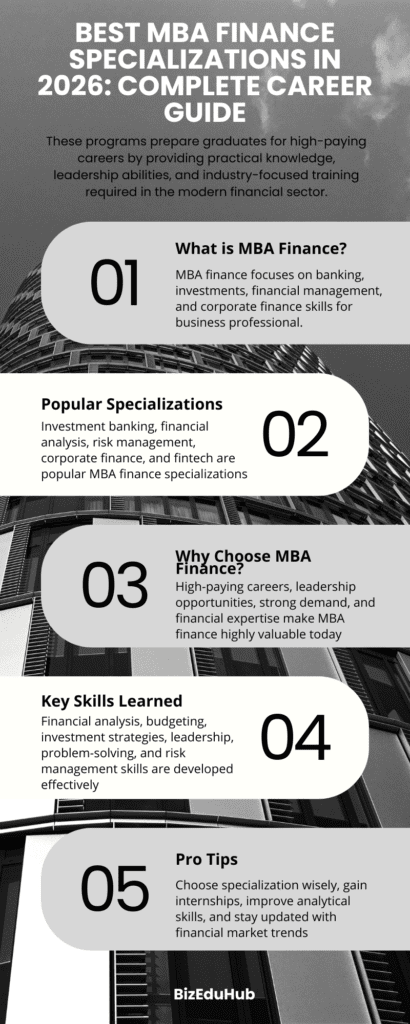
An MBA finance specializations are a focused track within a broader Master of Business Administration program that allows students to go deep into a specific area of finance, rather than stopping at the generalist exposure every MBA student receives. Think of the MBA itself as the foundation: you study strategy, operations, leadership, marketing, and accounting. The specialization is the direction you build from there.
Different schools use different terminology — some call them “concentrations,” others call them “tracks” or “majors.” The structure varies too. Some programs require students to complete a set of core finance specialization courses; others allow you to design your own track from a menu of electives. But the underlying logic is the same: you’re signaling to future employers, and to yourself, that you’ve gone beyond the basics in a particular domain.
For example, a student who chooses an investment management specialization will typically complete coursework in equity valuation, fixed income analysis, portfolio theory, and possibly a practicum managing a real student investment fund. Compare that to a student who specializes in financial technology — they might study blockchain infrastructure, algorithmic trading systems, regulatory compliance in digital finance, and the design of digital payment ecosystems. Same MBA. Fundamentally different skill sets and career trajectories.
In 2026, the landscape of available MBA finance specializations is broader and more nuanced than it was even five years ago. Programs are responding to market demand, and that demand has shifted meaningfully in the wake of global economic disruptions, the continued rise of fintech, and the growing importance of environmental risk in financial decision-making.
Why Your Choice of MBA Finance Specialization Matters
It’s tempting to think that once you have an MBA finance specializations, the rest sorts itself out. And to some extent, the credential opens doors. But inside those doors, what you’ve specialized in determines which rooms you’re shown.
Recruiters at top investment banks, asset management firms, and private equity shops are not hiring generalists when they go to business school campuses. They’re looking for people who can speak their language from day one — who understand deal structures, can model a leveraged buyout, or can discuss portfolio duration with genuine fluency. A well-chosen finance specialization gives you that language.
The financial return on specialization is also measurable. According to various graduate employment surveys, MBA graduates who enter finance roles with a relevant specialization tend to command higher starting salaries than their generalist peers. The gap widens further at the five-year mark, as specialized knowledge compounds into institutional credibility.
Beyond compensation, there’s a professional identity dimension that’s easy to underestimate. Finance is a big industry. The person who can say, “I specialize in corporate restructuring” or “my focus is sustainable finance” has a clearer professional identity — one that makes networking, job searching, and building expertise faster and more directed. In a competitive labor market, clarity is a competitive advantage through MBA finance specialization.
And then there’s the personal satisfaction argument. Spending two years and significant money on a program you’re genuinely engaged with is a better experience than sleepwalking through coursework that doesn’t connect to your actual interests. Choosing a specialization that aligns with both your strengths and your curiosity makes the whole MBA journey more meaningful.
Key MBA Finance Specializations to Know in 2026
1. Investment Banking and Capital Markets
This remains one of the most sought-after tracks in any top MBA program, and the demand hasn’t cooled. Students who pursue this specialization are typically targeting roles at bulge-bracket banks, boutique advisory firms, or the capital markets divisions of large financial institutions.
The coursework tends to center on financial modeling, mergers and acquisitions, debt and equity capital markets, and valuation methodologies. What separates strong candidates in this track isn’t just technical skill — it’s the ability to synthesize large amounts of financial information under pressure and communicate clearly to clients. If you’re drawn to high-stakes deal-making, complex financial structures, and the kind of work that ends up in the business press, this is the track that points there.
Investment banking recruiting is notoriously structured — internships during the MBA summer are make-or-break, and many students secure full-time offers before their second year even begins. Schools with strong Wall Street pipelines, alumni networks at top firms, and dedicated finance career services give students a meaningful edge. Choosing a program with this infrastructure matters as much as choosing the MBA finance specializations themselves.
2. Corporate Finance and Financial Strategy
Not everyone who gets an MBA finance specializations wants to go into banking. Many want to lead finance functions inside operating companies — serving as a CFO, VP of Finance, or Director of Financial Planning and Analysis at a corporation they believe in. This is where the corporate finance specialization lives.
The coursework here covers capital budgeting, working capital management, financial statement analysis, and the financial aspects of strategic decisions like acquisitions, divestitures, and major capital investments. Students learn how finance serves as the connective tissue of a business — how a pricing decision affects margin, how a capital structure choice affects flexibility, how financial reporting shapes investor perception.
This track is particularly well-suited to people who are already working inside companies and want to move into more senior finance leadership roles. The MBA credential, paired with a corporate finance specialization, is a well-traveled path to the C-suite.
3. Investment Management and Portfolio Strategy
Asset management, wealth management, endowment investing, hedge funds — this broad domain is what the investment management specialization prepares you for. Students in this track develop deep fluency in equity and fixed income markets, portfolio construction, risk-adjusted return analysis, and increasingly, factor-based and quantitative investing strategies.
One distinguishing feature of strong investment management programs is the CFA integration. Many top schools offer pathways that align MBA coursework with CFA exam preparation, recognizing that the Chartered Financial Analyst designation is the gold standard credential in this space. Finishing an MBA and sitting for the CFA simultaneously is demanding — but the combined credential is genuinely powerful in the asset management world.
4. Financial Risk Management
This MBA finance specializations has grown dramatically in prominence since the 2008 financial crisis and has continued to expand as financial institutions face increasingly complex regulatory environments, cyber risks, and the financial consequences of climate events. Risk managers are the people inside banks, insurance companies, and investment firms who model downside scenarios, stress-test portfolios, and design frameworks for managing exposure.
The technical demands here are significant. Students need comfort with quantitative methods, statistical modeling, and regulatory frameworks like Basel III and Solvency II. The FRM (Financial Risk Manager) certification from GARP is the most recognized credential in this field, and some MBA programs have built coursework that maps directly to its exam curriculum.
5. Fintech and Digital Finance
This is the MBA finance specializations that barely existed in business school curricula a decade ago and is now one of the most heavily subscribed-to tracks at forward-thinking programs. The financial services industry is being rebuilt from the ground up by technology — payments, lending, insurance, trading, and wealth management are all being disrupted or transformed — and the professionals who understand both the financial mechanics and the technological architecture are extraordinarily valuable.
Coursework typically spans blockchain and distributed ledger technology, digital payment systems, algorithmic trading, regulatory technology (regtech), and the financial analysis of technology-driven business models. Graduates from this track end up at fintech startups, the innovation divisions of major banks, venture capital firms with a financial services focus, and policy organizations grappling with digital finance regulation.
6. Sustainable Finance and ESG Investing
Perhaps the MBA finance specializations better reflect the shifting priorities of 2026 than sustainable finance. The integration of environmental, social, and governance (ESG) criteria into investment decision-making has moved from fringe conversation to institutional mandate in less than a decade. Major asset managers, sovereign wealth funds, pension funds, and development banks are all building teams specifically to analyze and manage ESG-linked financial risk and opportunity.
Students in this track learn ESG analysis frameworks, green bond markets, climate risk modeling, and the regulatory landscape governing sustainable disclosure requirements. The career paths are genuinely diverse — from ESG analyst roles at investment firms to sustainability finance positions inside corporations to policy work at organizations like the World Bank or IMF.
How to Choose the Right MBA Finance Specializations: Practical Steps

- Map your interests to your strengths honestly. Are you energized by quantitative analysis, or do you prefer client-facing work? Do you want to work inside companies or as an external advisor? Being honest about these preferences early saves a lot of time.
- Research on where each specialization actually leads. Look at the employment reports of programs you’re considering. Where do graduates with your target specialization end up? What are their actual starting salaries and job titles? This data is far more useful than a school’s general reputation.
- Talk to people working in the roles you’re targeting. A 30-minute conversation with someone in investment management or financial risk tells you more about day-to-day reality than any program brochure. Ask about their path, what skills they actually use, and what they’d look for when hiring an MBA finance specializations with a graduate.
- Consider the CFA, FRM, or other credentials as a complement. In several specializations, an industry certification alongside the MBA signals depth and commitment in ways that coursework alone doesn’t. Research which certifications are most valued in your target area and whether your program offers preparation support.
- Evaluate the school’s recruiting infrastructure for your chosen path. A great investment banking specialization at a school with minimal Wall Street recruiting relationships will take you further than you’d get without it — but not as far as the same specialization at a school with deep firm partnerships. Location, alumni networks, and on-campus recruiting all matter.
- Don’t choose based on prestige alone. Some people choose the most impressive-sounding MBA finance specializations rather than the one that actually fits their interests and goals. This leads to programs they’re not engaged with, jobs they don’t enjoy, and careers that eventually stall because the passion was never really there.
Real-Life Scenarios: What These Paths Actually Look Like MBA Finance Specializations
Meera had worked for four years as a financial analyst at a mid-size manufacturing company. She liked her work but felt capped — the CFO position she eventually wanted seemed distant, and she wasn’t sure she had the strategic credibility to compete for it. She chose an MBA with a corporate finance and strategy specialization, focused on the intersection of capital allocation and business strategy, and came out as a Director of FP&A at a Fortune 500 company. Within three years, she was promoted to VP of Finance. The MBA finance specializations didn’t just teach her new skills — it repositioned how she was perceived.
Daniel had spent his late twenties building a career in software product management. He found himself increasingly fascinated by the financial dynamics of tech companies — how they funded growth, structured equity, and went public. He pursued a fintech specialization in his MBA, leaned heavily into coursework on venture finance and digital business models, and landed at a growth-stage fintech as their Head of Strategy. The MBA gave him the financial credibility to complement his technical background in a way neither alone would have.
Both stories share a common thread: the MBA Finance specializations weren’t chosen randomly or becauthey it sounded good. It was chosen with a specific destination in mind and pursued with genuine engagement.
Common Mistakes to Avoid When Choosing MBA Finance Specializations
- Following the crowd without examining your own goals. Investment banking is glamorous and well-compensated. That draws a lot of MBA students — many of whom discover, sometimes mid-internship, that the lifestyle and the work itself don’t actually suit them. Choose based on fit, not just compensation benchmarks.
- Underestimating the importance of the internship. In finance, the MBA summer internship is effectively a six-to-ten-week interview for a full-time offer. Students who treat it as a formality — rather than the most important period of their entire program — frequently find themselves without an offer heading into their second year.
- Ignoring the quantitative requirements. Several MBA finance specializations — particularly risk management and fintech — require genuine quantitative comfort. Students who avoid coursework in statistics or financial modeling because it feels hard end up with a gap that limits where they can go in those fields. Take the hard courses.
- Choosing a school primarily for its overall ranking. A school ranked #15 overall with exceptional investment management faculty, a strong student-run investment fund, and direct recruiting relationships at top asset managers may serve you better than a school ranked #5 that doesn’t emphasize that specialization.
- Treating the specialization as separate from networking. Your classmates, professors, and alumni are as important as the curriculum. Actively build relationships within your MBA finance specializations cohort — these are the people who will refer you for roles, co-found companies with you, and support your career for decades.
Frequently Asked Questions About MBA Finance Specializations
Q1. Which MBA finance specializations have the highest earning potential in 2026?
Investment banking and private equity consistently produce the highest starting compensation figures for MBA finance specializations, with total first-year packages at top firms frequently exceeding $200,000 in major financial centers. Quantitative finance roles at hedge funds and proprietary trading firms can exceed even these figures for candidates with the right technical profile. That said, compensation varies enormously by firm, geography, and individual performance — and the highest-paying roles also tend to have the most demanding work environments.
Q2. Can I switch into finance from a non-finance background using an MBA?
Absolutely — this is one of the most common reasons people pursue an MBA in the first place. The career pivot into finance from engineering, consulting, law, or other fields is very achievable with the right program, specialization, and proactive networking. The key is choosing a school with strong finance recruiting and demonstrating genuine preparation — through pre-MBA coursework, certifications, or relevant projects — before you arrive.
Q3. How long does it take to complete an MBA finance specializations?
Full-time MBA programs typically run two years. Accelerated one-year programs exist at some schools, though they offer less time for recruiting and internship experience — a significant trade-off in finance. Part-time and executive MBA finance specializations can run two to five years, depending on pace, and are generally better suited to professionals who want to advance in their current organization rather than make a sharp pivot.
Q4. Is a CFA more valuable than an MBA finance specializations for investment management?
They serve different purposes and are arguably more powerful together than either is alone. The CFA is a rigorous technical credential that signals deep investment knowledge and is highly respected among portfolio managers and analysts. The MBA provides broader business and leadership training along with a professional network. For someone targeting investment management, pursuing both — particularly if their MBA finance specializations program supports CFA exam preparation — creates a genuinely differentiated profile.
Q5. Are online MBA programs with finance specializations worth it in 2026?
For certain goals, yes. If you’re looking to build financial skills, earn a recognized credential, and advance within your current organization, an online MBA from an accredited program with a strong finance curriculum can deliver meaningful value. However, for competitive finance roles — particularly in investment banking, private equity, or top-tier asset management — the recruiting relationships, peer network, and brand recognition of a full-time residential program remain difficult to replicate online.
Conclusion
Choosing among MBA finance specializations is not a decision to make lightly, and it’s not one to make based on what sounds most impressive at a dinner party. It’s a decision that shapes the first decade of your post-MBA career — the roles you’re recruited for, the skills you develop most deeply, the professional community you become part of.
The good news is that 2026 offers genuinely exciting options. Whether you’re drawn to the deal-making intensity of investment banking, the patient analytical discipline of portfolio management, the technical rigor of financial risk, or the frontier energy of sustainable finance and fintech, there is a credible, rewarding career path that begins with making a thoughtful choice right now.
Start with an honest self-assessment. Pair it with real research — employment data, informational interviews, and a clear-eyed look at where your target programs actually send their graduates. Choose an MBA finance specializations that connects your strengths to your genuine interests, not just your aspirations.
!You might be interested in reading this page as well
Top 10 Finance Tips for Beginners to Build a Strong Financial Foundation (2026)