


There is a particular kind of electricity in the air the moment you decide to start something of your own. Maybe you had a product idea that kept you up at night, or perhaps you stumbled onto a gap in the market that felt too obvious to ignore. Whatever the spark, it eventually leads you to the same crossroads: how do I actually make this work? Building an e-commerce business is one of the most thrilling — and humbling — journeys an entrepreneur can undertake. It demands creativity, patience, and a willingness to learn things you never expected to need to know, from supply chain logistics to the psychology of a product page.
The good news? The barriers to entry have never been lower. The challenging news? Neither has the competition. In this guide, we will walk through the essential steps to launch and grow a successful e-commerce business — not as a checklist to rush through, but as a thoughtful roadmap shaped by real-world experience. Whether you are starting from scratch or trying to revive a struggling online store, these insights are designed to help you build something that lasts.
What Is an E-Commerce Business?
At its core, an e-commerce business is any enterprise that sells products or services online. But that simple definition barely scratches the surface of what it can be. An e-commerce business might be a one-person operation selling handmade candles from a spare bedroom, or it could be a multi-million-dollar brand shipping thousands of orders per day from multiple warehouses. The model spans everything from physical goods to digital downloads, subscriptions, and services.
Consider Sarah, a graphic designer who started selling printable planners on Etsy after her colleagues kept asking for copies. Within two years, she had moved to her own Shopify store, built an email list of 20,000 subscribers, and quit her nine-to-five job. Or think about Marcus, who identified that left-handed kitchen tools were poorly served by mainstream retailers, launched a niche store, and found a fiercely loyal audience practically overnight. These stories are not anomalies. They are the natural result of someone meeting a real need in the marketplace, which is precisely what every successful online store does.
The categories within the e-commerce business are equally broad. Business-to-consumer (B2C) is what most people picture: a store selling directly to individual buyers. Business-to-business (B2B) involves transactions between companies. There are also consumer-to-consumer (C2C) platforms, such as platforms like eBay or Depop, and direct-to-consumer (DTC) models where brands sell directly rather than through third-party retailers. Understanding which model fits your vision is one of the first and most important decisions you will make.
Why Building an E-Commerce Business Matters More Than Ever
If you have been hesitating, now is genuinely the right time to act. Global e-commerce business sales have been on a steady climb for years, accelerated dramatically by shifts in consumer behavior over the last decade. People now expect to buy almost anything online — groceries, custom furniture, virtual coaching sessions, and rare vintage stamps. This cultural shift is not a trend; it is a permanent change in how commerce works.
Running an online retail venture also offers freedoms that traditional brick-and-mortar stores simply cannot match. You are not limited by geography; a boutique based in Jaipur can serve customers in Berlin or Buenos Aires just as easily as locals nearby. Your operating costs are typically much lower than a physical storefront, and you can test, iterate, and adapt your offerings with remarkable speed. A failed product line in a traditional shop might sit on shelves for months; online, you can pivot in days.
Beyond the financial opportunity, there is something deeply meaningful about building an e-commerce business that reflects your values and vision. Many founders discover that the process of creating their online shop — curating products, telling their brand story, connecting with customers — becomes a source of genuine fulfillment. That matters. A business you care about is far more likely to survive the inevitable rough patches than one you are only partially committed to.
Key Aspects of Launching Your E-Commerce Business

1. Finding the Right Niche and Product Fit
The most common mistake new entrepreneurs make is falling so deeply in love with their product idea that they skip the step of verifying whether anyone actually wants to buy it. In an E-Commerce Business, Passion matters enormously — but passion alone does not pay invoices. Finding the right niche means identifying the intersection of your interests, a real market demand, and an audience you can actually reach.
Start by exploring what problems you solve. Ask yourself: What do people complain about? What existing products disappoint buyers? Browse forums, Reddit threads, Amazon reviews, and social media comments in areas you care about. The frustrations people express publicly are often goldmines for product ideas. From there, use tools like Google Trends, keyword research platforms, and competitor analysis to assess whether the demand is real and whether the market is already saturated beyond viability.
2. Validating Before You Invest
Before ordering inventory or building a full website, validate your concept cheaply. Create a simple landing page describing your product, run a small ad campaign, and see whether real people sign up or express interest. Pre-sell if possible. Even ten genuine orders from strangers — not friends and family who are being polite — tells you something powerful: this idea has legs.
3. Building a Brand That People Remember
Your brand is not just your logo or your color palette. It is the feeling people get when they interact with your e-commerce business — the voice of your email newsletters, the care in your packaging, the responsiveness of your customer service. Great brands make people feel something. They create a sense of belonging and trust that turns first-time buyers into loyal advocates.
Invest time in defining your brand identity before you launch. Think about who your ideal customer is, what they value, what they find funny or inspiring or reassuring. Write a brief brand story — why does this business exist? What problem are you solving and why do you personally care? This story should live in your About page, your social media bio, and the way you respond to customer emails. Consistency here builds trust faster than almost anything else.
4. Choosing the Right E-Commerce Platform
The platform you build on will shape your day-to-day experience for years, so this decision deserves careful thought. Shopify is the most popular choice for independent merchants because of its ease of use, robust app ecosystem, and solid support. WooCommerce offers more flexibility for those comfortable with WordPress. BigCommerce suits stores with more complex needs. Etsy, Amazon, and similar marketplaces offer built-in traffic but come with steep competition and limited brand control.
If you are just starting, prioritize simplicity and the ability to grow. You do not need every feature on day one. Pick a platform that lets you launch quickly, looks professional with minimal customization, and can scale with you as your needs evolve. Switching platforms later is possible, but genuinely painful — plan ahead.
5. Crafting Product Pages That Convert
Your product page is your salesperson. Unlike a physical store, it cannot answer questions, offer a smile, or let someone touch the item before buying. It has to do all of that work through words, images, and design. High-quality photography is non-negotiable — blurry, dimly lit photos kill conversions even when the product is excellent. Show your product from multiple angles, in use, and at scale so buyers understand exactly what they are getting.
Write descriptions that speak to benefits, not just features. Instead of “made from stainless steel,” try “built to survive the kind of cooking sessions that break cheaper tools.” Address objections before they arise. Include social proof — reviews, ratings, and user-generated photos — near the buy button. And make the checkout process as frictionless as possible. Every unnecessary click is an invitation to abandon the cart.
Practical Steps to Launch Your Online Store
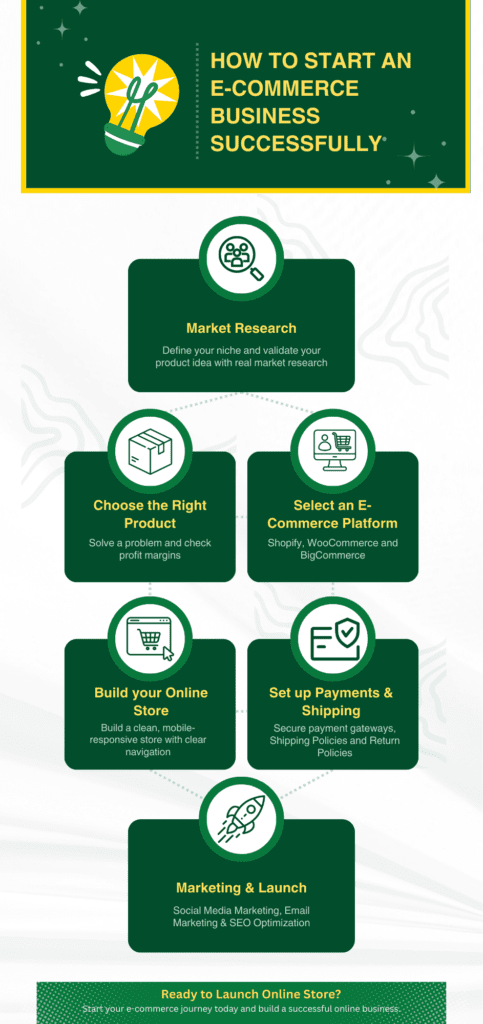
- Define your niche and validate your product idea with real market research before spending a rupee on inventory or development.
- Register your business legally — choose an appropriate structure (sole proprietorship, LLC, etc.) and ensure you understand your tax obligations.
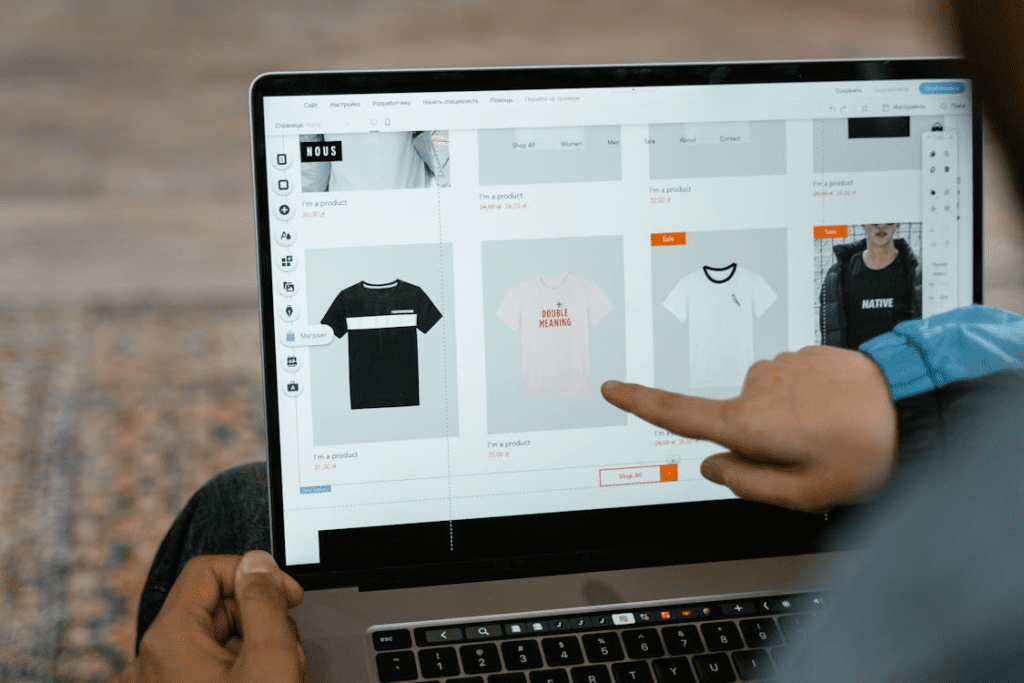
- Choose and set up your e-commerce platform. Build a clean, mobile-responsive store with clear navigation, compelling product pages, and a streamlined checkout.
- Set up reliable payment gateways (Stripe, PayPal, Razorpay, etc.) and configure secure checkout with SSL certificates.
- Establish your fulfillment and shipping strategy — decide between holding inventory, dropshipping, or using a third-party logistics provider.
- Develop a pre-launch marketing plan that builds anticipation through email sign-ups, social media teasers, and partnerships with influencers or bloggers in your niche.
- Launch with a focused effort — don’t try every channel at once. Master one or two marketing strategies before expanding.
- Implement analytics from day one. Track where your traffic comes from, which products get views versus sales, and where customers drop off in the purchase process.
- Build your post-purchase experience: automated thank-you emails, review requests, and loyalty incentives that keep customers coming back.
Real-Life Examples: What Success Actually Looks Like
Glossier started as a beauty blog. Its founder Emily Wei, ss spent years writing about skincare, building a loyal readership before launching a single product. By the time the first items hit the market, there was already a devoted community eager to buy. The lesson here is not just that content marketing works — it is that trust built before launch is worth more than advertising spend after it.
On a smaller scale, consider a hypothetical but entirely plausible scenario: a baker in Pune who begins sharing her grandmother’s mithai recipes on Instagram, slowly building an audience of people hungry for authentic traditional sweets that mass-market brands cannot replicate. She starts taking custom orders through DMs, then launches a simple website, and then begins shipping nationally. By year three, she is a thriving small business with a waitlist for festivals. She never ran a single paid ad. She just built a genuine connection.
What unites these stories is not luck. It is patience, attention to what customers actually want, and a willingness to listen and adapt. The businesses that struggle are often the ones that talk at their audience rather than with them. Make that shift early, and it changes everything.
Common Mistakes in an E-Commerce Business
- Skipping the business plan. Many first-time founders see planning as bureaucratic busywork. It is not. A clear plan forces you to confront hard questions about your cost structure, pricing, and competitive advantages before the market forces them on you.
- Underpricing out of fear. Charging too little not only erodes your margins — it can actually devalue your product in the eyes of buyers. People associate low prices with low quality. Know your costs, understand your market positioning, and price confidently.
- Neglecting mobile optimization. More than half of all online shopping now happens on mobile devices. If your store is clunky or slow on a phone, you are losing customers before they ever see your products. Test your site on multiple devices before launch.
- Ignoring customer service. A single bad experience shared publicly can undo months of reputation-building. Respond to inquiries quickly, handle complaints gracefully, and treat every customer interaction as an opportunity to create a fan.
- Trying to do everything at once. Social media, SEO, paid ads, influencer marketing, email campaigns — the options are overwhelming. Spreading yourself thin across all channels means doing none of them well. Start with one or two strategies, execute them properly, and expand only when you have real traction.
- Neglecting SEO from the start. Search engine optimization is not a quick win — it is a long game. But the founders who ignore it for the first year often look back with regret. Even basic on-page SEO — good product descriptions, clean URL structures, site speed optimization — compounds significantly over time.
Frequently Asked Questions
Q1. How much money do I need to start an e-commerce business?
The honest answer is: it depends enormously on your model. A dropshipping store can technically be launched for a few hundred dollars, covering platform fees, a domain, and initial marketing spend. A store that holds its own physical inventory will require significantly more, depending on your product costs and minimum order quantities. A realistic starting budget for a small but serious online store with inventory typically falls somewhere between $1,000 and $10,000. That said, many successful businesses started with far less — the key is spending wisely on the things that directly drive sales, rather than on perfecting details that customers rarely notice.
Q2. Do I need technical skills to run an online store?
Not at all, and this is one of the most empowering changes in the e-commerce business landscape over the last decade. Modern platforms like Shopify, Wix, and Squarespace have made it possible to build a professional, functional store without writing a single line of code. You will benefit from being curious and willing to learn — understanding basic analytics, email marketing tools, and social media advertising will help enormously — but a computer science degree is absolutely not required. If you hit a technical wall, platforms have excellent support resources, and freelancers can handle complex customization work affordably.
Q3. How long does it take for an e-commerce business to become profitable?
This varies widely, but most honest practitioners will tell you to expect at least six to twelve months before seeing consistent profit, and often longer. The first few months are usually about learning: which products move, which marketing messages resonate, and where your customer acquisition costs are sustainable. Profitability comes when you optimize that learning into a repeatable system. E-Commerce businesses that try to rush this timeline — by spending aggressively on ads before understanding their conversion rates, for example — often burn through their budgets before finding their footing. Patience and rigorous attention to your numbers are your best allies.
Q4. What is the best marketing strategy for a new online store?
There is no single best strategy, but for most new stores, a combination of SEO-driven content, social media presence, and email marketing delivers the strongest long-term results. SEO builds organic traffic that does not require ongoing ad spend. Social media — particularly Instagram, Pinterest, or TikTok, depending on your product category — allows you to show personality and build community. Email marketing converts interested visitors into buyers with remarkable efficiency and often delivers the best return on investment of any digital channel. Paid advertising can accelerate growth once you understand your conversion funnel, but it should typically come after you have established some organic traction.
Q5. How do I handle competition from large retailers and marketplaces?
Stop trying to beat them at their own game — you will not win a price war against Amazon, and you do not need to. The advantage independent online sellers hold is specificity, personality, and trust. A small e-commerce business can serve a niche that major retailers ignore, tell a story that resonates deeply with a particular community, and deliver a customer experience so personal and thoughtful that price becomes secondary. Focus on your story, your craft, and your relationship with customers. In the right niche, that is a moat that a giant simply cannot cross.

Conclusion: Your E-Commerce Business Starts With a Single Decision
Building an E-Commerce Business is not a sprint — it is a marathon that rewards those who are thoughtful, persistent, and genuinely committed to serving their customers. The steps outlined in this guide are not magic formulas. They are distilled common sense from the experiences of thousands of founders who have gone before you, some of whom stumbled through the hard lessons so that you do not have to.
What separates the stores that thrive from the ones that quietly fade is rarely a single brilliant decision. It is a hundred small right decisions made consistently over time — a product description rewritten until it finally converts, a customer complaint handled with enough grace that it turns a critic into a champion, a marketing email that arrives at just the right moment with just the right message. It is attentiveness, really. Paying close attention to what your customers need and being willing to evolve.
If you are standing at the beginning of this journey, know that the most important step is the one you take next. Start small if you need to. Start messy if you must. But start. Your e-commerce business will not build itself, and the market is not waiting. What it is doing, right now, is looking for someone who solves a problem better, cares more deeply, and shows up more consistently than the alternatives. That person can be you.
Go build something worth buying.
!You might be interested in reading this page as well
Best Practices for Leveraging the HPCL Sales Portal for Business Growth