
Introduction to Full-Stack Development Languages
Picture this: you have an idea for an app. Not a vague, someday idea — a real one, with a name, a purpose, and a mental image of what it should look like when someone opens it. The only thing standing between that idea and reality is knowing how to build both the part people see and the part that makes everything work underneath. That gap, for many aspiring developers, feels enormous. And it is — until it isn’t.
Full-stack development languages are the discipline that bridges that gap. It means being fluent in both the frontend, the visual layer users interact with, and the backend, the server-side logic that processes data, manages databases, and keeps everything running. A full-stack developer doesn’t just design a login page; they also build the system that validates credentials, stores user data securely, and returns the right response.
For beginners trying to map out a learning path in 2026, the most pressing question is usually the same: which languages should I actually learn? This guide answers that question clearly, honestly, and with the kind of context that makes the answer stick.
What are Full-Stack Development Languages?
The term gets used so frequently that its meaning can start to feel slippery. At its core, full-stack development refers to the practice of building complete web applications — both the client-facing interface and the server-side infrastructure — using a combination of programming languages, frameworks, and tools.
The “stack” in full stack refers to the collection of technologies layered together to make a web application function. The classic mental model divides this into three tiers: the presentation layer (what users see), the application layer (the business logic), and the data layer (how information is stored and retrieved). A full-stack development languages work across all three.
To make this concrete, imagine you’re building a travel booking platform. The frontend might be built with React and styled with CSS, presenting users with a clean search interface. The backend, written in Node.js or Python, handles search queries, validates inputs, communicates with external APIs for flight data, and processes payments. A PostgreSQL or MongoDB database stores user accounts, booking history, and transaction records. A full-stack developer understands how all of those pieces connect, communicate, and occasionally break.
What’s changed in recent years is the scope of what “full stack” now implies. In 2026, full-stack development languages practitioner are also expected to understand deployment pipelines, containerization basics, cloud hosting, and, increasingly, how to integrate intelligent features into their applications. The role has expanded, but so have the tools available to support it — making the learning journey more accessible than it’s ever been.
Why Full-Stack Development Languages Matter in 2026
There’s a pragmatic case and an emotional one. Let’s start with the pragmatic.
The job market for developers who can work across the entire application stack is robust and growing. Startups, in particular, rely heavily on Full-Stack Development Languages engineers because a single person who can ship end-to-end features is far more valuable to a small team than a specialist who can only touch one layer. Even in larger organizations, full-stack development languages make engineers more versatile collaborators — people who can have informed conversations with designers, backend specialists, and DevOps engineers alike.
Financially, the returns are real. Full-stack development languages consistently command competitive salaries across markets, and the freelance opportunity is significant. If you can take a client’s idea from wireframe to deployed application without needing to hire additional specialists, you’re offering something genuinely rare and valuable.
The emotional case is harder to quantify but just as important. There’s a particular kind of creative satisfaction that comes from building a complete thing. Not a component, not a module, not a feature that depends on someone else’s work to function — a whole, working product. That feeling of ownership and completeness is part of what draws so many developers to pursue full-stack skills rather than specializing early.
In 2026, the path to that competency runs through a specific set of languages and technologies. Here’s what matters most.
The Top 10 Full-Stack Development Languages in 2026
1. JavaScript: The Non-Negotiable Foundation
If there is one language every aspiring full-stack development languages must learn, it’s JavaScript. No serious debate exists on this point. JavaScript runs natively in every browser on earth, making it the only language capable of powering frontend interactivity without plugins or transpilation. Node.js also runs on the server side, enabling teams to use a single language across the entire application stack.
For beginners, the appeal is immediate: you can write a few lines of JavaScript, open a browser, and see results. The feedback loop is fast, the examples are everywhere, and the community is enormous. As you advance, frameworks like React, Vue, and Angular extend JavaScript into sophisticated frontend applications, while Express, Fastify, and NestJS bring structure to the backend.
The JavaScript Ecosystem in Practice
One of JavaScript’s greatest strengths in 2026 is TypeScript, its statically typed superset. TypeScript has moved from an optional enhancement to an industry standard. Writing TypeScript instead of plain JavaScript catches a large category of bugs before they reach production and makes large codebases far more maintainable. If you’re learning JavaScript today, learning TypeScript shortly after is not optional — it’s the natural next step.
2. Python: Readable, Powerful, Everywhere
Python’s rise in relevance as a full-stack development language is one of the more interesting stories in recent development history. Originally beloved by data scientists and academics for its clean syntax and powerful libraries, Python has grown into a legitimate full-stack language through frameworks like Django and FastAPI on the backend, and tools like HTMX and Jinja2 templating on the frontend side.
What makes Python particularly compelling for beginners is its readability. Code written in Python tends to look like a simplified form of English, which lowers the cognitive load of learning fundamentally new concepts. When you’re trying to simultaneously understand HTTP requests, database queries, and authentication flows, a language that doesn’t fight you syntactically is a genuine advantage.
Python’s dominance in data science and machine learning has also made it uniquely valuable in 2026’s landscape. Full-stack developers who can wire up a machine learning model to a web interface — taking user input, passing it to a Python-based model, and returning intelligent results — are doing work that didn’t even exist as a common job description five years ago.
3. HTML and CSS: The Craft Beneath the Surface
Technically not programming languages in the traditional sense, HTML and CSS are nevertheless foundational to every full-stack developer’s skill set. HTML defines the structure and meaning of web content. CSS controls its presentation — layout, typography, color, spacing, and responsiveness. Together, they are the medium through which every web experience is delivered.
Beginners sometimes underestimate this layer, treating HTML and CSS as simple or beneath their attention. That’s a mistake. Semantic HTML affects accessibility and search engine optimization. Modern CSS — with Grid, Flexbox, custom properties, and container queries — is genuinely complex and powerful. Developers who write clean, well-structured markup consistently build better products than those who treat presentation as an afterthought.
4. SQL: The Language of Data
Every meaningful web application stores and retrieves data, and SQL (Structured Query Language) is how that conversation happens. Whether you’re using PostgreSQL, MySQL, or SQLite, the core SQL syntax is consistent, and the conceptual model — tables, relationships, queries, joins — is one of the most durable ideas in all of computing.
Full-Stack Development Languages that don’t understand SQL tend to lean too heavily on ORMs (Object-Relational Mappers), which abstract away database interactions. ORMs are useful, but they generate inefficient queries surprisingly often, and debugging those inefficiencies requires understanding what the SQL underneath actually looks like.
5. TypeScript: The Professional Standard
Already mentioned as JavaScript’s typed superset, TypeScript deserves its own entry because, in 2026, treating it as a separate skill is accurate. Major frameworks — Angular requires it; React, and Vue strongly encourage it — have made TypeScript fluency a practical requirement for professional frontend and full-stack development.
The benefits compound as applications grow. A codebase that would become unmaintainable at scale in plain JavaScript often remains navigable in TypeScript because the type system documents intent, catches mismatches early, and enables powerful editor tooling that speeds development significantly.
6. PHP: The Quiet Giant
PHP may not generate excitement at developer conferences, but it powers a genuinely enormous portion of the web. WordPress, built on PHP, runs more websites than any other platform. Laravel, PHP’s flagship modern framework, is a sophisticated, expressive tool for building web applications that rivals Rails and Django in developer experience.
For Full-Stack Development Languages beginners targeting certain markets — content management, e-commerce, agency work — PHP knowledge opens significant doors that other languages don’t.
7. Ruby: Convention and Joy
Ruby and its web framework Rails were designed with developer happiness as an explicit goal. That philosophy permeates the language: it’s expressive, readable, and full of conventions that eliminate repetitive decisions. For beginners learning how web applications are structured — routing, models, views, controllers — Rails remains one of the clearest teachers available.
Many experienced developers trace their most productive early years to time spent with Rails, which provided intuition about application architecture that transferred cleanly to every other framework they worked with later.
8. Go: When Performance Becomes the Requirement
Go belongs on this list because in 2026, full-stack development increasingly means building not just web applications but the microservices and APIs they depend on. Go is the language of choice for high-performance backend services — fast to compile, efficient at runtime, and remarkably straightforward to learn for its performance tier.
Beginners won’t start with Go, but intermediate full-stack developers who want to expand their backend capabilities will find it a natural and rewarding progression, especially for building REST APIs and command-line tools.
9. Rust: The Future-Proof Investment
Rust is the most demanding language on this list, but its presence here is deliberate. WebAssembly — which allows code written in languages like Rust to run in the browser at near-native speed — is maturing into a legitimate frontend technology. For certain performance-intensive applications, Rust-powered WebAssembly modules are becoming the right tool.
Most beginners won’t touch Rust for years, and that’s fine. But knowing it exists, understanding what problem it solves, and having a long-term plan to explore it puts you ahead of developers who treat their skill set as static.
10. Kotlin/Java: The Android and Enterprise Angle
For full-stack development languages whose applications include mobile components, Kotlin is the modern language of Android development. Java, Kotlin’s predecessor on the JVM, remains the foundation of enterprise backend systems worldwide. Learning either language — ideally, more expressive Kotlin — gives full-stack developers access to mobile development and a massive category of enterprise software work.
Practical Tips for Beginners Starting Their Full-Stack Development Languages Journey

- Master one language deeply before sampling many. Breadth comes with time; early depth builds the mental models that make everything else easier to learn.
- Build real projects, not just tutorials. Tutorials teach syntax. Projects teach problem-solving, debugging, and decision-making under uncertainty.
- Learn the web fundamentals before the frameworks. Understanding how HTTP works, what a request-response cycle looks like, and how browsers parse HTML will make every framework you encounter more intuitive.
- Version control is not optional. Learn Git early and use it for every project, including personal ones. The habit pays dividends immediately.
- Read other people’s code. Open-source projects on GitHub are free education from experienced engineers. Study how they structure projects, name variables, and handle errors.
- Deploy something, even if it’s small. The experience of taking an application from your laptop to a live URL teaches things no tutorial covers.
- Embrace confusion as information. When something doesn’t work, and you don’t understand why, that’s the moment when real learning happens. Sit with it longer than feels comfortable with full-stack development languages.
Real-Life Examples That Show the Full-Stack Development Languages Path in Action
Sarah started learning web development while working a full-time marketing job. She spent evenings with JavaScript tutorials, then built a simple budget tracking tool for herself. When she realized she needed data to persist between sessions, she learned Node.js and connected a basic database. Eight months later, she had a portfolio of three complete projects and a junior developer role. The Full-Stack Development Languages path wasn’t a straight line, but each frustration pointed directly to the next thing she needed to learn.
Marcus came from a computer science background and felt comfortable with Java, but had never built anything users could actually open in a browser. He spent a focused three months on React and CSS, then built a project management tool by connecting his new frontend skills to a Spring Boot backend he was already comfortable with. The hybrid approach — leveraging existing strength while aggressively filling gaps — accelerated his timeline significantly.
These aren’t exceptional cases. They’re patterns that repeat across thousands of developers who took the full-stack development languages path seriously.
Common Mistakes Beginners Make When Learning Full-Stack Development Languages
- Tutorial paralysis. Watching course after course without building anything is the most common way beginners stall. At some point, the discomfort of building something broken and incomplete is exactly the experience you need.
- Skipping the fundamentals. Jumping straight to React without understanding JavaScript, or learning Django without touching SQL, creates brittle knowledge. The frameworks make sense when the foundations are solid. Before that, they’re just magic you can’t debug.
- Trying to learn everything at once. Full-stack development languages are genuinely broad. The developers who learn it successfully pick a path — often JavaScript frontend plus Node.js or Python backend — and go deep on that combination before expanding.
- Neglecting soft skills. Writing clear commit messages, documenting your code, and communicating about technical decisions are skills that separate junior developers from mid-level ones. They’re learnable, and they matter more than most beginners expect.
- Comparing progress to others. The learning timeline varies enormously based on prior experience, available time, and learning style. Comparisons rarely help and frequently discourage.
Frequently Asked Questions About Full-Stack Development Languages
Q1. Which language should a complete beginner start with for full-stack development languages?
JavaScript is the strongest starting point. It works in the browser immediately, has a massive community, and with Node.js, covers both frontend and backend. The feedback loop is fast, resources are abundant, and the skills transfer directly to real professional work.
Q2. How long does it take to become a full-stack development languages?
This varies significantly, but most people who dedicate consistent hours — roughly ten to fifteen hours per week — and build real projects can reach a junior-level employable skill set within twelve to eighteen months. Faster timelines are possible with more intensive focus; longer timelines are normal for people balancing other major commitments.
Q3. Do I need to learn all ten languages on this list?
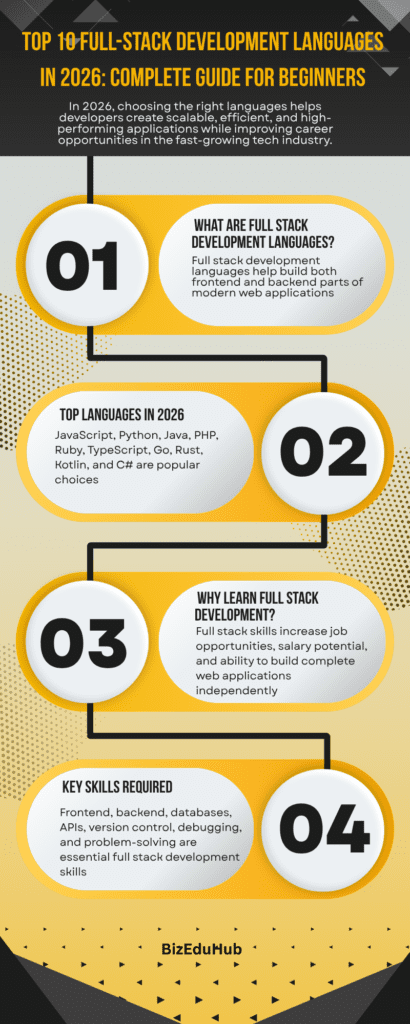
No, and trying to do so would be counterproductive. Focus on JavaScript (and TypeScript), HTML and CSS, SQL, and one backend framework in depth. Python or Node.js are both excellent choices. The other languages on this list represent growth opportunities for later stages of your career.
Q4. Are full-stack development languages harder than specializing in just frontend or backend?
In some respects, yes — the breadth of knowledge required is genuinely larger. But the skills are complementary in ways that make the learning process reinforcing rather than simply additive. Understanding the backend makes you a better frontend developer, and vice versa.
Q5. Are full-stack development languages still in demand in 2026?
Developers still in demand in 2026? Very much so. The ability to build and ship complete features independently remains highly valued, particularly in startups and product companies. Full-stack developers who also understand deployment, cloud services, and integration patterns are among the most employable people in the technology industry.
Conclusion
The journey into full-stack development languages is rarely linear and never entirely comfortable, and that’s actually what makes it worth doing. Every time you connect a frontend component to a backend service, every time a database query returns exactly what you needed, every time a feature you designed and built yourself entirely works for a real user — those moments accumulate into genuine competency and genuine confidence.
In 2026, the languages and tools available to Full-Stack Development Languages are more capable and more accessible than ever. JavaScript and TypeScript anchor the frontend and increasingly the backend. Python and Go power serious server-side work. SQL remains the enduring language of data. HTML and CSS are the craft that determines whether an application feels finished or amateur.
What this guide has tried to offer isn’t just a ranked list — it’s a perspective. An understanding of why these languages matter, what problems they were designed to solve, and how they fit together into a coherent skill set worth building. That perspective is what separates developers who follow tutorials from developers who build things that last.
Start with one language. Build something real. Break it. Fix it. Then build something bigger. The Full-Stack Development Languages path begins exactly where you are.
!You might be interested in reading this page as well
Top Freelancing Tips for Achieving Career Success in 2026