

Introduction to Backend Development Languages
There’s a moment every developer remembers — the first time they realized that what happens behind a website matters just as much as what you see on the screen. Maybe it was when a form they built finally talked to a database, or when an API returned real data for the first time. That moment of connection, invisible to the end user but electric to the person who built it, is what backend development languages are all about.
Choosing the right backend development languages is one of the most consequential decisions a developer or a tech team can make. It shapes how fast your application performs, how easily your codebase scales, how quickly new engineers can onboard, and ultimately, how much value your product delivers to real people. And in 2026, with AI-integrated services, microservices architectures, and global-scale applications becoming the norm rather than the exception, that decision has never carried more weight.
This guide isn’t a dry list of syntax comparisons. It’s a real, experience-informed exploration of the languages powering the modern web — written for developers who want to build things that last.
What Are Backend Development Languages?
If a website were an iceberg, the frontend would be the polished tip above the water — the colors, buttons, and animations. Backend development languages are everything beneath the surface: the logic, the data handling, the authentication systems, the business rules, and the server responses that make the frontend actually work.
In practical terms, a backend development language is used to write server-side code — the code that runs on a remote machine rather than the user’s browser. When someone places an order on an e-commerce site, logs into a banking app, or sends a message on a social platform, a backend system written in one of these languages is processing that action, querying a database, validating the request, and sending a response back.
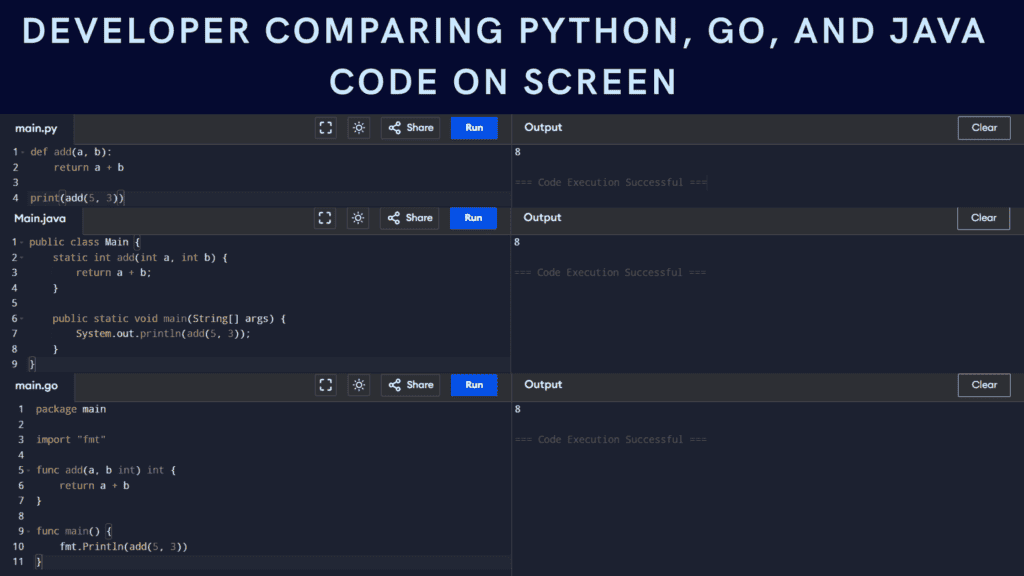
The difference between languages often comes down to their design philosophy. Python, for example, was designed to be readable and expressive, which makes it ideal for rapid prototyping and data-heavy applications. Go, on the other hand, was engineered at Google specifically to handle concurrent, high-throughput systems with minimal resource usage. Java was built for platform independence and enterprise reliability. Each language carries a distinct worldview, and understanding those worldviews is how you make a genuinely informed choice.
Backend development languages and server-side languages also differ in terms of runtime environment, package ecosystems, community support, and how well they integrate with cloud infrastructure, databases, and third-party APIs. These aren’t abstract distinctions — they translate directly into developer hours, infrastructure costs, and user experience.
Related Reading: Best Python Backend Developer Roadmap for Beginners (2026)
Why Backend Development Languages Matter More Than Ever in 2026
A few years ago, you could reasonably argue that most backend frameworks were “good enough” for most projects. That argument is harder to make today. Applications are more complex, user expectations are higher, and the infrastructure powering modern software — serverless functions, distributed systems, containerized microservices — demands languages that are precise, efficient, and well-supported.
The rise of AI integration has also shifted the landscape. More backend development languages now interface with machine learning models, process large datasets in real time, and serve intelligent features to end users. That shift has changed which languages teams treat as strategic investments. Python, once seen primarily as a scripting language, is now central to enterprise backend development because of its dominance in the AI/ML ecosystem.
Performance has also come back into focus. For years, developer productivity was prioritized over raw execution speed — and for good reason. But as applications scale to millions of concurrent users, the cost of inefficient backend code becomes very real, measured in server bills and latency metrics. Languages like Go and Rust have gained serious momentum precisely because they offer near-native performance without sacrificing developer ergonomics too severely.
Security, too, is no longer an afterthought. Server-side vulnerabilities — injection attacks, authentication flaws, data exposure — are among the most damaging in software. Some backend development languages, by virtue of their type systems and memory management, make entire categories of bugs structurally impossible. That’s not a minor detail. That’s a fundamental advantage.
The Top Backend Development Languages to Know in 2026
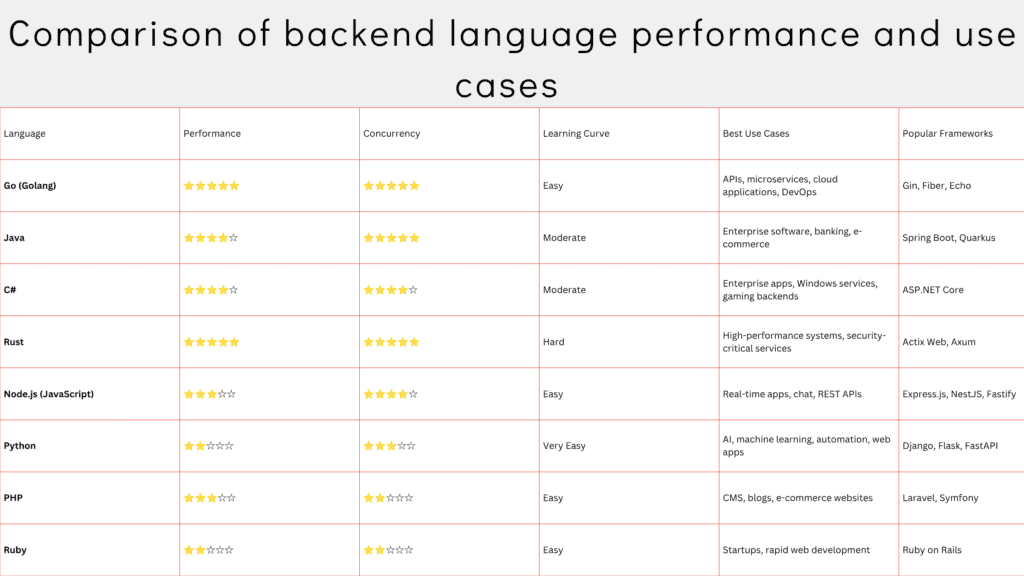
1. Python: The Pragmatist’s Powerhouse
Python has been around since 1991, but it has never felt more relevant than it does right now. Its syntax reads almost like English, its community is vast, and its ecosystem — particularly the libraries available for data science, machine learning, and web development — is unmatched.
For backend development languages specifically, frameworks like Django and FastAPI have made Python a serious choice for production systems. Django follows a “batteries included” philosophy, meaning most of what you need to build a robust web application — ORM, authentication, admin panel, form handling — is built right in. FastAPI, newer and sleeker, leverages Python’s type hints to deliver impressive performance and automatic API documentation.
Where Python Shines
Python is the natural choice when your backend needs to talk to data pipelines, machine learning models, or scientific computing libraries. If your application ingests large amounts of data, processes it intelligently, and serves insights to users, Python’s ecosystem has no real rival. Companies like Instagram (at scale, using Django), Spotify, and Dropbox have built significant backend infrastructure in Python.
The trade-off is performance under raw concurrency. Python’s GIL (Global Interpreter Lock) can limit multi-threaded performance in CPU-intensive scenarios. Asynchronous frameworks like FastAPI and tools like Celery for task queues help mitigate this, but it’s a consideration worth understanding before committing.
2. JavaScript (Node.js): The Full-Stack Bridge
Node.js brought JavaScript to the server side, and in doing so, it changed the calculus for a generation of developers. The appeal is straightforward: if your team already writes frontend JavaScript, using Node.js on the backend means one language across the entire stack. That’s fewer context switches, a shared codebase for utilities and types, and a faster path from idea to deployment.
Node.js is event-driven and non-blocking by design, which makes it genuinely excellent for I/O-intensive tasks — think real-time applications, chat systems, streaming services, and APIs that handle large numbers of simultaneous connections without heavy computational load. The npm ecosystem is enormous, with packages for virtually every use case imaginable.
The Runtime Ecosystem in 2026
One notable development in 2026 is the continued growth of Deno and Bun as Node.js alternatives. Bun, in particular, has gained real traction for its remarkable speed — it’s a JavaScript runtime, bundler, and package manager rolled into one, and in benchmarks, it consistently outperforms Node.js in many scenarios. Whether you choose Node, Deno, or Bun depends on your team’s familiarity and project requirements, but knowing all three options exist is important.
3. Go (Golang): Built for Scale
Go was created at Google and released publicly in 2009. It was designed to solve a specific set of problems that large engineering teams face: slow compile times, difficult concurrency management, and bloated binaries. Go addresses all three elegantly.
What makes Go remarkable for backend development languages is its concurrency model. Goroutines — Go’s lightweight threads — can run in the thousands without the overhead that would cripple other languages. Paired with channels for communication, they make writing concurrent systems far less error-prone than managing threads manually in Java or C++.
Go compiles to a single binary with no runtime dependencies, which makes deployment straightforward and container images small. For teams building microservices or high-throughput APIs, this is a significant practical advantage.
Where Companies Bet on Go
Uber migrated significant portions of its backend to Go for performance reasons. Cloudflare uses Go extensively. Docker and Kubernetes — two tools that define modern infrastructure — are written in Go. That’s not a coincidence. It’s a signal about where the language excels.
4. Java: The Enterprise Veteran
Java has been the backbone of enterprise software for nearly three decades, and despite countless predictions of its decline, it remains one of the most widely deployed backend development languages in the world. There’s a reason for this staying power: Java is extraordinarily stable, well-tooled, and supported by one of the richest ecosystems in software development.
The Spring Boot framework has modernized Java development significantly, making it possible to build production-ready REST APIs with remarkably little boilerplate compared to traditional Java enterprise development. The JVM ecosystem — which includes Kotlin and Scala as alternative languages — also means that investments in Java infrastructure aren’t wasted when teams want to experiment with more expressive languages.
For financial services, healthcare systems, and large-scale enterprise applications where reliability and auditability are non-negotiable, Java remains the default choice. It’s not glamorous, but it delivers.
5. Rust: The Performance Frontier
Rust is the most technically demanding language on this list, but also one of the most rewarding. Its central innovation is a memory ownership system that eliminates entire classes of bugs — null pointer dereferences, buffer overflows, data races — at compile time. No garbage collector. No runtime overhead. Just fast, safe, predictable code.
In 2026, Rust is making serious inroads into backend development languages, particularly for systems where performance and reliability are both critical — network services, WebAssembly backends, database internals, and embedded systems. The learning curve is real and steep, but developers who climb it consistently describe the experience as transformative.
6. Ruby and PHP: Still Relevant, Still Reliable
Ruby on Rails deserves mention for its extraordinary influence on web development philosophy. Convention over configuration, developer happiness, and rapid iteration were ideas that Rails popularized before most frameworks took them seriously. For startups that need to ship quickly, Rails remains a compelling choice, and its ecosystem has modernized substantially.
PHP, despite its complicated reputation, powers a significant portion of the web — WordPress alone accounts for a remarkable share of all websites. Modern PHP, from version 8 onwards, is a genuinely capable language with solid type support and performance improvements. Dismissing it wholesale means ignoring an enormous amount of real-world infrastructure.
Related Reading: Front-End Development Best Practices in 2026: Build Fast and User-Friendly Websites
Practical Tips for Choosing the Right Backend Development Languages
- Start with the problem, not the language. Understand whether your bottleneck is I/O, computation, concurrency, or developer speed — then let that guide your choice.
- Consider your team’s existing expertise. A language your team already knows will always deliver faster results than a theoretically superior one that requires months of upskilling.
- Evaluate the ecosystem, not just the syntax. Libraries, frameworks, database drivers, and monitoring tools matter enormously in production.
- Think about hiring. If your backend is built in a language with a small talent pool, scaling your team becomes expensive and difficult.
- Prototype in more than one language before committing to a long-term project. Real experience with a language in your specific context reveals things that benchmarks and blog posts never will.
- Pay attention to long-term support. Languages backed by major corporations or strong open-source foundations are safer long-term bets.
Real-Life Examples of Backend Development Languages
Airbnb built much of its initial infrastructure in Ruby on Rails, which allowed the team to iterate rapidly in the early days and validate their business model before scale demanded optimization.
Discord famously migrated parts of its backend from Go to Rust when it needed even finer control over latency and memory usage at massive scale — a decision that yielded measurable improvements and was well documented publicly.
Netflix runs a polyglot backend, using Java heavily for its core services while leveraging Python and Node.js for tooling and auxiliary services. Their approach reflects a mature understanding that no single language is optimal for every problem.
These examples share a common thread: the choice of backend development languages followed the engineering reality, not the other way around.
Related Reading: Top 10 Online Front-End Development Courses 2026: Best Complete Guide
Common Mistakes to Avoid When Selecting Backend Development Languages
- Choosing based on hype. Every year, a new language or framework gets enormous attention. Hype is not a reliable predictor of long-term stability or community support. Evaluate maturity, ecosystem depth, and production track record.
- Ignoring operational complexity. Some languages are wonderful to write but difficult to deploy, monitor, or debug in production. Always consider the full lifecycle of the software you’re building.
- Underestimating the migration cost. Switching backend development languages mid-project is expensive and disruptive. Make the decision carefully upfront, because reversing it is rarely easy.
- Conflating personal preference with team reality. Just because you love a language doesn’t mean it’s the right fit for your organization. Team dynamics, existing skill sets, and organizational context matter.
- Neglecting security posture. Some languages and frameworks have better security defaults than others. Don’t treat security as a layer you add later — choose tools that make the right choice the easy choice.
Frequently Asked Questions About Backend Development Languages
Q1. What are the best backend development languages for beginners in 2026?
Python is widely considered the most beginner-friendly backend language. Its clean syntax, extensive documentation, and enormous community make the learning curve gentler than most alternatives. Django and FastAPI provide clear pathways into real-world backend development without overwhelming new learners.
Q2. Is Node.js still a good choice for backend development languages in 2026?
Absolutely. Node.js remains highly relevant, particularly for teams that want JavaScript across the full stack, for real-time applications, and for projects where time-to-market is a priority. The emergence of Bun as a high-performance alternative is worth watching, but Node.js’s ecosystem and community remain strong.
Q3. How do I choose between Python and Go for a new backend project?
If your project involves machine learning integration, data processing, or you need to ship quickly with a small team, Python is likely the better fit. If you’re building a high-concurrency system, a microservice-heavy architecture, or a performance-critical API, Go’s advantages become compelling. Many teams use both for different services within the same system.
Q4. Is Rust practical for backend web development in 2026?
Rust is increasingly practical for backend development languages, particularly with frameworks like Axum and Actix-web maturing significantly. However, the steep learning curve means it’s best suited for teams with strong systems programming backgrounds or projects where raw performance and safety are primary requirements, rather than general-purpose web applications.
Q5. Will AI replace the need to learn backend development languages?
Not meaningfully, no. AI coding assistants can accelerate development and help with boilerplate, but building reliable, secure, scalable backend systems still requires a deep understanding of how languages work, how systems behave under load, and how to reason about failure modes. If anything, developers who understand backend fundamentals will make better use of AI tools than those who don’t.
Conclusion
Choosing among backend development languages is not a decision you make once and forget. It’s something you revisit as your team grows, your requirements evolve, and the ecosystem shifts around you. What makes this field fascinating — and sometimes exhausting — is that there’s no universally correct answer. There’s only the most appropriate answer for your specific context, moment, and goals.
What this guide has tried to do is give you something beyond a feature comparison table. Understanding why Python’s ecosystem makes it the default for data-heavy systems, why Go was engineered specifically for concurrency, and why Java persists in enterprise environments despite younger alternatives — that kind of understanding equips you to make better decisions, ask better questions, and build more thoughtfully.
The backend development languages are where the real logic of your application lives. Invest the time to choose your tools wisely, build with intention, and don’t be afraid to revisit those choices as the landscape evolves. The developers who thrive aren’t the ones who picked the “right” language – they’re the ones who deeply understood why they picked it.