

Introduction to Career Guidance
There is a particular kind of anxiety that belongs only to students — that restless, 3 a.m. feeling when the world seems to be asking, loudly and impatiently, “So, what are you going to do with your life?” If you have ever sat with that question and found no easy answer, you are in far better company than you think. Choosing a direction is hard. It always has been. But what makes 2026 both exciting and overwhelming is the sheer number of paths now available — paths that did not exist a decade ago, paths that are still being carved out in real time. That is exactly why meaningful career guidance matters more now than at any previous point in modern education.
This article is not a list of “hot jobs” or a cheerful reminder to “follow your passion.” It is something more honest than that. It is a conversation about how to think through your future with clarity, how to make decisions that hold up over time, and how to navigate the noise of a world that is constantly telling you what you should want. Whether you are a high school student picking subjects, an undergraduate unsure of your major, or a final-year student staring down the job market — there is something here for you.
What is Career Guidance?
At its simplest, career guidance is the process of helping individuals understand themselves and the world of work well enough to make informed choices about their professional lives. But that definition, while technically accurate, undersells what good guidance actually looks like in practice. It is less like a GPS giving you a precise route and more like a wise friend helping you figure out what you actually want before you start moving.
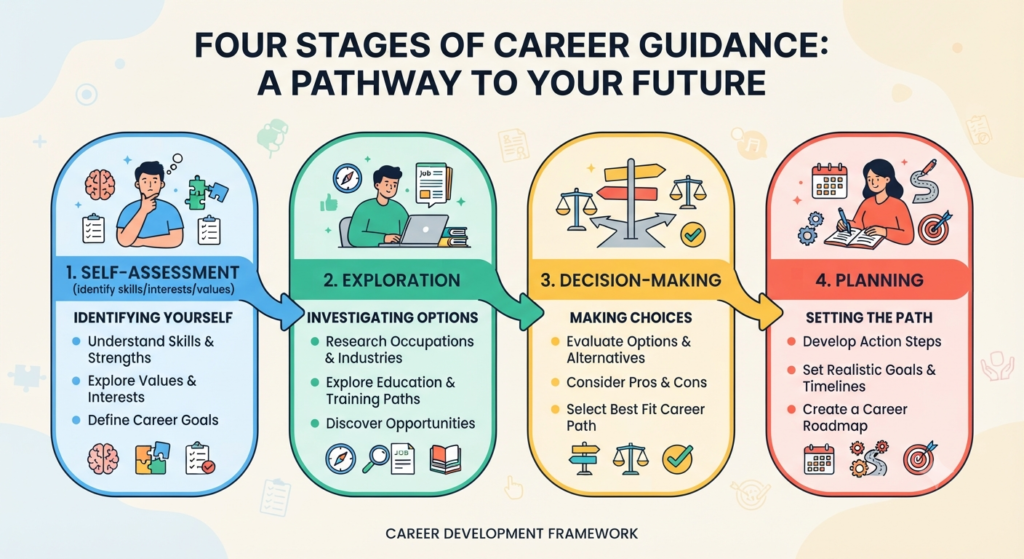
Career guidance encompasses self-assessment — understanding your strengths, values, and interests. It includes exploration, meaning researching industries, roles, and work cultures. It involves decision-making, learning how to weigh options and commit to a direction even without complete information. And it extends into planning, which is mapping out the concrete steps needed to reach your goal. Each of these elements feeds the others. Skipping any of them tends to leave you with that uncomfortable feeling of being busy without going anywhere.
Related Reading: How to Choose the Right Career Path in 2026: Evaluating Interests, Skills, and Market Trends
Why Career Guidance is Important in 2026?
The labor market of 2026 is a genuinely different animal from what it was even five years ago. Automation has quietly absorbed entire categories of routine work. The boundaries between industries have blurred — a healthcare company might employ as many software engineers as a tech firm; a fashion brand might employ as many data analysts as a consulting agency. Remote and hybrid work have restructured what “a career” looks like geographically. And yet, despite all this change, most students are still receiving career advice designed for a world that no longer quite exists.
That gap is precisely why intentional professional career guidance has become so important. Without it, students tend to fall back on the paths of least resistance – doing what their parents suggest, chasing whatever field their friends are entering, or defaulting to whatever their university’s placement cell pushes hardest. None of these is inherently wrong, but none of them starts with the student’s own authentic reflection. Decisions made without that inner anchor tend to wobble badly when the work gets difficult or the market shifts.
There is also the mental health dimension, which deserves to be stated plainly. Students who feel directionless or who have chosen fields they do not connect with are significantly more likely to experience anxiety, burnout, and early-career disillusionment. Career guidance is not just a professional investment – it is a well-being investment. Knowing why you are doing what you are doing is one of the most stabilizing things a person can have.
Key Aspects of Effective Career Guidance
1. Know Yourself Before You Know the Market
Values Clarification
Every sustainable career rests on a foundation of personal values. These are not abstract ideals — they are the things that make work feel worthwhile or unbearable, depending on whether they are honored. Some people need autonomy above almost everything else; they wilt in rigid hierarchical structures, no matter how well-paid they are. Others need community and collaboration; working solo, however creatively fulfilling, leaves them depleted. Some are motivated primarily by impact — the tangible difference their work makes in other people’s lives.
Identifying your core values requires more than answering a questionnaire, though questionnaires can be a useful starting point. It requires paying attention to when you feel most alive versus most drained, and asking yourself honestly why. It means noticing which aspects of past jobs, internships, or school projects you genuinely enjoyed and which you merely endured.
Strengths vs. Interests: An Important Distinction
One of the most useful distinctions in all of career development is the difference between what you are good at and what you find genuinely interesting. These overlap more often than not, but they are not the same thing, and conflating them causes real confusion. You might be excellent at spreadsheet analysis, but find it deeply tedious. You might be passionate about film but have not yet developed the technical skills needed to work in that industry. Good career guidance helps you hold both dimensions simultaneously — building on strengths while finding ways to incorporate and develop genuine interests.
2. Understanding the Modern Landscape of Work
Industries in Transition
Certain sectors are expanding rapidly in 2026: renewable energy, biotechnology, digital health, cybersecurity, logistics technology, and creative industries augmented by new tools. Others are contracting or restructuring: traditional print media, parts of retail banking, and entry-level roles in data entry and basic customer service. Understanding these shifts is not about chasing trends — it is about making informed decisions with realistic expectations about where opportunities are likely to exist in five or ten years.
The Rise of Portfolio Careers
Perhaps the most significant structural shift of the past decade is the normalization of what might be called the portfolio career. This professional life does not follow a single linear track but instead combines multiple streams of work, skill-building, and income. A graduate might work part-time in a marketing agency while freelancing as a content strategist and developing an independent podcast. This is not a failure to commit; it is increasingly a deliberate and sophisticated way to navigate a complex market. Career guidance today must account for this reality rather than insist on old models of climbing a single ladder.

3. The Role of Mentors and Networks
Every person who has built a meaningful career will, if they are honest, point to someone who believed in them, connected them to an opportunity, or simply showed them that a particular path was possible. Mentorship matters. And yet most students wait passively for a mentor to find them rather than actively building these relationships. A mentor does not need to be a famous executive or a distant celebrity — often the most useful mentors are professionals who are only five or ten years ahead of you, who remember clearly what it felt like to be where you are, and who have navigated the specific terrain you are about to enter.
Related Reading: Top Competitive Exams After 12th in 2026: Complete Career Guide
Practical Tips for Students Navigating Their Career Path
- Start with a structured self-assessment. Tools like the Holland Code (RIASEC) or a consistent journaling practice can surface patterns in your interests that are easy to miss day to day.
- Conduct informational interviews. Reach out to professionals in fields you’re curious about — ask what their days actually feel like, not just what they do. The gap between a job title and the lived experience of it is often large.
- Prioritize internships over theoretical research. Reading about a field gives you information; working in it gives you knowledge.
- Build T-shaped skills — broad exposure across areas like technology, communication, and project management, with real depth in one or two aligned with your direction.
- Treat your LinkedIn profile as a living document, not a copy of your CV.
- Create a five-year sketch, not a five-year plan. Plans break; sketches allow revision. Know roughly where you want to be and why, and hold the specifics loosely.
- Seek feedback regularly. Students who grow fastest professionally aren’t necessarily the most talented — they’re the ones most willing to act on feedback without defensiveness.
How Career Guidance Frameworks Actually Play Out
Rather than invented case studies, here are two established approaches worth knowing, since both are used in real career counseling practice:
The Holland Code (RIASEC) model categorizes interests into six types — Realistic, Investigative, Artistic, Social, Enterprising, Conventional — and matches them to compatible work environments. It’s widely used by university career centers because it’s simple enough to self-administer and specific enough to narrow a broad search into a shortlist of roles worth exploring further.
Design Your Life methodology (developed at Stanford’s design program) applies product-design thinking to career decisions — prototyping small, low-risk versions of a potential path (a short project, a volunteer role, an informational interview) before committing years to it. The core idea: you can’t think your way to clarity, but you can build your way there through small, reversible experiments.
Both approaches share the same underlying principle: guidance works best when it produces small, testable actions, not just self-reflection in the abstract.
Related Reading: Top Entrance Exams After 12th Science: A Step-by-Step Preparation Guide (2026)
Common Mistakes Students Make When Seeking Career Guidance
- Waiting for certainty before making a move. Certainty is a luxury that career decisions rarely offer. Students who wait until they are completely sure about a direction often find themselves waiting for years. The more useful approach is to make the best-informed decision you can with available information, then update your direction as you learn more. Action generates information that passivity never will.
- Letting salary be the only filter. Compensation matters — it pays rent, reduces stress, and signals market value. But students who filter entirely by salary and ignore alignment, growth potential, and work culture often find themselves well paid yet profoundly unhappy within two or three years. The decision is rarely “money or meaning” — it is about finding work where both can coexist, which requires knowing what “meaning” actually looks like for you specifically.
- Comparing your path to others on social media. The curated highlight reels of peers who seem to have landed perfect jobs immediately after graduation are rarely the full picture. Behind almost every impressive LinkedIn announcement is a story of rejection, uncertainty, and luck that never made it into the post. Comparison on these terms is not just emotionally corrosive — it is informationally misleading.
- Treating career guidance as a one-time event is perhaps the most fundamental mistake. Guidance is not a checkbox to tick in your second year of university. The world changes, you change, and your understanding of what you want changes. Building a habit of periodic reflection-revisiting your values and direction every six to twelve months-is one of the most professionally mature habits a young person can develop.
- Underestimating soft skills. Communication, empathy, conflict resolution, and the ability to work effectively in teams are not soft skills in the dismissive sense of that phrase — they are the skills that determine whether technically competent people get to do meaningful work or get stuck in roles that never quite fit.
Frequently Asked Questions About Career Guidance
Q1. When should a student start seeking career guidance?
Ideally, the process begins in secondary school — not to lock in a destination, but to develop self-awareness and explore possibilities. The earlier a student begins reflecting on their interests, values, and strengths, the more informed their later decisions will be. That said, it is genuinely never too late. Students who arrive at career guidance in their final year, or even after graduation, can still benefit enormously from a structured approach to self-assessment and planning.
Q2. What if I genuinely have no idea what career I want?
This is far more common than the confidence with which some peers seem to navigate their futures might suggest. The absence of a clear direction is not a character flaw — it is simply a starting point. The most productive response is to experiment deliberately: take on internships, volunteer roles, or project-based work in several different areas over a short period.
Q3. How important is it to pursue a career directly related to my degree?
Less important than most students fear. Research consistently shows that a significant proportion of professionals work in fields that have no direct relationship to their undergraduate major. What a degree typically develops — the ability to think rigorously, communicate clearly, manage time under pressure, and learn independently — transfers across industries in ways that are underappreciated. Specialized knowledge matters in some fields (medicine, law, engineering) and is far less decisive in others.
Q4. How can I find a career counselor or guidance professional?
Most universities and colleges offer career counseling services, often at no cost to enrolled students — a resource that is dramatically underused. Beyond campus, professional associations in various fields often provide mentoring programs. Online platforms have also made it possible to connect with career coaches across geographic boundaries.
Q5. Is career guidance relevant for students entering creative fields like art, writing, or music?
Absolutely — and perhaps especially so. Creative fields often involve more complex and varied career structures than traditional industries, including freelancing, portfolio development, grant applications, self-promotion, and navigating irregular income. Students entering creative professions benefit enormously from guidance that addresses both the artistic and professional dimensions of their work — including how to price their services, build a sustainable client base, and protect their creative work legally.

Conclusion
Here’s a thought to ponder: many individuals who create a career they truly value didn’t arrive at that point by knowing all the answers from the start. They arrived at their destination by maintaining curiosity, by being open about what succeeded and what did not, by taking calculated risks rather than hasty ones, and by forming connections with individuals who trusted them enough to share their honest opinions. Those who appeared the most adrift at twenty-two were, in hindsight, not at any distinct disadvantage—they were merely undergoing a process that appeared chaotic from within but was truly a form of exploration.
Effective career guidance does not hand you a finished map. It teaches you to read the terrain as you move through it — to notice what draws you forward, to recognize what is not a good fit before you invest years in it, and to ask for help without feeling ashamed that you do not have it all figured out. In 2026, with the labor market shifting as fast as it is, that kind of adaptive intelligence is worth more than any single set of credentials.
You are not behind. You are not broken. And the uncertainty you feel about your future is not a sign that you have failed to pay attention — it is often a sign that you are taking the question seriously enough to want a real answer. That instinct is worth honoring. Follow it, with patience, with honesty, and with the help of people who know you well enough to challenge you when you settle for less than what you are capable of.