
Introduction to UX Research Courses
You stop consuming content passively and start looking for structured education that actually sticks. If you’re at that point with user experience research — tired of piecing together YouTube tutorials and hoping they add up to something coherent — then finding the right UX research courses might be the decision that changes your career trajectory.
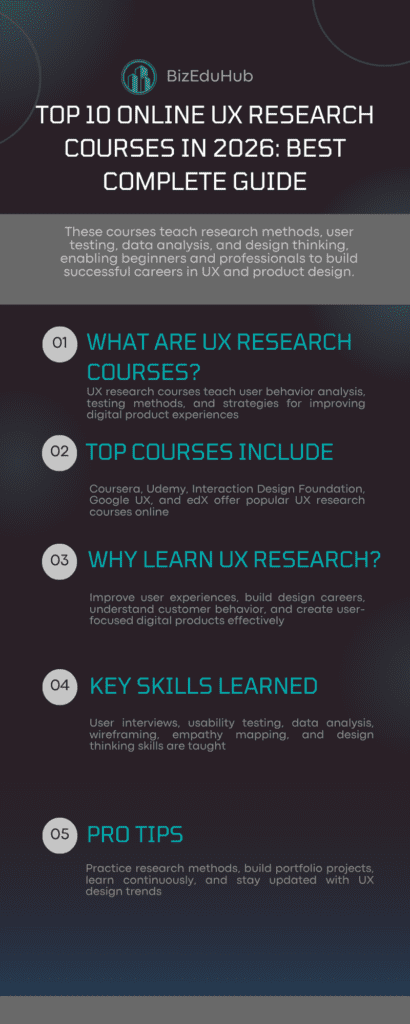
The demand for skilled UX researchers has grown steadily over the past decade, and 2026 is no exception. Companies of every size have learned, sometimes painfully, that building products without understanding users is expensive. The people who can bridge that gap — who know how to design a study, conduct an interview, synthesize messy qualitative data, and communicate findings that actually influence decisions — are in genuine demand.
This guide covers the ten best online UX research courses available in 2026, what makes each worth your time, and how to choose the right one for where you are right now.

What are UX Research Courses?
UX research courses are structured learning programs that teach the principles, methods, and practical skills involved in understanding how people experience digital products. Unlike general design courses that focus on visual output, UX research training is centered on the process of inquiry — how to ask the right questions, find the right participants, gather meaningful data, and translate it into recommendations that drive better product decisions.
These courses range widely in depth and format. Some are short, standalone modules covering a single method, such as usability testing or survey design. Others are multi-month programs that simulate the full research lifecycle — from a brief through to stakeholder presentation. The best ones combine theory with hands-on practice, often including real or simulated projects that you can add to a portfolio.
What they all share is a focus on developing a particular kind of thinking: rigorous, curious, empathetic, and skeptical all at once. A good UX research program doesn’t just hand you templates; it trains you to think like a researcher — to question assumptions, design studies that minimize bias, and resist the pull toward the answers your stakeholders want rather than the answers your participants actually give.
For example, a UX research courses on qualitative methods might walk you through the mechanics of an interview guide, then have you conduct a mock session, then review it with feedback focused on where you led the participant or missed a pivotal thread. That layered approach — concept, practice, reflection — is what distinguishes a meaningful course from a long read.
Why UX Research Courses Are Worth Your Investment
There’s a version of this question that sounds cynical: can’t you just read a few books and figure it out? The honest answer is yes, partially. But the gap between reading about research and actually doing it well is wider than most people expect, and a structured course closes that gap faster and more reliably than self-directed reading alone.
The practical stakes are real. UX research courses are a field where the quality of your methodology directly affects the quality of your findings. Bad interview technique produces data that confirms existing biases rather than challenging them. Poor study design produces findings that don’t hold up under scrutiny. A course taught by experienced practitioners gives you the corrective feedback loop — the equivalent of a senior researcher watching your sessions and pointing out the habits you don’t know you have.
Beyond skill development, completing recognized courses builds credibility. When you’re transitioning into UX research courses from another field — psychology, journalism, design, teaching — formal training signals to hiring teams that you’ve taken the work seriously. It also provides community: cohort-based courses in particular connect you with peers who become collaborators, references, and honest sounding boards over the years.
The return on investment compounds. A single course might unlock a career transition. A sequence of courses, paired with real project work, builds a researcher who can operate independently in complex product environments. Given the salary ranges associated with mid-to-senior UX research roles in 2026, even a single well-chosen program can pay for itself many times over.
Top 10 UX Research Courses in 2026
1. Nielsen Norman Group (NN/g) — UX Research Certificate
Best for: Working professionals seeking industry credibility
Nielsen Norman Group has been the gold standard for UX education for decades, and its research-focused curriculum remains one of the most rigorous options available. The UX Research Certificate is earned by completing a combination of online courses across core research competencies: interviewing, usability testing, survey design, quantitative methods, and research operations.
Each course is taught by practitioners who have worked in the field at scale — not academics presenting theory, but researchers who have run studies at companies like Google, Microsoft, and major financial institutions. The curriculum is updated regularly, and the certificate carries genuine weight with hiring managers who recognize the NN/g name.
The UX research courses are self-paced with no hard deadline, which suits professionals fitting training around full-time work. The downside is the cost — completing the full certificate requires purchasing multiple individual courses, and the total investment can reach several hundred to over a thousand dollars. But for career advancement in a research-specific direction, few credentials are more universally recognized.
2. Interaction Design Foundation (IDF) — UX Research Courses Bundle
Best for: Budget-conscious learners who want breadth
For a low monthly subscription fee, you get access to a large library of courses, including several specifically focused on research methods. Their curriculum covers the fundamentals thoroughly: user interviews, usability testing, surveys, card sorting, and tree testing are all represented.
Where IDF excels is in providing a solid conceptual foundation across a wide range of topics. Where it sometimes falls short is in practical, hands-on application — the courses lean more theoretical than some competitors. That said, the community forums and mentor Q&A sessions add real value, and completing multiple IDF research courses gives you a respectable portfolio of credentials for an entry-level role.
3. Google UX Design Certificate (Coursera) — Research Modules
Best for: Complete beginners building a foundational portfolio
Google’s UX Design Certificate on Coursera has become one of the most popular entry points into the field since its launch. While it’s a design-forward program overall, the research modules are substantive. You’ll cover how to plan and conduct research, synthesize findings, and integrate insights into a design process. The program is structured around building three real portfolio projects, which is a significant practical advantage.
The certificate is designed for beginners with no prior experience, which means the pace can feel slow for someone already working in a related field. But for a career switcher building from scratch, the structured scaffolding and portfolio output make it one of the most accessible starting points available in 2026.
4. CareerFoundry — UX Design Program with Research Specialization
Best for: Career changers who want mentorship and accountability
CareerFoundry’s program model is distinctive: you’re assigned both a mentor (an industry professional who reviews your work) and a tutor (available for questions and feedback throughout). The UX research courses components are woven throughout their full UX program, with a dedicated specialization track that goes deeper into methods, analysis, and research strategy.
The combination of structured curriculum, real project work, and human feedback at every stage produces a genuinely useful learning experience — not just knowledge, but practiced skill. The program isn’t cheap, but CareerFoundry offers a job guarantee for qualifying graduates, which meaningfully de-risks the investment for someone making a significant career change.
5. UserTesting University — Practical Research Skills
Best for: Practitioners wanting hands-on platform training
UserTesting University is less well-known than the programs above, but it offers something distinct: training that is deeply practical and directly tied to the tools and workflows used in professional UX research settings. Courses cover how to design effective test plans, write tasks that don’t lead participants, analyze session recordings efficiently, and present findings to non-research audiences.
The platform-specific training is particularly useful for researchers who are new to unmoderated testing or who want to get more rigorous about their methodology within that format. It’s best used as a complement to more comprehensive foundational training rather than a standalone credential.
6. LinkedIn Learning — UX Research Foundations Path
Best for: Professionals supplementing existing skills
LinkedIn Learning’s UX Research Foundations path is a curated sequence of short courses covering the essentials. It won’t replace a comprehensive program, but for someone who already works in a product role and wants to build research literacy without enrolling in a full program, it’s a practical and accessible option. UX Research Courses are typically between one and three hours, and the Learning Path certificate integrates directly with your LinkedIn profile.
7. Springboard — UX Design Career Track (with Research Emphasis)
Best for: Those wanting a structured bootcamp with job support
Springboard’s UX program devotes meaningful time to research, including a deep dive into mixed-methods approaches and research planning. Like CareerFoundry, it pairs students with a mentor from the industry and offers a job guarantee. The program is intensive — designed to be completed over six months — and the research curriculum is strong enough that graduates often move into hybrid researcher-designer roles.
8. Maze Academy — Research Skills for Designers
Best for: Designers looking to integrate research into their practice
Maze Academy is built by the team behind the Maze testing platform and takes a pragmatic, tool-adjacent approach to research training. Their courses are short, focused, and designed for people who need to add research skills to a design workflow without becoming full-time researchers. Topics include unmoderated usability testing, concept testing, and interpreting quantitative research data.
If you’re a designer who wants to bring more rigor to your user testing without making a full pivot into research, Maze Academy is worth exploring.
9. IDEO U — Human-Centered Research and Strategy
Best for: Senior practitioners and strategists
IDEO U operates at a different level than most online UX research courses — it’s less focused on method mechanics and more concerned with the strategic application of research to organizational decision-making. Their courses on research and design thinking are particularly valuable for mid-career professionals who already know how to run a usability study but want to develop their ability to connect research to business strategy.
The courses are cohort-based, meaning you go through them with a group of peers over several weeks. The discussions and peer feedback are often as valuable as the formal curriculum.
10. Dovetail Learn — Research Operations and Synthesis
Best for: Research ops professionals and researchers at scale
As UX research courses have matured as a practice, a new specialization has emerged: research operations. Dovetail — the research repository platform — has developed a learning curriculum specifically focused on this area. Courses cover how to build a research practice from scratch, manage participant panels, create research repositories, and develop frameworks for measuring research impact.
This is a niche offering, but for the right person — someone building or scaling a research function inside a growing company — it fills a gap that most broader programs don’t address.
Practical Tips for Choosing and Getting the Most From a UX Research Courses

- Match the course to your current stage. A beginner enrolling in an advanced synthesis workshop will feel lost. A senior researcher completing a beginner certification will feel bored. Be honest about your baseline before you commit.
- Prioritize programs with hands-on projects. Reading about research methods produces familiarity. Doing them produces skill. UX Research Courses that require you to conduct actual or simulated sessions, analyze real data, and present findings develop capabilities that passive learning cannot.
- Check when the curriculum was last updated. The field moves. Tools change, platforms evolve, and remote research methods that barely existed five years ago are now standard. A course last updated in 2019 may still have useful foundational content, but verify before investing significantly.
- Don’t stack courses without doing real work in between. The temptation is to complete one course and immediately start another. Resist it. Apply what you’ve learned on a real or volunteer project — the friction of application is where the learning actually happens.
- Use the community. Most UX research courses have forums, Slack groups, or peer review components. These are not optional extras. Connections made in learning communities regularly turn into job referrals, collaborators, and long-term professional relationships.
Real-Life Examples: How the Right UX Research Course Changes Trajectories
A high school teacher with a background in social science spent two years feeling like UX research courses were a field she could see but not enter. She completed the Google UX Design Certificate on Coursera, then followed it with NN/g’s interviewing course and a CareerFoundry mentored program. Eighteen months after starting her first course, she was working as a UX researcher at a mid-sized healthcare technology company. The sequence mattered — each course built on the last, and the portfolio she constructed across those programs gave her something concrete to show in interviews.
A junior product designer at a startup found that his team kept making assumptions about users that no one was testing. He completed Maze Academy’s UX research courses over six weeks and introduced unmoderated testing into his team’s workflow. Within a quarter, the team had changed two major design decisions based on findings that would have otherwise gone undiscovered. He didn’t change his job title — he expanded his capability.
Common Mistakes to Avoid When Enrolling in UX Research Courses
- Choosing based on price alone. Free is not always worse, but it’s also not always better. A free course that teaches you bad habits — like confirming user assumptions rather than testing them — can cost more in the long run than a paid course that builds rigorous technique. Evaluate curriculum quality and instructor credibility before cost.
- Treating the certificate as the goal. A certificate from any program is a credential, not proof of competence. Employers who hire researchers evaluate portfolios, a discussion of methodology, and the ability to think on their feet in an interview. A certificate signals effort; your work samples signal ability.
- Skipping the projects. Many self-paced programs include optional projects. They’re not optional if your goal is skill development. Do the projects. They’re the difference between a course you completed and a course that changed how you work.
- Choosing a course that doesn’t match your learning style. Some people thrive in self-paced environments. Others need the accountability of a cohort and deadlines. Know which one you are before committing several months and significant money to a program that works against how you actually learn.
Frequently Asked Questions About UX Research Courses
Q1. Which UX research courses are best for complete beginners in 2026?
The Google UX Design Certificate on Coursera is the most accessible starting point for complete beginners. It requires no prior experience, provides structured scaffolding, includes research modules alongside design fundamentals, and outputs portfolio projects. For someone who wants a research-specific entry point from day one, the Interaction Design Foundation’s research bundle is a close second at a lower cost.
Q2. How long does it take to complete a UX research courses?
It varies significantly. Short, method-specific courses on platforms like LinkedIn Learning or Maze Academy can be completed in a few hours. Comprehensive programs like CareerFoundry or Springboard are designed to take six months at a part-time pace. NN/g certificates, depending on how many courses are included, typically take several months to complete if pursued consistently. Be realistic about the time you can commit weekly before choosing a format.
Q3. Do online UX research courses lead to jobs?
They can, but with a caveat: UX research courses alone rarely get people hired. What gets people hired is a combination of demonstrated skill (portfolio work), relevant experience (real projects, even volunteer ones), and the ability to discuss their methodology fluently in interviews. Courses build the foundation for all three, and programs with job guarantees — like CareerFoundry and Springboard — provide additional support in translating training into employment.
Q4. Is a UX research certificate worth it without a design background?
Yes. Many of the most effective UX researchers come from non-design backgrounds — psychology, sociology, anthropology, journalism, and social work are all well-represented in the field. What matters is methodological rigor and the ability to communicate findings. Courses that focus on research methods specifically are accessible to anyone with strong analytical and communication skills, regardless of design background.
Q5. How do I build a UX research portfolio while taking courses?
Most reputable programs include project work that belongs in a portfolio. Beyond that, volunteer for nonprofits, conduct studies on free tools for apps you personally use, or reach out to early-stage startups that rarely have a budget for UX research courses. Document everything — your research questions, methodology, findings, and recommendations. A portfolio case study that walks through your thinking is more compelling to a hiring team than a list of completed courses.
Conclusion
The landscape of UX research courses in 2026 is rich, varied, and genuinely capable of changing the direction of your career — if you choose deliberately and engage seriously. From the industry authority of Nielsen Norman Group to the accessibility of Coursera, from the strategic depth of IDEO U to the operational focus of Dovetail Learn, there’s a program calibrated for almost every starting point and ambition.
What the best UX research courses share is not a platform or a price point. It’s a commitment to teaching you to think — to question assumptions, design studies that surface truth rather than confirmation, and present findings in ways that actually move product decisions. That kind of thinking is increasingly rare and consistently valuable.
So choose the course that matches where you are, do the projects, apply what you learn before starting the next one, and remember that the credential is not the point. The point is becoming someone who genuinely understands users — and can prove it with work that speaks for itself.
!You might be interested in reading this page as well
A Day in the Life of a UX Researcher in 2026: Tools, Techniques, and Best Practices