


Introduction to Remote Operations
Managing a team you can’t physically see used to be the exception. Now, for tens of millions of managers around the world, it’s simply Tuesday. The shift toward distributed work has moved so far and so fast that many leaders find themselves running genuinely complex remote operations — spanning time zones, cultures, and communication styles — without ever having been formally trained for it. And yet the stakes have never been higher. Get it right, and you unlock productivity, talent, and creativity that a single-office setup could never contain.
Remote operations in 2026 are not the same beast they were in 2020 or even 2022. The novelty has worn off, the makeshift arrangements have either solidified into real systems or collapsed under their own weight, and employees now carry genuine expectations about how distributed work should feel. They want flexibility without isolation, accountability without micromanagement, and leadership that is present without being intrusive. This guide is built for managers and business leaders navigating exactly that challenge.
What are Remote Operations?
Remote operations refer to the full ecosystem of processes, systems, tools, and management practices that allow an organization — or a team within one — to function effectively without a shared physical workspace. It is more than just letting employees work from home. True remote operations encompass how decisions are made and communicated, how projects are tracked and delivered, how culture is built across geographic distances, and how people are hired, onboarded, developed, and retained without the benefit of in-person proximity.
A company practicing genuine remote operations has thought carefully about asynchronous communication — the art of getting work done without requiring everyone to be available at the same time. It has invested in documentation so that knowledge lives in systems rather than in individual heads. It has designed workflows that account for different time zones, different communication preferences, and the particular isolation that can settle in on a team member who has not spoken to a colleague in three days.
To understand the range of what remote operations can look like, consider two contrasting examples. A software development team of twelve spread across Europe, Southeast Asia, and North America that ships code collaboratively every day, holds one weekly all-hands video call, and otherwise coordinates primarily through written documentation and asynchronous video messages — that is, mature remote operations. Contrast that with a marketing agency that hastily moved remote during a crisis, still expects everyone online from nine to five, holds five one-hour video calls per day, and has never documented a single internal process.
Why Remote Operations Strategy Matters in 2026
The organizations that have invested seriously in their remote operations strategy are, by most measures, outperforming those that have not. Access to global talent is perhaps the most dramatic advantage — a company that can hire from anywhere does not settle for the best available person within a fifty-mile radius. It finds the best available person, full stop. Over time, that hiring advantage compounds into a capability advantage that is genuinely difficult for location-constrained competitors to close.
There is also the retention dimension. Employees who have experienced well-managed remote work — genuine flexibility, autonomy, trust, and results-oriented culture — are deeply reluctant to surrender it. Companies that fail to develop real remote operations competency are at constant risk of losing their best people to organizations that have. In a tight labor market, that attrition is not just a people problem; it is a strategic one.
Beyond talent, the operational resilience that comes with distributed teams is significant. Organizations that depend entirely on physical co-location have a single point of failure: the office. Organizations with robust remote operations have built-in redundancy. A natural disaster, a local infrastructure failure, or any number of other disruptions that would cripple a co-located team simply routes around a well-designed distributed one.
And perhaps most underappreciated is the effect on individual performance. Contrary to the fears that animated many return-to-office mandates, extensive research has found that knowledge workers — particularly those with strong self-management skills — are often meaningfully more productive when working remotely. The elimination of commuting time alone returns hours to workers’ lives that many invest directly back into their work, their health, and their relationships.
Key Strategies for Effective Remote Operations Management
1. Designing Intentional Communication Architecture
In a traditional office, much of the information flow that keeps a team aligned happens informally — a quick question across desks, a conversation overheard in the break room, the ambient awareness of what colleagues are working on. Remote operations strip all of that away. What replaces it has to be deliberate. The most effective distributed teams have what organizational designers sometimes call “communication architecture” — a clear, documented understanding of what gets communicated through which channel, at what frequency, and to whom.
This means distinguishing thoughtfully between synchronous and asynchronous communication, and defaulting to async far more than most teams instinctively do. Synchronous meetings — video calls requiring everyone present simultaneously — are expensive. They consume time, fragment focus, and create scheduling headaches across time zones. Reserve them for discussions that genuinely benefit from real-time interaction: complex problem-solving, sensitive conversations, and relationship-building moments.
The Power of Written-First Culture
Teams that invest in clear, thorough written communication consistently outperform those that rely heavily on verbal exchanges. A decision captured in writing is searchable, shareable, and doesn’t require the people who weren’t in the room to track down someone who was. Cultivating a written-first culture means training your team to default to documentation, rewarding thorough written communication rather than just rewarding availability, and building systems — wikis, shared drives, project management tools — where knowledge naturally accumulates rather than evaporating after every call.
2. Building Psychological Safety Across Distance
One of the most underappreciated challenges in remote operations is the way physical distance amplifies uncertainty. When you cannot read a colleague’s body language, when you are unsure whether your manager noticed your contribution, when you have not had an informal conversation with a teammate in two weeks, that uncertainty tends to fill with anxiety. Over time, anxiety produces withdrawal — people share less, take fewer creative risks, and contribute less of their full selves to the work.
Effective remote managers actively counteract this by building psychological safety deliberately and consistently. This means acknowledging people’s contributions publicly and specifically, not just generically. It means creating structured opportunities for team members to voice concerns or disagree — not hoping it will happen organically. It means making one-on-one conversations a genuine priority, not a box-checking exercise, and showing up to them with curiosity rather than an agenda.
3. Results-Oriented Performance Management
Perhaps the most important mindset shift required for effective remote operations is the move from measuring presence to measuring output. In an office, there is a persistent illusion that visibility equals productivity — a manager can see who arrived early, who stayed late, who seems busy. Remote work strips that illusion away entirely, forcing a confrontation with the more honest question: what did this person actually produce, and did it move the business forward?
Organizations that make this shift well define success clearly for every role and every project. They set outcomes rather than activity metrics. They evaluate performance on the quality and impact of work rather than on hours logged or messages sent. And they hold everyone — including leadership — to the same standard. This approach is both fairer and more effective than presence-based management, but it requires real clarity about what success looks like, which is precisely the discipline that many teams have historically avoided.
4. Creating Connection in a Distributed Culture
Culture does not happen by accident in any organization. In a remote organization, it requires even more deliberate cultivation. The coffee machine conversations, the lunch table debates, the Friday afternoon drinks that build the tissue of human connection in an office — none of those happen automatically when a team is distributed. Leaders of effective remote operations substitute intentional equivalents: virtual social events that people actually want to attend, team rituals that create a sense of shared identity, and investment in bringing the full team together in person periodically for connection rather than just for work.
It is worth saying plainly that not all team-building activities translate well to remote settings. Mandatory virtual happy hours that feel like an extension of the workday are resented more than appreciated. The best remote culture builders ask their teams what connection actually means to them, and build rituals around those answers. Some teams bond over shared Spotify playlists. Others have a dedicated channel for non-work conversation. Still others build a quarterly tradition of sending each other small packages from their local area. The specifics matter less than the genuine effort behind them.
5. Technology Infrastructure and Tool Discipline
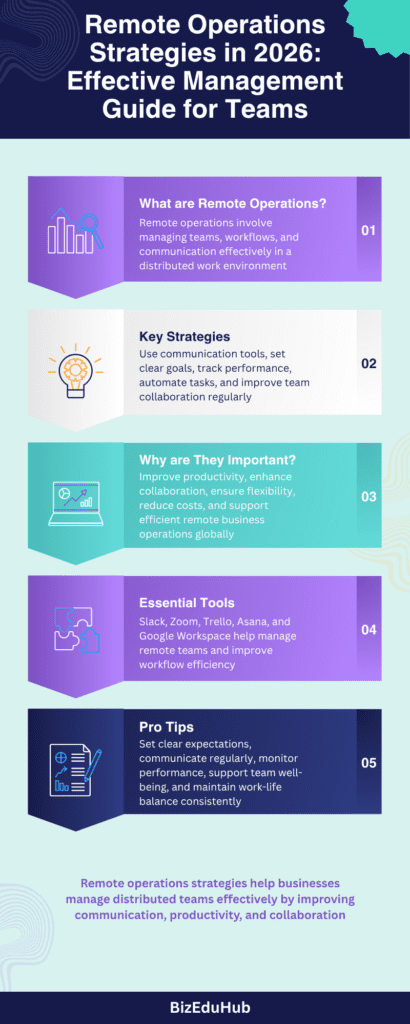
A remote team without the right technology infrastructure is not truly remote — it is just co-located work made inconvenient. The core toolkit for effective distributed work in 2026 typically includes a reliable video conferencing platform, a robust asynchronous messaging system, a project and task management tool, a shared documentation and knowledge base, and secure cloud-based file storage. The specific products matter less than the discipline with which they are used.
Tool sprawl is one of the most common and damaging problems in remote organizations. When teams use ten different applications with overlapping functions, no one knows where anything lives, context gets fragmented across platforms, and the cognitive load of simply staying organized becomes exhausting. Effective remote operations leaders are ruthless about consolidation — choosing fewer tools, used more consistently, with clear protocols about what belongs where.
Practical Steps to Strengthen Your Remote Operations


- Audit your current communication channels. List every platform your team uses to communicate and ask honestly: does each one serve a distinct purpose, or is there significant overlap? Consolidate where possible and document which channel is for what.
- Document your core processes. Identify the ten most important repeatable workflows in your team and write them down clearly enough that a new hire could follow them independently. This investment pays dividends in onboarding speed, consistency, and operational resilience.
- Redesign your meeting schedule. Review every recurring meeting your team holds. For each one, ask: Does this require real-time conversation, or could it be replaced by an asynchronous update? Cancel or restructure anything that doesn’t pass that test.
- Define clear performance outcomes for every role. Work with each team member to articulate what success looks like in their role — in terms of deliverables, impact, and quality — rather than in terms of hours worked or tasks completed.
- Invest in regular one-on-ones. Block time weekly or biweekly for individual conversations with each direct report. Come prepared with genuine curiosity about their experience, their obstacles, and their development — not just their project status.
- Create a team working agreement. Collaboratively develop a document that captures your team’s norms around communication, availability, meeting culture, and feedback. Having explicit shared agreements prevents the misunderstandings that fester in ambiguous remote environments.
- Build in deliberate social time. Schedule regular moments for connection that are clearly distinct from work time — a no-agenda virtual coffee, a team challenge, a shared creative activity. Make attendance optional, but make the invitation genuine.
- Review and refine regularly. Remote operations best practices evolve quickly. Build a quarterly habit of reviewing what is working, what is frustrating the team, and what needs to change.
Real-Life Examples: Remote Operations Done Right
GitLab, the software development company, has operated as a fully distributed organization since its founding and now employs thousands of people across more than sixty countries. What makes GitLab’s remote operations particularly instructive is not the scale — it is the documentation culture. The company maintains a publicly accessible employee handbook of extraordinary depth, covering everything from how meetings are run to how promotions are decided. Nothing about how the company operates is left to assumption or informal memory.
On a smaller and more relatable scale, consider a mid-sized consulting firm that transitioned to a fully remote model during 2020 and spent the following two years figuring out what that actually meant. Their first year was chaotic — too many meetings, unclear ownership, and a culture of performative busyness that left everyone exhausted and nothing particularly well-organized. In year two, they hired a head of remote operations, conducted a comprehensive audit of their processes, cut their standing meetings by sixty percent, built a documentation wiki from scratch, and implemented clear asynchronous protocols for routine work.
What both examples share is this: effective remote operations are designed, not stumbled into. They require someone in the organization taking ownership of the question “how does work actually happen here?” and being willing to examine and improve the answer with real rigor.
Common Remote Operations Mistakes to Avoid
- Replicating the office online. The most pervasive mistake is trying to recreate the office experience in a digital environment — scheduling back-to-back video calls, expecting constant availability, and measuring presence rather than output.
- Neglecting onboarding for remote hires. Bringing someone new into a remote team without a structured, thorough onboarding process almost guarantees a slow and frustrating start. Remote onboarding needs to be more deliberate than in-person onboarding, not less.
- Letting documentation slide. Many remote teams start with good intentions about documentation and gradually let it decay as the urgency of daily work takes over. When documentation lapses, knowledge becomes siloed in individual heads again, and the operational fragility that good systems.
- Failing to address isolation proactively. Loneliness and disconnection are real risks in remote work, and managers who wait for employees to raise them are waiting too long.
- Over-indexing on synchronous communication. When managers feel anxious about visibility, they often default to scheduling more meetings as a form of oversight. This is counterproductive — it signals mistrust, fragments the deep work time that produces your team’s best output.
- Ignoring time zone equity. Teams that span multiple time zones often inadvertently disadvantage members in less-represented zones by scheduling meetings at times that are convenient for the majority.
Frequently Asked Questions About Remote Operations
Q1. How do you maintain team culture in remote operations?
Culture in remote settings is built through consistent, intentional behaviors over time rather than through spontaneous in-person interaction. The most effective approaches combine regular rituals — weekly all-hands, team channels for non-work conversation, virtual social events — with genuine leadership investment in individual relationships. One-on-one conversations where managers express real interest in their team members as people, not just as workers, are foundational.
Q2. What tools are essential for remote operations management in 2026?
The essential toolkit for most remote teams in 2026 includes a video conferencing platform for synchronous communication, an asynchronous messaging system for daily coordination, a project management tool for tracking work and accountability, a shared documentation platform for institutional knowledge, and secure cloud storage for files. Beyond those foundations, many teams benefit from asynchronous video tools for longer explanations that don’t warrant a meeting, collaborative whiteboarding tools for visual thinking, and integration platforms that connect these tools to reduce context-switching.
Q3. How do you manage performance in a remote team?
Effective remote performance management starts with clarity about outcomes. Each team member should have a well-defined understanding of what success looks like in their role — described in terms of impact and output rather than activity and hours. Regular one-on-ones provide the ongoing feedback loop that helps people stay on track and feel supported. Annual reviews should surface no surprises, because the ongoing conversation has been continuous.
Q4. How do you prevent burnout in remote operations?
Burnout prevention in remote teams requires attention to several distinct risk factors. The blurring of work and home boundaries — when the office is a corner of the bedroom, it is psychologically difficult to ever fully leave — leads to chronic overwork if not actively managed. Encourage and model clear working hours. Create cultural permission to disconnect in the evenings and on weekends. Monitor workloads actively, particularly during busy periods, and redistribute when individual loads become unsustainable.
Q4. Is remote operations management harder than managing an in-person team?
It is different, rather than straightforwardly harder, though the differences demand genuine new skills from managers who were trained in and for office environments. The informal observation and ambient awareness that office-based management relies on are simply absent remotely, requiring managers to become more intentional about gathering information, more explicit about their expectations, and more deliberate about building trust.

Conclusion
Remote operations in 2026 are not a temporary workaround or a consolation prize for teams that cannot afford an office. For the organizations that have invested in getting them right, they are a genuine competitive advantage — a way of working that attracts better talent, produces stronger results, and builds more resilient organizations than the co-located alternatives. But none of that happens by accident, and none of it is sustained without continuous attention.
The thread connecting everything in this guide is intentionality. Effective distributed work is designed: the communication architecture, the performance frameworks, the cultural rituals, and the documentation systems. None of these emergencies naturally emerges froma group of people scattered across different locations. They have to be built deliberately by leaders who are willing to examine how their teams actually work in the office.
It is to take the time to design your distributed way of working with the same rigor you would apply to any important business system. That investment is available to every team, regardless of size or budget. What it requires is not money — it is the willingness to be honest about what is and is not working, and the discipline to build something better.
!You might be interested in reading this page as well
Top 10 Small Business Ideas for Women in 2026: Inspiring & Profitable Options