


Introduction to Punjab School Education Board
There is something quietly profound about the moment a child first walks into a classroom, wide-eyed and uncertain, clutching a schoolbag that seems almost too large for their small shoulders. In that moment, the entire weight of a family’s hopes — of a parent’s sacrifices, a grandparent’s prayers — rests in that small room. Education is not just policy. It is personal. And when an institution as vast and influential as the Punjab School Education Board decides to change, the ripple effects touch millions of those small shoulders across one of India’s most populous states.
In 2026, the Punjab School Education Board (PSEB) embarked on a series of transformative changes that are genuinely reshaping how students learn, how teachers teach, and how communities relate to formal education. These are not cosmetic updates or bureaucratic reshuffles. They are substantive reforms — some years in the making — that reflect a serious reckoning with what modern education should look like. If you are a parent, a student, a teacher, or simply someone who cares about the future of Punjab’s children, this conversation is very much for you.

What is the Punjab School Education Board?
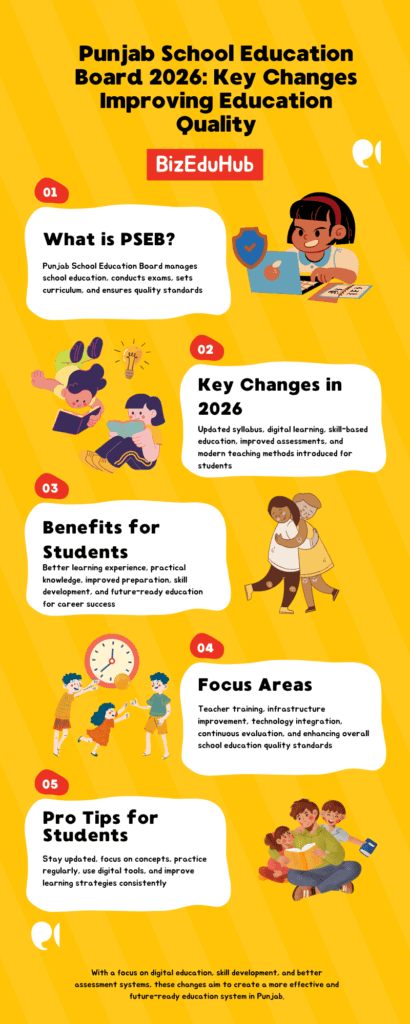
To understand why the 2026 changes matter, it helps to first appreciate just how central the Punjab School Education Board is to the educational fabric of the state. Established in 1969 and headquartered in Mohali, PSEB is the apex body responsible for conducting examinations, prescribing curricula, and regulating affiliated schools across Punjab. It governs the academic lives of millions of students from Class 3 through Class 12, overseeing everything from the textbooks a child reads to the board exams that define their academic futures.
Think of PSEB not merely as an examination board but as an architect. When the blueprint is outdated, the structures built on it — no matter how earnest the effort — eventually crack. For years, educators and parents alike had been quietly raising concerns: rote memorisation rewarded over critical thinking, assessment patterns that tested recall rather than understanding, and a disconnect between what children studied and what the world outside actually demanded of them.
The Punjab School Education Board has, in previous years, introduced incremental changes. But 2026 feels different. The scale is broader, the intent more deliberate, and the community engagement more genuine. This is a board that appears to have genuinely listened.
Why Reform in PSEB Matters So Much
Education reform, when done thoughtfully, is one of the most profound investments a society can make. But when it is done poorly — when it is performative, rushed, or politically motivated — it can do real damage to a generation that had no say in the matter. This is why the 2026 Punjab School Education Board reforms deserve careful attention rather than either blind applause or reflexive cynicism.
Punjab occupies a unique position in India’s educational landscape. The state has historically had high literacy rates compared to many other Indian states, yet outcomes in higher education, critical employment, and applied problem-solving have often lagged behind those literacy numbers. There exists a gap — sometimes a chasm — between being able to read and being able to think independently, between passing examinations and being genuinely prepared for adult life.
For families in rural Punjab, particularly, this gap has been a source of quiet frustration for years. A farmer’s daughter who clears her Class 12 boards with distinction may still struggle to navigate a college application, write a persuasive letter, or solve a real-world financial problem. The system, for all its reach, was not equipping children with the full range of tools they needed. The 2026 reforms from the Punjab School Education Board represent a meaningful attempt to close that gap.
Key Changes the Punjab School Education Board Is Implementing in 2026
1. Revised Curriculum Framework Aligned with NEP 2020
One of the most significant shifts the Punjab School Education Board has undertaken is the comprehensive revision of its curriculum in alignment with the National Education Policy (NEP) 2020. This is not a simple reprint of old textbooks with new covers. The revised framework fundamentally reorients what is taught, how it is sequenced, and why.
The new curriculum emphasises conceptual understanding over content coverage. In practical terms, this means fewer topics taught more deeply rather than a broad syllabus skimmed at the surface level. A Class 9 student in Punjab is now expected to genuinely understand the reasoning behind a mathematical concept before moving on, not simply memorise a formula and reproduce it in an examination hall.
Integration of Vocational Education
For the first time in a genuinely systematic way, vocational education has been embedded into the mainstream curriculum rather than treated as a secondary track for students who “didn’t make it” academically. Students from Class 6 onward will have structured exposure to vocational skills — agriculture technology, basic coding, culinary arts, and healthcare basics — delivered alongside their academic subjects.
This matters enormously in a state like Punjab, where the economy is deeply tied to agriculture and small businesses. A young person who understands soil science alongside algebra, or basic bookkeeping alongside literature, leaves school with a far more versatile toolkit.
Competency-Based Assessment
Perhaps the most quietly revolutionary change is the shift from marks-based to competency-based assessment in the lower classes. Rather than ranking a child purely by their ability to reproduce information during a three-hour examination, teachers now assess ongoing competencies — the ability to communicate, reason, collaborate, and apply knowledge in varied contexts. This change, modest as it may sound on paper, fundamentally alters the experience of being a student in a Punjab School Education Board-affiliated school.
2. Teacher Training and Professional Development
No curriculum reform survives contact with a classroom if the teachers delivering it are underprepared, overburdened, or unconvinced. The Punjab School Education Board has recognised this and invested substantially in structured teacher training programmes in 2026.
Partnerships with state universities and select national institutions have produced a series of in-service training modules that teachers can access through both in-person workshops and an online portal. These are not the perfunctory training sessions of the past — two days of lectures followed by a certificate nobody ever looks at again. These modules are outcome-linked, meaning teachers are expected to demonstrate changed classroom practice, not just attendance.
Mentorship Networks for New Teachers
A particularly thoughtful addition has been the establishment of mentorship networks, where experienced teachers guide newly appointed ones through the first two years of service. Teaching can be an isolating profession, especially in rural postings. Having a mentor — someone who has navigated the same challenges, taught in similar conditions, and found creative solutions — can be the difference between a teacher who grows and one who quietly gives up.
3. Inclusive Education and Special Needs Support
One area that deserves particular recognition in PSEB’s 2026 agenda is the expanded focus on inclusive education. For too long, children with learning differences — dyslexia, hearing impairment, visual challenges, or cognitive disabilities — were either quietly sidelined or left to navigate a system that was never designed with them in mind. The Punjab School Education Board has this year introduced specific guidelines for inclusive classroom practices, trained resource teachers in specialised support methods, and mandated that affiliated schools develop individual learning plans for students with identified needs. This is not just a policy shift — it is a moral one. Every child in Punjab deserves to be seen, and the board’s 2026 commitments move meaningfully in that direction.
4. Digital Infrastructure and Smart Classrooms
The pandemic years exposed, with brutal clarity, the vast digital divide in Punjab’s schools. Children in Mohali with stable internet connections continued learning while children in Mansa or Fazilka fell weeks and then months behind. The Punjab School Education Board has used this painful lesson to drive a serious digital infrastructure push in 2026.
Over 5,000 government-affiliated schools have been equipped with smart classrooms featuring interactive digital boards, reliable connectivity, and curated e-learning content developed in Punjabi and Hindi as well as English. This is not simply about technology for technology’s sake. The content itself has been redesigned to be culturally relevant — drawing on local stories, regional geography, and real examples from Punjab’s agricultural and industrial landscape.
5. Strengthened Examination Integrity
For years, examination leaks and malpractice have cast a shadow over the credibility of PSEB results. Families and employers alike sometimes questioned the real value of board certificates. In 2026, the Punjab School Education Board implemented a multi-layered examination security protocol, including centralised question paper printing with biometric access controls, randomised question sets distributed across examination centres, and expanded flying squads with real-time reporting mechanisms. These are unglamorous changes — they do not make headlines the way a curriculum overhaul does —, but they matter enormously to a student who has genuinely worked hard and deserves results that actually reflect their effort.
Practical Tips for PSEB Students and Families Navigating the 2026 Changes

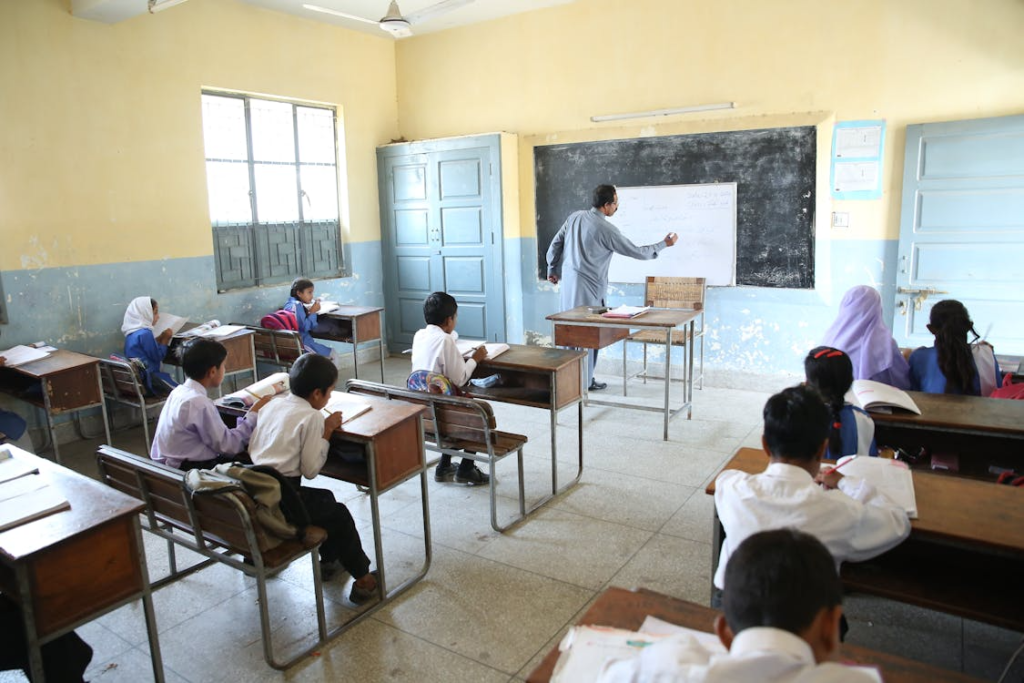
- Read the revised curriculum guides. PSEB has made the new syllabus documents publicly available. Download them, understand the competency benchmarks for your child’s class, and align your home study accordingly.
- Embrace vocational subjects, not just academic ones. The tendency to dismiss vocational learning as “lesser” is both outdated and harmful. These subjects are now formally graded and have real-world applications.
- Use the official PSEB e-learning portal. The digital content is free, curriculum-aligned, and often more engaging than standard textbook reading.
- Communicate with teachers about the new assessment format. Competency-based assessment is a new territory for teachers, too. Open, respectful dialogue helps everyone adapt better.
- Don’t rely on outdated question banks. The examination pattern has shifted. Old model papers based on pure recall will not adequately prepare students for the new format.
- Focus on conceptual clarity. Ask “why” and “how,” not just “what.” This is now what the board is testing.
Real-Life Examples: What Change Looks Like on the Ground PSEB
Consider Harpreet, a Class 8 student in a government school in Ludhiana. Last year, she would have spent the better part of her school day copying notes from a blackboard, preparing to reproduce them in an examination. This year, her science class involves a structured inquiry project on water quality in her neighbourhood — she collects samples, records observations, and presents findings to her class. Her marks are not just based on a year-end paper but on how she conducted her inquiry, communicated her findings, and responded to questions.
Her teacher, Rajinder Singh, admits the shift was uncomfortable at first. “We were trained for so many years to cover the syllabus, finish chapters, prepare students for the exam,” he says. “Now I have to think differently. I have to ask whether they understand, not just whether they can write the answer.” After attending the Punjab School Education Board’s new teacher training workshops, he describes feeling more confident — and more alive in the classroom.
In rural Bathinda, a school principal named Gurpreet Kaur describes the impact of smart classrooms on attendance. “When children know something is interesting waiting for them — a video, an activity on the board — they come. Parents notice when children want to go to school.” The anecdote is simple, but the implication is significant: engagement drives attendance, and attendance is the first prerequisite of learning.
Common Mistakes to Avoid PSEB
- Assuming the old exam pattern still applies. Many families continue preparing based on previous years’ formats, especially for Classes 10 and 12. The Punjab School Education Board has updated its blueprint significantly; ignoring this change is a costly mistake.
- Treating vocational subjects as unimportant. Parents sometimes pressure children to skip or underinvest in vocational learning. Given that these subjects are now formally assessed and carry weight in overall performance, this approach can backfire.
- Relying solely on private tuition centres using outdated material. Many coaching centres lag behind official curriculum updates. Supplement their help with direct reference to the Punjab School Education Board’s official materials.
- Ignoring mental health in the transition period. Change is stressful for children. The shift to competency-based assessment, while ultimately healthier, requires adjustment. Be patient and communicative.
- Not engaging with the PSEB portal. The board has made an extraordinary effort to digitalise resources. Not using them is leaving free, high-quality help on the table.
Frequently Asked Questions About PSEB
Q1: What is the Punjab School Education Board, and what does it govern?
The Punjab School Education Board (PSEB) is the statutory body responsible for prescribing curriculum, conducting public examinations, and regulating affiliated schools in Punjab, India. It covers students from Class 3 through Class 12 across government and many private schools in the state.
Q2: How will the 2026 curriculum changes affect Class 10 and Class 12 board examinations?
The board examinations for Class 10 and 12 in 2026 reflect revised syllabi with greater emphasis on application-based and conceptual questions rather than pure memorisation. Students should download the updated examination blueprints from the official Punjab School Education Board website to understand the new question paper structure.
Q3: Are the new vocational education subjects compulsory?
From Class 6 onward, vocational education modules have been integrated into the curriculum. While specific implementation varies by school and class level, students in most PSEB-affiliated government schools will encounter formally assessed vocational components.
Q4: Where can students access the digital resources the Punjab School Education Board has developed?
PSEB has launched an official e-learning portal where students can access video lessons, practice assessments, and curriculum materials. These are available in multiple languages and are free to access. Check the official Punjab School Education Board website for the current portal link and access instructions.
Q5: How are teachers being supported through this transition?
The Punjab School Education Board has introduced structured in-service training programmes, online professional development modules, and a mentorship system for newly appointed teachers. These initiatives are designed to help educators adapt to the new curriculum framework and assessment methods confidently.

Conclusion
What the Punjab School Education Board is attempting in 2026 is, in the deepest sense, an act of faith — faith in teachers, in students, in communities, and in the idea that education can be something more than a system of sorting and certifying. Reform of this scale is never smooth. There will be gaps between policy and practice, between intent and outcome. Teachers will need time. Students will need patience. Parents will need reassurance.
But the direction matters. When a board as influential as PSEB chooses to move toward deeper learning, toward equity in access, toward examinations that actually test understanding, it sends a message to every child in Punjab: you are being prepared for life, not just for a marksheet.
If you are a student reading this, lean into the change. Ask questions. Engage with the new materials. If you are a parent, stay informed and stay engaged — not anxiously, but thoughtfully. If you are a teacher, know that your role in this transformation is irreplaceable. No policy document, however well-crafted, ever taught a child anything. You do.
The Punjab School Education Board’s 2026 changes are not a destination. They are a direction. And for the millions of small shoulders carrying those oversized schoolbags across this remarkable state, that direction — toward curiosity, capability, and genuine understanding — is one worth walking in.
!You might be interested in reading this page as well
Top Competitive Exams After 12th in 2026: Complete Career Guide