


Introduction to Competitive Exams
The summer after Class 12 is one of the strangest seasons of a young person’s life. Your board exams are done, your roll number has been retired, and suddenly the question every adult in your life has been building up to finally lands: “So, what next?” It’s a question that carries the weight of expectation, the sting of comparison, and — if you’re honest — a quiet undercurrent of excitement. Because, despite all the pressure, this is the moment where your path actually begins to take shape.
For millions of students across India, the answer to “what next” runs directly through competitive exams. These high-stakes tests are the gatekeepers to some of the most coveted careers and colleges in the country — from IITs and AIIMS to the defence forces, civil services, and beyond. But here’s what rarely gets said in all the chaos of coaching brochures and parent group chats: the best competitive exam for you is not necessarily the most famous one. It’s the one that aligns with your strengths, your interests, and the life you actually want to build.
This guide is your honest, comprehensive companion to navigating that decision in 2026.
What are Competitive Exams?
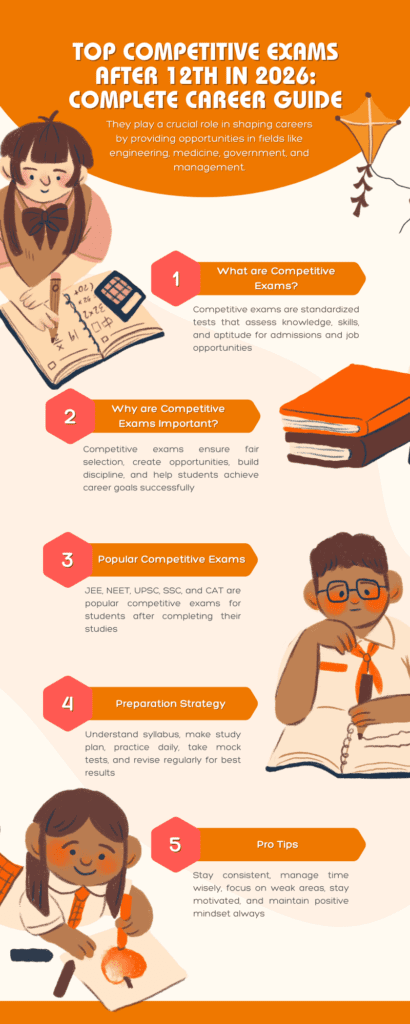
At their core, competitive exams are standardised tests in which candidates compete against each other for a limited number of seats, positions, or scholarships. Unlike board exams — which evaluate whether you’ve met a minimum academic standard — competitive exams rank you relative to everyone else who appeared. This distinction changes everything about how you study, how you manage your time, and how you interpret your results.
The competitive exams landscape after Class 12 in India is vast and diverse. It spans engineering, medicine, law, defence, design, commerce, hospitality, journalism, and even pure research. The most well-known are JEE (for engineering), NEET (for medicine), CLAT (for law), and NDA (for defence), but these represent only the tip of the iceberg.
Here’s a quick illustration. Two students from the same school, same marks, same science stream — let’s call them Priya and Dev. Priya has always loved biology and wants to become a doctor; her path goes through NEET-UG. Dev is fascinated by computer systems and wants to study at an IIT; his path goes through JEE Main and JEE Advanced. Both are preparing for competitive exams, but their journeys — their syllabi, their timelines, their strategies — are entirely different.
Some competitive exams are national in scope — conducted by central bodies like the NTA, UPSC, or SSC and accepted across India. Others are state-level, conducted by state governments or universities, and are valid only within specific regions. Some test academic knowledge almost exclusively; others, like NDA, combine academic testing with physical fitness and psychological assessment.
Why Competitive Exams are Important
The importance of competitive exams goes well beyond the obvious — yes, they determine which college you get into, and yes, certain careers are accessible only through them. But the deeper value is often overlooked, and it deserves to be named directly.
First, these exams create meritocratic access. In a country as large and socioeconomically diverse as India, a well-conducted competitive exam is often the most level playing field a student from a small town or a lower-income background will ever encounter. A student from rural Maharashtra and a student from an elite Delhi school appear for the same NEET paper, under the same conditions, with their ranks determined solely by their performance.
Second, the process of preparing for serious competitive exams builds capabilities that outlast the exam itself. Students who go through rigorous JEE or NEET preparation — the structured schedules, the problem-solving under pressure, the habit of consistent revision — routinely report that college coursework feels manageable by comparison.
Third, from a pure career perspective, the doors that competitive exams open are often irreplaceable. There is no alternate path to an IIT. There is no other way to become an Indian Army officer through the NDA route. AIIMS Delhi does not have a management quota. These institutions exist at the intersection of excellence and opportunity, and the only key that fits the lock is a strong performance in the relevant exam.
Key Aspects: A Stream-Wise Guide to Top Competitive Exams in 2026
1. For Science Stream Students
Engineering Entrance Exams
JEE Main is the most widely taken engineering entrance exam in India, conducted by the National Testing Agency (NTA) twice a year. It tests Physics, Chemistry, and Mathematics and serves as the qualifying exam for JEE Advanced. A strong JEE Main score opens doors to NITs, IIITs, and GFTIs — collectively offering thousands of quality engineering seats across the country.
JEE Advanced, conducted by one of the IITs on a rotational basis, is the gateway to the Indian Institutes of Technology. Only the top 2.5 lakh JEE Main qualifiers are eligible, and the exam itself is a step up in complexity — testing not just knowledge but the ability to reason deeply under time pressure. For students with IIT dreams, this is the ultimate target.
BITSAT (BITS Pilani), VITEEE (VIT University), SRMJEE, and state-level exams like MHT CET, KCET, and WBJEE round out the engineering exam calendar and offer excellent alternatives for students who may not qualify through JEE but have strong academic fundamentals.
Medical Entrance Exams
NEET-UG is the single national exam for admission to MBBS, BDS, BAMS, and other health science programmes across India. Conducted in pen-and-paper format, it tests Physics, Chemistry, and Biology across 200 questions. A score of 650 or above is generally competitive exams for government medical exams, though cutoffs vary significantly by state and category.
For students interested in paramedical fields, BSc Nursing, or allied health sciences, institutions like AIIMS (for BSc Nursing and paramedical programmes) and various state-level health university exams provide additional pathways.
Research and Pure Sciences
The IISER Aptitude Test (IAT) is for students drawn to fundamental scientific research — physics, chemistry, biology, mathematics, and earth sciences. The five-year BS-MS programme at IISERs is one of the best research-oriented undergraduate options in the country, and the aptitude test rewards genuine conceptual thinking over rote preparation.
CUET (Common University Entrance Test) has emerged as a major gateway for central university admissions. Science students can use it to seek admission to B.Sc programmes at Delhi University, Jawaharlal Nehru University, Banaras Hindu University, and over 200 other participating institutions.
2. For Commerce Stream Students
CA Foundation
The CA Foundation exam, conducted by the Institute of Chartered Accountants of India (ICAI), is the entry point to one of India’s most respected professional qualifications. Students who register after Class 12 and clear this four-paper exam move on to the CA Intermediate and Final levels. A qualified Chartered Accountant is among the most sought-after financial professionals in the country, with careers in audit, taxation, corporate finance, and consulting.
IPMAT and BBA Entrance Exams
IPMAT (Integrated Programme in Management Aptitude Test) is the entrance exam for the five-year integrated BBA + MBA programme at IIM Indore and IIM Rohtak — prestigious management programmes that allow students to bypass the traditional MBA entrance route. DU JAT (for Delhi University’s commerce colleges) and Christ University Entrance Test are popular alternatives.
CLAT (Common Law Admission Test)
Although CLAT is open to all streams, commerce students with a strong aptitude for logical reasoning and English often perform particularly well. It’s the gateway to the National Law Universities (NLUs) — India’s premier law schools — for the five-year integrated LLB programme.
3. For Arts Stream Students
CLAT and AILET
CLAT and AILET (All India Law Entrance Test, for National Law University Delhi) are the top competitive exams for arts students pursuing law. NLU graduates are heavily recruited by top law firms, corporations, and the judiciary, making these exams high-value targets.
NDA (National Defence Academy)
Open to unmarried male students of any stream who are between 16.5 and 19.5 years of age (with recent changes also permitting women to appear), NDA is conducted by the Union Public Service Commission (UPSC) twice a year. It is the most prestigious route into the Indian Army, Navy, and Air Force as a commissioned officer. The written exam is followed by an SSB (Services Selection Board) interview — a multi-day psychological and physical assessment unlike any other selection process in the country.
Mass Communication and Journalism Exams
For students with a passion for writing, broadcasting, or media, exams like the IIMC Entrance Exam (Indian Institute of Mass Communication) and ACJ Entrance Test (Asian College of Journalism) are competitive gateways to excellent journalism programmes.
Practical Steps: How to Prepare for Competitive Exams Strategically


- Identify your target exam before you pick up a single book. This sounds obvious, but thousands of students begin preparation without a clear direction and end up with scattered, ineffective study. Know your primary exam, your backup exams, and how they overlap in the syllabus.
- Map the syllabus completely on Day 1. Print or write out the official syllabus from the conducting body’s website. Go chapter by chapter — don’t rely on coaching notes for this. Official syllabi tell you exactly what’s in scope.
- Build a monthly study plan, not a daily one. Daily plans are too rigid and collapse the moment life intervenes. Monthly targets give you flexibility while keeping you accountable. Aim to cover new chapters in the first three weeks of each month and dedicate the fourth week to revision.
- Prioritise NCERT for JEE and NEET. For any competitive exams that include the Class 11 and 12 syllabus, the NCERT textbooks are non-negotiable. Read them before moving to advanced references like HC Verma, DC Pandey, or Morrison & Boyd.
- Solve previous year question papers with a timer. Past papers are the single most valuable preparation resource for any competitive exam. They reveal question patterns, difficulty trends, and frequently tested concepts. Do them under timed conditions, then analyse every mistake.
- Take full-length mock tests every week for six months before the exam. Mock tests build exam temperament — the ability to stay calm, manage time, and make smart guessing decisions under pressure. The analysis after each mock is where real improvement happens.
- Maintain a mistake journal. Every error you make in practice — whether conceptual, careless, or time-related — should be logged and reviewed weekly. Patterns in your mistakes are your roadmap for targeted improvement.
- Protect your sleep and physical health. Seven to eight hours of sleep a night is not a luxury; it’s a performance requirement. Sleep is when memory consolidates. Students who sleep well retain more and perform better on exam day than those who pull all-nighters.
Real-Life Examples of Competitive Exams
Simran from Chandigarh had always wanted to become a lawyer. After her Class 12 boards (she was in the humanities stream), she had seven months before her first CLAT attempt. Instead of joining an expensive coaching programme, she bought the previous five years of CLAT papers and spent the first month doing nothing but working through them to understand what the exam actually tested. She discovered that her reading comprehension speed was her biggest weakness. She began reading one editorial from a national newspaper every morning and summarising it in five sentences. By the time of her competitive exams, her comprehension scores had improved by nearly 30%. She cleared CLAT on her first attempt and joined NLU Jodhpur.
Arjun from a small town in Rajasthan wanted to join the Indian Army through NDA. His family couldn’t afford coaching. He used YouTube lectures for the mathematical portion of the exam, bought a single comprehensive NDA guidebook, and practised physical fitness by running five kilometres every morning. He cleared the written NDA exam on his first attempt. The SSB — the interview and psychological assessment — was harder, and he was screened out the first time. He went back, reflected on the feedback, worked on his communication skills and leadership presence, and cleared the SSB in his second attempt. He was commissioned as an officer at nineteen.
Neither Simran nor Arjun had exceptional resources. What they had was clarity, consistency, and the willingness to learn from failure.
Common Mistakes to Avoid Competitive Exams
- Starting preparation without a plan. Enthusiasm without structure is just energy being wasted. The student who sits down with a syllabus map, a study schedule, and a mock test calendar on Day 1 will outperform the student who “studies hard” without direction, every single time.
- Following too many resources. This is one of the most common preparation mistakes — collecting twenty books, five YouTube channels, and three coaching module sets, then rotating between them without finishing any. Pick one primary resource per subject and exhaust it before adding anything else.
- Avoiding weak subjects. Human nature pushes us toward what we’re already good at. Exam performance is often determined by your weakest subject, not your strongest. Identify your weak spots early and spend disproportionate time on them.
- Underestimating the psychological component. Exam anxiety is real, and it peaks right before and during high-stakes tests. Students who don’t practise sitting through three-hour mock exams often fall apart on the actual day — not because they don’t know the material, but because their body and mind aren’t conditioned to perform under that kind of pressure. Conditioning matters.
- Comparing rank predictions with peers constantly. Social comparison is corrosive during exam preparation. Your classmate’s mock score is not a reliable predictor of your own, nor is it relevant to your improvement trajectory. Focus on your own progress week to week.
- Ignoring the physical and mental health baseline. Burnout in the six months before an exam is not uncommon and can be devastating. Build one rest day per week into your schedule without guilt. Eat properly. Move your body. These are not indulgences — they’re performance essentials.
Frequently Asked Questions About Competitive Exams
Q1. Which competitive exams can I appear for after 12th from any stream?
Several high-value competitive exams are open to students from all streams. These include NDA (for defence), CLAT (for law), CUET (for central university programmes), and state-level civil service preliminary exams in some states. Students from science, commerce, and arts can all target these exams, making them particularly important for students who are still exploring their career direction.
Q2. How do I choose the right competitive exams after Class 12?
Start with interest, not prestige. Ask yourself what kind of work you actually want to do — serve in the military, practise law, treat patients, build systems, write code, run a business. Let that answer guide you to the relevant exam, rather than choosing an exam because it’s well-known or because your peers are preparing for it. Misaligned exam choices lead to poor preparation, motivation,n and, ultimately, poor outcomes.
Q3. Is it possible to prepare for competitive exams without coaching?
Absolutely, and thousands of students prove this every year. Coaching provides structure, pacing, and access to curated material — all of which can be replicated with discipline, good books, online resources, and a consistent study plan. The key elements are a clear syllabus map, quality study material, previous year papers, and regular mock tests. These can all be assembled without enrolling in a coaching programme.
Q4. What is the ideal time to start preparing for competitive exams after 12th?
Ideally, preparation begins in Class 11 for major exams like JEE and NEET, since the syllabus spans both years. For exams like CLAT, NDA, and CUET, starting in Class 12 or even after boards is feasible — especially with a focused, well-structured plan. Starting later is not an excuse for poor preparation; it simply means your timeline is tighter and your strategy needs to be sharper.
Q5. Can I appear for multiple competitive exams simultaneously?
Yes, with strategic planning. Many exams have overlapping syllabi — JEE and state CETs, or NEET and AIIMS nursing entrance exams. The key is identifying your primary target, optimising preparation for that, and letting secondary exams benefit from the same preparation with minimal additional effort. Trying to give equal attention to fundamentally different exams simultaneously — like JEE and NEET — is generally counterproductive unless you have an extended timeline.

Conclusion
Somewhere between the last day of board exams and the first day of college, there is a window — sometimes seven months, sometimes a year — that has the power to shape the next decade of your life. The competitive exams that fill that window are not just tests. They are invitations: to push harder than you thought you could, to learn more deeply than school ever required, and to discover something real about your own resilience.
The landscape of competitive exams in 2026 is broader and more accessible than ever before. There are excellent options for every stream, every interest, and every kind of ambition — from the student who dreams of wearing a white coat to the one who wants to stand in a courtroom, sit in a cockpit, or build systems that touch millions of lives. The exam you choose matters. But how you prepare — with honesty about your weaknesses, consistency in your effort, and patience with your own growth — matters even more.
Don’t let the noise of comparison and expectation drown out the one voice you most need to hear: your own. Know what you want. Build a plan that serves what they want. Commit to the process, not just the outcome.
Because long after the rank is forgotten, the version of yourself that prepared for it — disciplined, focused, persistent, and brave enough to try — is the one that will carry you forward.
!You might be interested in reading this page as well
Essential Career Guidance for Students in 2026: Navigating Your Future Path