
Introduction to PSEB Exam Pattern
Ask any Class 10 or Class 12 student in Punjab what keeps them up at night, and the answer will almost always circle back to board examinations. Not just the studying — though that is real enough — but the uncertainty. The anxiety of not knowing exactly what the paper will look like, how marks will be distributed, which question types will dominate, and whether the preparation strategy they have been following actually aligns with what the board intends to test. That uncertainty is not weakness. It is a completely rational response to high stakes and incomplete information.
In 2026, the PSEB Exam Pattern has undergone meaningful updates that every student, parent, and teacher needs to understand — not in vague, general terms, but with the kind of specific clarity that actually changes how you prepare. The Punjab School Education Board (PSEB) has aligned its examination framework with national education policy directions, revised its question paper blueprints, and introduced assessment components that reward understanding over memorisation.
If you have been preparing based on the old pattern — or worse, based on rumour and hearsay about what might have changed — this article will give you the accurate, structured picture you need to walk into your examination with genuine confidence rather than hopeful guessing.

What is the PSEB Exam Pattern?
The PSEB Exam Pattern refers to the structured framework that governs how PSEB designs, distributes, and evaluates its examination question papers for students in Classes 10 and 12, as well as other classes under its jurisdiction. It defines the types of questions asked, the marks allocated to each section, the duration of papers, the internal assessment components, and the overall blueprint that question setters follow when creating examination papers.
Think of the exam pattern as the architecture of the examination. Just as an architect’s plan determines what a building will look like before a single brick is laid, the exam pattern determines what a question paper will look like before a student reads the first question. Understanding architecture in advance is one of the most powerful preparation advantages a student can have.
The pattern covers several dimensions. It specifies what proportion of questions will be objective type — multiple choice, fill in the blanks, true or false — and what proportion will require written answers of varying lengths. It establishes the internal assessment or practical component weighting relative to the theory examination. It defines whether there will be internal choice within questions, how many sections a paper will have, and what the marks distribution across topics or units of the syllabus will look like.
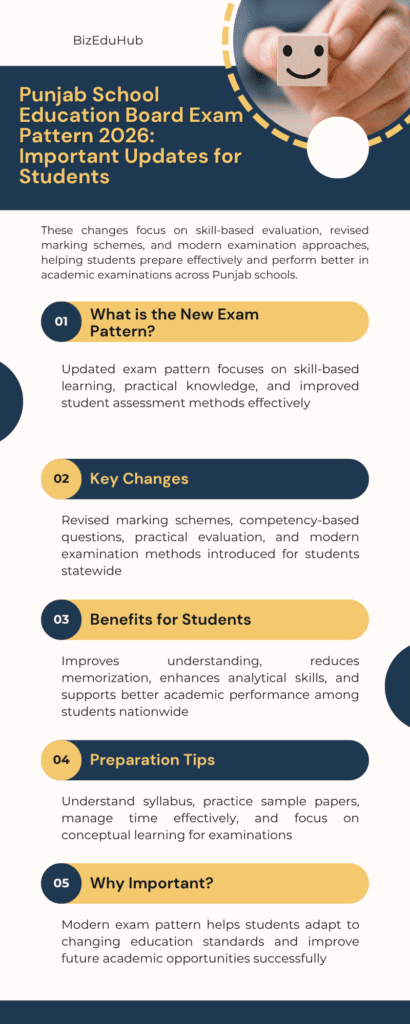
For the 2026 examination cycle, the PSEB Exam Pattern has updated these specifications across most subjects at the Class 10 and Class 12 levels. These updates are not random or arbitrary. They reflect the board’s alignment with the National Education Policy’s push toward competency-based assessment — a shift away from questions that test a student’s ability to reproduce remembered content toward questions that test their ability to apply, analyse, and reason.
Why Understanding the Updated PSEB Exam Pattern Matters So Much
There is a common misconception among students that working hard is sufficient preparation for board examinations. Work ethic matters enormously — nobody passes PSEB boards without genuine effort. But effort directed at the wrong targets, or using strategies misaligned with the actual examination format, is effort that does not fully convert into marks. Understanding the PSEB Exam Pattern is what ensures your effort converts efficiently.
Consider the practical stakes. For Class 10 students, board results influence which stream they can choose in Classes 11 and 12, which schools will admit them, and the confidence with which they approach the next phase of their academic lives. For Class 12 students, the stakes are even higher — university admissions, scholarship eligibility, career pathways, and the accumulated weight of twelve years of schooling all converge in those final board results.
In this context, the updated 2026 PSEB Exam Pattern carries immediate and specific relevance. Students who understand that the new pattern includes a higher proportion of case-based and source-based questions in Social Science will allocate preparation time differently than students who assume the format is unchanged. Students who know that the English paper now has a restructured writing section with revised mark weightings will approach that component differently. This is not about gaming the system — it is about understanding the system well enough to demonstrate your genuine knowledge in the way the examination is designed to receive it.
There is also a teacher and parent dimension to this. Teachers who understand the updated blueprint can design their classroom instruction and revision sessions to mirror the examination demands. Parents who understand what their children are being assessed on can provide more targeted support and encouragement. The exam pattern is not arcane information reserved for insiders — it is public documentation that every stakeholder in a student’s education should engage with directly.
Key Updates in the PSEB Exam Pattern 2026
1. Structural Changes to Question Paper Design
Increased Weightage for Competency-Based Questions
Perhaps the most significant change in the 2026 PSEB Exam Pattern is the increased proportion of competency-based questions across almost all subjects. Where previous papers allocated the majority of marks to knowledge-recall and procedure-application questions, the 2026 blueprint shifts a meaningful portion — typically between 30 and 40 per cent depending on the subject — toward questions requiring application, analysis, and evaluation.
In practical terms, this means a student cannot rely solely on memorising definitions, theorems, dates, and model answers. They need to understand concepts deeply enough to apply them in contexts that may differ from the examples they encountered in class or in their textbooks. This is a harder demand, but it is also a fairer one — it rewards students who have genuinely understood their subjects over students who have merely reproduced content.
Objective Questions and Their Revised Role
Objective questions — multiple choice, very short answer, assertion-reason, and fill-in-the-blank formats — continue to form a significant section of the paper across most subjects in 2026. However, their design has been refined. Rather than straightforward recall questions with obvious correct answers for a well-prepared student, many objective questions in the new pattern are designed to test conceptual understanding and the ability to distinguish between closely related ideas.
Case-Based and Source-Based Questions
In subjects including Social Science, Science, and English, the 2026 PSEB exam pattern introduces or expands case-based and source-based question sets. These present a short passage, data table, map extract, or visual stimulus and ask a series of related questions that require the student to read, interpret, and respond based on both the provided material and their subject knowledge.
These question types are new to many students who were prepared under earlier patterns, and they require a specific skill: the ability to read carefully and connect provided information to learned concepts under time pressure. Practising with case-based question sets is not optional for students aiming to perform strongly under the 2026 pattern — it is an essential preparation component.
2. Subject-Specific Pattern Updates
Class 10 Mathematics
The 2026 Mathematics paper for Class 10 retains its four-section structure but with revised mark distributions. Section A comprises objective questions carrying one mark each. Section B has short-answer questions. Section C contains longer application-based problems. Section D includes case-based question sets in the PSEB exam pattern.
Class 10 Science
Science in Class 10 follows a similar structural evolution. The practical-based questions — testing knowledge of laboratory procedures, observations, and experimental reasoning — now carry increased weight in the theory paper alongside the continued practical examination. This rewards students who engage seriously with their laboratory sessions rather than treating them as separate from examination preparation.
Class 12 Physics, Chemistry, and Mathematics
At the Class 12 level, the science subjects have seen a recalibration of marks distribution across units to better reflect the NEP-aligned emphasis on foundational concepts. Some units that previously carried lighter examination weight have been given additional marks, while certain high-memorisation content areas have been slightly reduced. Students and teachers should cross-reference the official 2026 examination blueprint released by PSEB exam pattern against their preparation schedules to ensure alignment.
Class 12 English
The Class 12 English paper in 2026 has been restructured around three broad sections: Reading, Writing and Grammar, and Literature. The Reading section now includes two unseen passages with a combination of objective and short-answer questions, testing both literal comprehension and inferential reading. The Writing section carries revised mark allocation with greater weight on extended writing tasks. The Literature section requires both textual understanding and the ability to make connections between texts and broader themes.
3. Internal Assessment and Practical Components
The 20-80 Split and What It Means
Across most subjects at both Class 10 and Class 12 levels, the 2026 PSEB exam pattern maintains a 20-per cent internal assessment and 80-per cent theory examination structure. This means that 20 marks in each subject are determined by school-level assessment — periodic tests, project work, practical activities — while 80 marks come from the board examination.
The internal assessment component is not supplementary decoration. Twenty marks can be the difference between a grade boundary in either direction, and students who dismiss internal assessment as less important than board examination preparation are making a costly miscalculation. Consistent performance in periodic tests, careful submission of project work, and serious engagement with practical activities are all components of the complete 2026 examination pattern.
4. Duration and Timing Structure
Most Class 10 and Class 12 theory papers in 2026 are three hours in duration, with a 15-minute reading time at the start, during which students may read the question paper but not begin writing. This reading time is a genuine strategic resource — students who use it to plan their answers, identify which optional questions they will attempt, and mentally sequence their paper-writing approach consistently perform better than those who begin writing the moment the clock starts.
Practical Tips for Preparing for the PSEB Exam Pattern 2026

- Download the official PSEB Exam Pattern 2026 examination blueprint for every subject. This document, available on the PSEB official website, specifies the exact mark distribution, question types, and unit-wise weightage for each paper. This is the single most important preparation document you can access.
- Practise case-based and source-based questions specifically. These are the question types most likely to feel unfamiliar on examination day if you have not deliberately prepared for them. Use sample papers and PSEB-released practice materials.
- Do not neglect the objective question section. Many students over-invest in long-answer preparation and under-prepare for objective questions. In the 2026 pattern, objective sections carry significant marks and test conceptual precision, not just broad knowledge.
- Attempt full-length mock papers under timed conditions. Time management in a three-hour examination is a skill that only develops through repeated practice under real-time constraints. Completing individual chapters is not the same as completing a full paper.
- Use the 15-minute reading time strategically. Read the entire paper, identify optional questions you intend to attempt, and mentally plan your sequencing before writing a single word.
- Take the internal assessment seriously from the beginning of the academic year. Internal marks are earned over months, not recovered in days. Starting the year with full engagement in periodic tests and project submissions builds a cushion that is psychologically valuable during examination season.
- Revise the official PSEB textbook content, not just guidebooks. Guidebooks are supplementary. The official curriculum remains the primary source, and questions are set from its content through the PSEB exam pattern.
- Identify your weak units using the blueprint’s mark weighting. High-mark units deserve proportionally more revision time. Low-mark units should not be abandoned, but your time allocation should reflect the examination’s own prioritisation.
Real-Life Examples: How Understanding the PSEB Exam Pattern Changes Everything
Simran was a Class 10 student in Amritsar who had been studying diligently for her board examinations using previous years’ question papers as her primary practice resource. She was performing well in those mock attempts — finishing papers in time, hitting high marks on the familiar question types. Then her school teacher sat down with the 2026 PSEB exam pattern blueprint and compared it carefully with the 2024 pattern Simran had been practising from.
The comparison revealed a meaningful structural shift. The case-based questions in Science — which Simran had not encountered in the older papers she was using — now carried 16 marks in the 2026 blueprint. Simran had no experience with this format. Six weeks before her examination, she dedicated two weeks specifically to practising case-based question sets from PSEB’s released sample papers. By the time she sat for the actual examination, the format felt familiar and manageable. She attributes eight of her final Science marks directly to those two targeted weeks of format-specific preparation.
Harjot, a Class 12 student in Patiala, had a different experience — one that illustrates what happens when the pattern change is not accounted for. He had focused his Class 12 Mathematics preparation almost entirely on long-answer problem types from the previous pattern, confident in his procedural skills. The 2026 paper’s increased emphasis on application-based questions in the Section D case study format caught him unprepared. He completed the paper but felt uncertain throughout the unfamiliar sections. His final score reflected that uncertainty in the PSEB exam pattern.
Common Mistakes to Avoid in 2026 PSEB Exam Pattern Preparation
- Preparing from outdated sample papers without checking the current blueprint. The 2026 pattern differs from previous years in specific, measurable ways. Using older papers exclusively — without cross-referencing the current blueprint — means you are practising for an examination that no longer exists in that form.
- Ignoring case-based and competency-based question formats. These question types feel unfamiliar to students accustomed to traditional formats. The discomfort of unfamiliarity on examination day costs marks that deliberate practice would have prevented.
- Over-focusing on high-difficulty content while neglecting foundational questions. The PSEB exam pattern rewards depth of understanding across the full syllabus. Students who master a few difficult topics while leaving foundational content underprepared create gaps that objective and short-answer questions will reliably expose.
- Treating the internal assessment component as less important than the board examination. The 20 internal marks are determined at the school level throughout the year. Students who disengage from this component in favour of exclusive focus on theory study are surrendering marks they could have accumulated without the pressure of an examination hall.
- Not reading the question paper fully before beginning to write. Students who begin writing immediately — especially in papers with internal choice — sometimes miss better options or misallocate their time based on an incomplete picture of the paper.
- Relying on peer-shared summaries of the pattern rather than the official blueprint. The official PSEB exam pattern blueprint is a public document. Reading it directly takes thirty minutes and provides accurate, authoritative information. Relying on secondhand summaries introduces error into your preparation foundation.
Frequently Asked Questions About PSEB Exam Pattern
Q1: Where can I find the official PSEB Exam Pattern for 2026?
The official examination blueprints and sample papers for 2026 are available on the PSEB official website. Navigate to the examinations section and look for the 2025-26 academic year resources. Each subject has a specific blueprint document detailing mark distribution, question types, and unit-wise weightage. Always use these official documents as your primary reference rather than third-party summaries.
Q2: How many marks are allocated to the internal assessment in the PSEB Exam Pattern 2026?
Most subjects at Class 10 and Class 12 follow a 20-80 split, with 20 marks allocated to school-level internal assessment — including periodic tests, project work, and practicals — and 80 marks from the board theory examination. The exact split may vary slightly for some subjects with significant practical components; check the subject-specific blueprint for precise figures.
Q3: What types of questions are new or expanded in the 2026 PSEB exam pattern?
The most significant addition to the PSEB exam pattern is the expanded inclusion of competency-based and case-based question formats. These present a short passage, data set, or visual stimulus followed by related questions requiring both textual interpretation and application of subject knowledge. These question types appear prominently in Social Science, Science, and English papers at both Class 10 and Class 12 levels.
Q4: Has the syllabus changed along with the PSEB Exam Pattern in 2026?
The 2026 examination cycle reflects the PSEB’s revised curriculum framework aligned with NEP 2020. While the core subject content is substantially continuous with previous years, the marks weighting across units has been adjusted in several subjects, and some content areas have been updated to reflect the revised curriculum. Students should verify their textbook editions and cross-reference with the official blueprint to ensure they are studying from current materials.
Q5: How should students manage time during the 2026 PSEB board examination?
Most papers are three hours in duration with a 15-minute prior reading period. Students should use the reading time to survey the full paper, identify optional questions they will attempt, and plan their answer sequence. A general time-allocation strategy is to reserve roughly one minute per mark for written answers, complete objective sections first to secure those marks reliably, and leave the final 10-15 minutes for review. Practising this strategy during full-length mock papers before the actual examination is essential.
Conclusion
The examination hall is not where preparation happens — it is where preparation is revealed. Everything you do in the weeks and months before your board examinations either builds or diminishes the confidence and capability you bring into that room. And the single most important factor in ensuring your preparation is well-directed is understanding exactly what the examination is designed to test and how it is structured to test it.
The PSEB Exam Pattern for 2026 represents a genuine evolution — more thoughtful in its design, more aligned with the competencies that genuinely matter, and more honest in its assessment of what students actually understand versus what they have merely memorised. For students willing to engage with that evolution seriously, the updated pattern is not a threat. It is an opportunity to demonstrate the kind of learning that goes beyond surface coverage.
Download the official blueprint. Practise the new question formats deliberately. Take your internal assessment seriously from day one. Manage your time with a strategy you have actually rehearsed. These are not dramatic transformations of your preparation approach — they are targeted adjustments that can meaningfully shift your outcomes.
The PSEB Exam Pattern 2026 rewards students who prepare with precision rather than just volume. You now have the information to do exactly that. What you do with it is your choice — and your examination result will, more than anything else, reflect the quality of that choice.
!You might be interested in reading this page as well
Punjab School Education Board 2026: Key Changes Improving Education Quality