
Introduction to E-Commerce Platforms
Choosing where to build your online store is one of the most consequential decisions you will make as an entrepreneur — and one of the most overwhelming. The number of options has multiplied, the feature sets have grown more complex, and the marketing language around every product sounds more or less identical until you dig into the details. Whether you are launching your first store or reconsidering the infrastructure of an established business, the question of which e-commerce platform to trust with your livelihood deserves a clearer, more honest answer than most comparison articles provide.
In 2026, e-commerce platforms are not just digital storefronts. They are the operational heart of online retail — managing inventory, processing payments, handling logistics integrations, powering marketing automation, and shaping the customer experience that determines whether someone buys once or becomes a loyal repeat customer. Getting this choice right gives your business a foundation it can grow on. Getting it wrong means rebuilding from scratch six months down the road, which is as painful and expensive as it sounds. This guide cuts through the noise, examines the ten most important platforms operating today, and gives you the framework to make a decision that fits your actual situation — not a hypothetical average business, but yours.

What are E-Commerce Platforms?
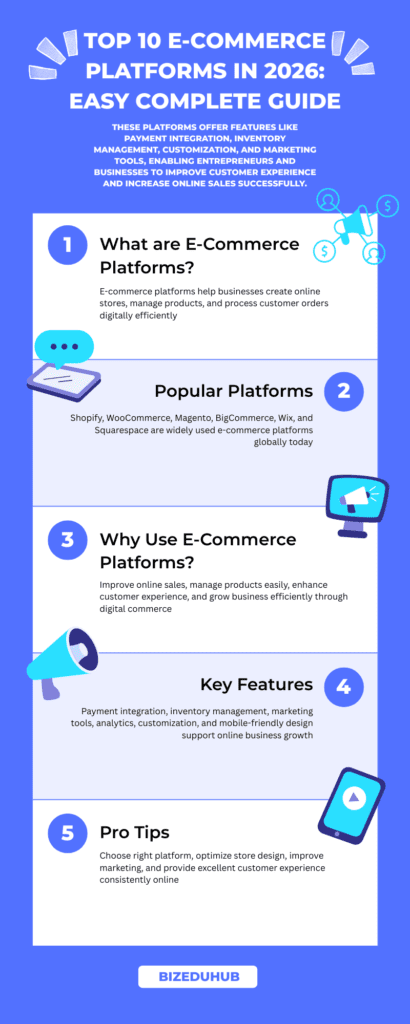
An e-commerce platforms are the software infrastructure that enables a business to sell products or services online. At a minimum, it handles a product catalogue, a shopping cart, payment processing, and order management. But the best platforms in 2026 do far more than that — they integrate with logistics providers, automate email marketing, power loyalty programmes, provide detailed analytics, support multiple sales channels simultaneously, and scale from a single-product test store to a multi-million-dollar operation without requiring a platform change.
It helps to understand the two fundamental models on offer. Hosted platforms — Shopify, Wix, Squarespace Commerce, and BigCommerce are the clearest examples — manage all the technical infrastructure for you. You pay a monthly subscription, and in return, the platform handles hosting, security, software updates, and most of the technical complexity. The tradeoff is that you are working within the platform’s constraints, with limited ability to modify underlying code. Self-hosted platforms — WooCommerce is the dominant example — give you complete control over your store’s code and data, but require you to manage hosting, security, and technical maintenance yourself, either personally or by hiring someone who can.
Neither model is universally better. A solopreneur launching a first product benefits enormously from the simplicity and speed of a hosted platform. A business with highly specific technical requirements, or one that needs deep integration with custom internal systems, may find that self-hosting is the only way to achieve what they need. The wisest choice is the one that matches your current technical capability, budget, and growth ambitions — not the platform with the longest feature list or the loudest marketing through e-commerce platforms.
Why Your Choice of E-Commerce Platforms Shapes Everything
The e-commerce platforms you build on affect almost every dimension of your online business. It determines how fast your store loads — and page speed is directly correlated with conversion rates, with even a one-second delay measurably reducing sales. It shapes your customer’s checkout experience, which is the single moment when intention becomes revenue or abandonment. It dictates which payment methods you can accept, which countries you can sell to, and how seamlessly your store integrates with the fulfilment providers, accounting software, and marketing tools your business depends on.
Beyond the day-to-day operational reality, your platform choice has strategic implications. Migrating an established e-commerce store from one platform to another is a serious undertaking — involving data transfer, URL restructuring, SEO recovery, staff retraining, and typically a period of reduced performance as the new setup stabilises. Most businesses that switch platforms wish they had made the right choice the first time. The founders who make the right choice tend to be the ones who spent time understanding their options before committing, rather than choosing whatever platform a friend used or whatever appeared first in a search result.
There is also the question of cost transparency. Some e-commerce platforms present low headline subscription prices but charge transaction fees on every sale, add premium costs for essential features, or lock basic functionality behind higher-tier plans. Others appear expensive on the surface but include everything a growing business needs without additional charges. Understanding the true total cost of ownership — including transaction fees, app costs, theme purchases, and developer fees — is essential to an honest comparison.
Top 10 E-Commerce Platforms in 2026: An Honest Assessment
1. Shopify — The Market Standard
Shopify remains the most widely used hosted e-commerce platforms in the world, and in 2026, that dominance is thoroughly deserved. Its combination of ease of use, reliability, and ecosystem depth is genuinely difficult to match. A first-time store owner can have a professional, functional shop live within a day. An established brand with complex operations can build on Shopify’s advanced infrastructure, custom development capabilities, and enterprise-tier Shopify Plus offering. The platform handles hosting, security, and software maintenance invisibly, allowing merchants to focus on their business rather than their technology.
2. WooCommerce — Maximum Flexibility for WordPress Users
WooCommerce is a free, open-source plugin that transforms a WordPress website into a fully functional online store. It powers an enormous share of global e-commerce, particularly among businesses that already have a WordPress presence, value complete control over their data and code, or need customisation that hosted platforms cannot provide. Because WooCommerce is self-hosted, you own everything — your store’s code, your customer data, your product information — with no platform standing between you and your business.
3. BigCommerce — Built for Scale
BigCommerce occupies an interesting position in the market: more powerful than Shopify for complex catalogue management and multi-channel selling, but less immediately intuitive for complete beginners. It is particularly strong for businesses with large product catalogues, complex variant structures, or significant B2B sales alongside B2C. BigCommerce charges no transaction fees on any plan — a genuine advantage for high-volume sellers — and includes many features that Shopify reserves for paid apps, such as advanced faceted search and real-time shipping quotes.
4. Wix E-Commerce — Best for Creative Simplicity
Wix built its reputation as a website builder, and its e-commerce platforms functionality reflects that heritage: it prioritises visual design flexibility and ease of use above almost everything else. For small businesses, artists, photographers, food producers, and service providers who want a beautiful online presence with integrated selling capability, Wix delivers an experience that is genuinely hard to improve on in terms of simplicity and aesthetic control. The drag-and-drop editor gives non-technical users extraordinary design freedom.
5. Squarespace Commerce — For Design-Focused Brands
Squarespace has long been the platform of choice for businesses where aesthetic presentation is central to the brand — photographers, designers, independent fashion labels, speciality food brands, creative agencies. Its templates are among the most visually refined in the industry, and the integrated commerce features have matured significantly, now supporting subscription products, digital downloads, and appointment booking alongside standard physical goods.
6. Magento (Adobe Commerce) — Enterprise Power
Magento, now operating as Adobe Commerce in its enterprise form and as Magento Open Source in its self-hosted form, is the platform of choice for large-scale retailers with complex requirements, deep technical resources, and significant development budgets. It is genuinely powerful — capable of handling enormous product catalogues, sophisticated pricing rules, multi-store international operations, and custom functionality that smaller platforms cannot accommodate. Companies like Nike, Ford, and numerous major retailers have built on Magento.
7. Etsy — The Marketplace Model
Etsy is not a platform in the traditional sense — it is a marketplace, meaning you are selling within Etsy’s ecosystem rather than building a standalone store. For makers, artists, crafters, and vintage sellers, this distinction matters less than the practical reality: Etsy provides built-in traffic from buyers actively searching for handmade, unique, and artisan products. The audience alignment is powerful. A new Etsy seller can make their first sale within days without any external marketing, because buyers come to Etsy specifically looking for what independent sellers make.
8. Amazon Seller Central — Volume and Reach
Amazon is the largest e-commerce marketplace in the world, and selling on it gives access to a customer base that no independent store can replicate. For businesses with established products, robust margins, and the operational capability to handle Amazon’s fulfilment requirements — whether through Fulfilment by Amazon (FBA) or Seller Fulfilled Prime — the platform can generate enormous volume. Amazon is particularly powerful for commodity and comparison-shopped products where search intent is high, and brand differentiation matters less.
9. Meesho — India’s Reselling Powerhouse
For entrepreneurs in India, particularly those targeting value-conscious buyers in tier-2 and tier-3 cities, Meesho has become one of the most significant e-commerce platforms of the last five years. Its social commerce model — which enables resellers to share products via WhatsApp and other social networks and earn a commission on sales — has brought millions of first-time entrepreneurs into online selling with essentially zero upfront investment. Meesho also operates a direct marketplace where small businesses can list products to a massive, price-sensitive domestic audience.
10. Shopify Markets / Headless Commerce — The Future Layer
The final entry in this list is less a single platform and more a direction: the growing sophistication of headless commerce, which decouples the customer-facing front end of a store from the back-end commerce infrastructure. Shopify Markets, combined with headless architecture, allows businesses to present entirely different storefronts for different geographies, languages, and customer segments while running on a single unified back end. This approach is increasingly accessible to mid-sized businesses that previously could not afford the engineering investment it required, and it represents where enterprise-grade e-commerce platforms are unambiguously heading.
How to Choose the Right E-Commerce Platforms for Your Business

- Be honest about your technical capability. If you do not have developer access and do not plan to hire one, a hosted platform like Shopify or Wix is almost certainly the right choice, regardless of what self-hosted alternatives offer in theory.
- Calculate your true total cost. Add up monthly subscription fees, transaction fees on your expected volume, the cost of apps you will need, theme purchase, and any developer setup costs. Compare e-commerce platforms on total annual cost, not headline subscription price.
- Prioritise your specific bottleneck. Identify the one or two things that matter most for your business — beautiful design, powerful inventory management, B2B pricing, international selling, built-in audience — and choose the platform that does those specific things best, rather than the one with the most features overall.
- Test before committing. Every major platform offers a free trial. Use it. Build a few product pages, test the checkout flow, explore the admin panel, and try one or two integrations. The experience of actually using a platform reveals things that no review article can.
- Think two to three years ahead. Your first month’s needs and your third year’s needs will be very different. Choose a platform you can grow into, not one you will outgrow by the time you need it most.
- Check the support quality before you need it. Read recent support reviews on independent sites. Test the customer service with a question before you have a crisis. Platform support that fails you during a payment processing outage or a major sale event is a business problem, not just an inconvenience.
- Plan your migration exit strategy. Even if you are confident in your choice, understand what it would take to migrate away from your chosen platform if your needs change. E-Commerce Platforms that make data export easy and clean deserve points for this.
Real Stories: How E-Commerce Platforms’ Choice Made a Difference
A small ceramics studio in Bristol, England, started on Etsy in 2021 and built a following of several thousand buyers over two years. The founder, a trained ceramicist with no background in technology, found Etsy’s marketplace traffic invaluable in the early stages — she would never have reached those customers through her own marketing alone. By 2023, she had migrated to Squarespace Commerce, keeping her Etsy shop active for new customer discovery while directing repeat buyers to her own store,e where she controlled the relationship, offered subscription boxes, and kept a significantly higher share of each sale. Today, her Squarespace store generates roughly sixty per cent of her revenue, and Etsy generates the rest on the e-commerce platforms.
Contrast that with a fast-growing supplement brand that launched on Shopify and scaled to seven figures within eighteen months. The founders chose Shopify specifically because of its ecosystem depth — they needed email marketing automation, subscription billing, loyalty programme integration, and seamless connection to their fulfilment warehouse, all of which they were able to build quickly through Shopify’s app marketplace. When they tried to replicate this setup on WooCommerce during an early evaluation, the developer time required to make everything work together was several times greater. Shopify’s integrated ecosystem was, for their specific needs, a genuine competitive advantage that justified its higher cost.
What both examples illustrate is that e-commerce platforms’ success is not about choosing the objectively best product. It is about choosing the right fit for your specific situation, needs, and capacity — and then using that platform’s strengths deliberately rather than accidentally.
Common Mistakes When Choosing and Using E-Commerce Platforms
- Choosing based on someone else’s recommendation without assessing your own needs. What works for a fashion boutique may be entirely wrong for a B2B industrial supplier. E-Commerce Platforms choices are context-dependent, not universal.
- Underestimating migration costs. Many businesses choose a starter platform with the intention of switching later, without fully reckoning with the time, cost, and SEO disruption that a platform migration involves. It is almost always worth investing more thought in the initial choice than in a future migration.
- Over-relying on apps to compensate for platform weaknesses. If you need six paid apps to make a platform work for your core use case, that platform may not be the right fit. Some app dependency is normal; building your entire operational model on third-party integrations creates fragility.
- Neglecting mobile optimisation testing. More than half of all online purchases are made on mobile devices. If you have only tested your store on a desktop during setup, you may be unaware of checkout friction that is costing you sales every day.
- Ignoring platform analytics until something goes wrong. Every major platform provides meaningful data about traffic, conversion rates, abandoned carts, and product performance. Treating analytics as a crisis tool rather than a routine management instrument means missing improvement opportunities that are visible in the data every single week.
- Choosing an e-commerce platforms for its current feature set without checking its development roadmap. Platforms that are investing in improvement will serve you better in three years than platforms maintaining the status quo. Check recent changelog history and publicly available roadmap information before committing.
Frequently Asked Questions About E-Commerce Platforms
Q1. Which e-commerce platforms are best for beginners?
For absolute beginners with no technical background, Shopify is the most consistently recommended starting point because of its balance of simplicity, reliability, and growth potential. Wix and Squarespace are strong alternatives for businesses where design presentation is central, as both offer particularly intuitive visual editors. The key is to start with a platform whose admin interface you find genuinely comfortable to navigate — you will spend significant time in it, and friction in your own admin environment slows down every operational task.
Q2. What are the cheapest e-commerce platforms available?
WooCommerce is free as a plugin, though the hosting, security, and maintenance costs associated with self-hosting mean the total cost varies significantly by setup. Among hosted platforms, Wix and Squarespace offer lower entry-level subscription prices than Shopify, though their transaction fees and feature limitations at lower tiers are worth examining closely. For sellers who are purely starting and testing demand, Etsy and Meesho offer near-zero startup costs, though they come with the constraints of marketplace selling on e-commerce platforms.
Q3. Can I sell on multiple e-commerce platforms at the same time?
Yes, and many successful online sellers do exactly this. A common model is to maintain a primary independent store on Shopify or WooCommerce for direct customer relationships, while simultaneously listing on Amazon and Etsy for marketplace reach. Managing multi-channel selling requires inventory synchronisation to prevent overselling, which most major platforms handle through dedicated multi-channel management tools or apps. The operational complexity is real but manageable, and the diversification of revenue sources is a significant strategic benefit.
Q4. How do e-commerce platforms handle payment processing?
Most major platforms offer integrated payment processing either through their own payment gateway (Shopify Payments, Wix Payments, Squarespace Payments) or through connections to third-party processors like Stripe, PayPal, Razorpay, and others. Using a platform’s own payment solution typically eliminates transaction fees but may require meeting certain eligibility criteria and is not available in every country. Third-party processors offer more flexibility and are accessible globally, but most platforms charge an additional transaction fee on top of the processor’s fee when you do not use their native solution.
Q5. Which e-commerce platforms are best for selling digital products?
For digital products — ebooks, online courses, software, music, photography, printables — the platform requirements are slightly different from physical goods because there is no inventory, shipping, or logistics to manage. Shopify handles digital products well with the right app support. Squarespace includes digital downloads natively and handles them particularly smoothly for creative sellers. Gumroad and SendOwl are specialist platforms built specifically for digital product sales, offering simpler setups and lower transaction fees for this specific use case than e-commerce platforms.
Conclusion
The ten e-commerce platforms covered in this guide represent a range of capabilities, philosophies, and ideal use cases that are broader than most comparison articles acknowledge. There is no single best platform — there is the best platform for your specific business, at your specific stage of growth, with your specific technical resources and strategic priorities. That distinction matters enormously, and it is the one most rushed platform decisions ignore.
If there is a single principle to carry away from this guide, it is this: invest the time in your platform decision that the decision deserves. Use free trials. Run the real cost calculations. Think about where your business needs to be in three years, not just where it is today. Talk to other founders in your category who have built on the platforms you are considering. The information is available; the effort of gathering it is the only cost.
In 2026, e-commerce platforms have matured to the point where even the simpler, lower-cost options can support genuinely sophisticated businesses. The quality gap between the top platforms has narrowed, which means the competitive advantage increasingly comes not from which platform you choose, but from how well you understand and use it. A merchant who deeply understands Shopify will consistently outperform one who chose the same platform and never explored its capabilities. The same is true across the board. Choose thoughtfully, learn thoroughly, and build something worth building on.
!You might be interested in reading this page as well
How to Start an E-Commerce Business Successfully in 2026 (Step-by-Step Guide)