
Introduction to Bharath Institute of Higher Education and Research
Choosing a university is one of the most consequential decisions a young person will ever make. It is not simply about picking a college from a ranked list or following a friend’s choice. It is about choosing the environment where you will spend some of the most formative years of your life — where your thinking will be challenged, your friendships forged, your professional identity shaped. That decision deserves more than a casual Google search. It deserves real inquiry, honest conversation, and a genuine understanding of what an institution stands for beyond its brochures.
In that spirit, Bharath Institute of Higher Education and Research has been drawing increasing attention from students across India and beyond — and for reasons that go considerably deeper than marketing. Located in Chennai, Tamil Nadu, this deemed university has been building a reputation over decades that now, in 2026, positions it as one of the more genuinely compelling choices available to students across a wide range of disciplines.
This is not a promotional piece. It is an honest exploration of what makes Bharath Institute of Higher Education and Research stand out, what prospective students should realistically expect, and how to make the most of what this institution offers.

What is Bharath Institute of Higher Education and Research?
Before diving into rankings, programmes, and campus life, it helps to understand what Bharath Institute of Higher Education and Research actually is — its history, its structure, and the philosophy that drives it.
Founded in 1984 and granted deemed university status by the University Grants Commission (UGC), Bharath Institute of Higher Education and Research — commonly referred to as BIHER — is a multi-disciplinary institution that has grown from its engineering and technology roots into a comprehensive university offering programmes across medicine, law, management, arts, science, and education. The university operates multiple schools and faculties under one umbrella, allowing for the kind of cross-disciplinary interaction that modern careers increasingly demand.
What distinguishes BIHER from the enormous number of private deemed universities in India is its accreditation record and research output. The institution holds NAAC accreditation and has consistently maintained a presence in national and international ranking frameworks. But numbers and acronyms only tell part of the story. What matters equally is the institutional culture — the way faculty engage with students, the seriousness with which research is pursued, and the degree to which the university prepares its graduates for lives that are both professionally successful and personally meaningful.
The campus itself spans a substantial area in Selaiyur, Chennai, accommodating tens of thousands of students across undergraduate, postgraduate, and doctoral programmes. For a student arriving from a smaller town or city, the scale of the institution can feel both exciting and slightly overwhelming. That is, frankly, true of most large universities. What matters is whether the systems within the campus help students find their footing — and here, Bharath Institute of Higher Education and Research has invested considerably in orientation, counselling, and peer support mechanisms.
Why Choosing the Right University Matters More Than Ever in 2026
There is a temptation, particularly among students under enormous family pressure, to treat university selection as a purely logistical exercise — which Bharath Institute of Higher Education and Research will accept my scores, which programme offers the best salary prospects, which college is closest to home. These are not irrelevant considerations. But they are incomplete ones.
The year 2026 presents a genuinely different landscape for higher education than the one that existed even five years ago. Industries are shifting with unprecedented speed. The skills that commanded premium salaries in 2020 are being supplemented — and in some cases replaced — by new competencies. In this environment, the quality of a university’s industry connections, the currency of its curriculum, and the depth of its research culture matter more than they ever have.
Bharath Institute of Higher Education and Research operates with an acute awareness of this reality. The institution has, over the past several years, made deliberate efforts to bring its curriculum in line with contemporary industry demands, forge meaningful partnerships with national and international organisations, and create pathways for students that extend well beyond the classroom. For a student entering higher education in 2026, these are not peripheral benefits — they are central to the value of the degree they will eventually hold.
There is also the question of personal growth, which tends to get short shrift in the pragmatic conversations about university choice. A university is a community. The people you study alongside, debate with, collaborate with, and occasionally disagree with are as formative as any lecture or examination. BIHER’s diverse student body — drawing from across India and from several international destinations — creates an environment that naturally broadens perspective. For a young person from a relatively homogenous background, that exposure has value that does not appear on any transcript.
Key Reasons Bharath Institute of Higher Education and Research Stands Out
1. A Broad Academic Portfolio That Meets Diverse Aspirations
One of the quiet strengths of Bharath Institute of Higher Education and Research is the sheer breadth of its academic offerings. The university is home to schools of engineering and technology, medicine, law, management, architecture, education, and arts and sciences. This is not merely a feature of scale — it has practical implications for students.
Flexibility and Interdisciplinary Opportunity
In a world where the most interesting careers increasingly sit at the intersection of disciplines — biomedical engineering, health law, digital humanities, environmental management — a university that houses multiple faculties under one roof offers something genuinely valuable: the possibility of crossing boundaries. Bharath Institute of Higher Education and Research has structured some of its programmes to encourage elective selection across departments, meaning an engineering student can develop a working understanding of business management, or a law student can develop literacy in technology and data.
Medical and Allied Health Sciences
Bharath Institute of Higher Education and Research is particularly well-regarded for its medical programmes. The Sree Balaji Medical College and Hospital, associated with the university, provides students with clinical exposure that combines academic rigour with hands-on patient care experience. For students aspiring to medicine, nursing, physiotherapy, or allied health disciplines, this integration of academic and clinical environments is a significant advantage that cannot be replicated in institutions without hospital affiliations.
2. Research Culture and Output
A university that only teaches and never questions is, in the long run, a diminishing institution. Research is the mechanism by which knowledge is renewed, faculty stay sharp, and students learn to think beyond received wisdom. Bharath Institute of Higher Education and Research has made research a genuine institutional priority, not merely an afterthought.
The university hosts multiple research centres focused on areas including biotechnology, nanotechnology, renewable energy, and public health. Doctoral programmes are active and publishing. Faculty members maintain research profiles that are internationally cited. For undergraduate and postgraduate students, this matters because it creates an environment where curiosity is modelled at the highest levels — where the person teaching your class has spent serious time grappling with unsolved problems, not just rehearsing established answers.
Funded Research and Industry Collaboration
Research at Bharath Institute of Higher Education and Research is not purely academic in the ivory-tower sense. The institution has attracted funded research projects from government bodies, including DST, ICMR, and AICTE, as well as from private industry partners. This connection between research and real-world application means that students who engage with research opportunities at BIHER are working on problems that actually matter outside the campus gates.
3. Faculty Quality and Pedagogical Approach
The reputation of any university ultimately rests on the quality of its teaching. Infrastructure can be impressive, rankings can be favourable, and marketing can be polished — but if the faculty are disengaged, under-qualified, or simply going through the motions, none of the rest matters very much.
Bharath Institute of Higher Education and Research has invested in building a faculty that combines academic credentials with professional experience. Many faculty members hold doctoral degrees from reputed institutions, and the university actively encourages ongoing professional development. The pedagogical approach has also evolved — moving away from purely lecture-based delivery toward problem-based learning, case studies, laboratory immersion, and project-based assessments that better reflect the demands of contemporary professional environments.
4. Industry Connections and Placement Support
For most students — and their families — the question of employability is a central one. What happens after graduation? Will this degree open doors or merely decorate a wall? Bharath Institute of Higher Education and Research’s placement cell has worked systematically to build relationships with recruiters across sectors, and the results are visible in the diversity of organisations that engage with the campus for recruitment.
Companies from sectors including information technology, healthcare, banking and finance, manufacturing, and consulting have been part of BIHER’s placement ecosystem. The university also supports students through internship placement, resume development, mock interviews, and entrepreneurship incubation for those who prefer to build rather than join.
5. International Exposure and Global Partnerships
In 2026, a degree with an international dimension carries real weight. Bharath Institute of Higher Education and Research has cultivated partnerships with universities and research institutions in several countries, enabling student and faculty exchange programmes, joint research initiatives, and dual-degree pathways in select disciplines. For a student who wants their education to have a global frame of reference without necessarily studying entirely abroad, these partnerships offer a meaningful middle path.
Practical Tips for Students Considering Bharath Institute

- Visit the campus before committing. No amount of online research substitutes for walking through the facilities, sitting in on an open day, and speaking directly with current students about their day-to-day experience.
- Research the specific department, not just the university. Bharath Institute of Higher Education and Research’s overall reputation is strong, but like all large universities, the quality of individual departments varies. Speak with faculty, read recent publications, and ask about placement outcomes specifically in your chosen field.
- Engage with alumni networks. BIHER has a substantial alumni community. Reaching out through LinkedIn or alumni groups can give you an honest, unfiltered perspective on what the university actually delivers versus what it promises.
- Apply early and understand the scholarship landscape. BIHER offers merit-based and need-based financial support. These opportunities are competitive and often have early application deadlines that students miss by assuming they have more time.
- Plan your hostel and accommodation needs. For outstation students, campus accommodation is available but limited. Early application significantly improves your options.
- Take advantage of research and internship opportunities from Year 1. Students who engage with the university’s research centres and industry partnerships early — rather than waiting until their final year — graduate with significantly more depth to their professional profiles.
- Use the counselling and student support services. Transitioning to university life, particularly in a large city like Chennai, can be genuinely challenging. BIHER’s student support infrastructure exists to help — use it without hesitation.
Real-Life Examples: What the BIHER Experience Looks Like
Consider Priya, a young woman from Coimbatore who enrolled in Bharath Institute of Higher Education and Research’s Bachelor of Physiotherapy programme after being drawn by the hospital integration model. What she did not anticipate was how quickly she would be placed in clinical observation settings — not merely watching from the edges, but engaging under supervision with real patients in real therapeutic contexts. By her second year, she had a level of practical confidence that her friends at purely academic institutions would not develop until much later.
Then there is Karthik, an engineering student from Andhra Pradesh who enrolled in Bharath Institute of Higher Education and Research’s mechanical engineering programme with an eventual goal of working in the automotive industry. Through the university’s industry partnership with a Chennai-based manufacturing firm, he secured an internship at the end of his second year. That internship led to a pre-placement offer before his final year examinations were even complete. The pipeline from classroom to career, he says, was shorter and more direct than he had expected.
These are not exceptional stories. They are representative of what becomes possible when a student arrives at a well-connected institution with genuine curiosity and a willingness to engage beyond the minimum requirements of their programme.
Common Mistakes Students Make When Evaluating BIHER
- Choosing based on programme name alone rather than programme content. Two universities can offer a degree with identical titles but radically different curricula, faculty, and outcomes. Dig into the actual syllabus, the teaching methodology, and the placement record of the specific programme you are considering.
- Ignoring the non-academic dimensions of university life. Clubs, cultural events, sports, and student governance — these are not distractions from education. They are part of it. Students who engage with campus life beyond the classroom consistently report richer, more satisfying university experiences.
- Assuming that a large institution means impersonal treatment. Bharath Institute of Higher Education and Research is a large university, and some students arrive expecting to feel like a number. In reality, most departments maintain manageable class sizes, and faculty are generally accessible. The impersonal experience is often a self-fulfilling prophecy.
- Underestimating the importance of location. Chennai is a major metropolitan city with significant professional opportunities, particularly in healthcare, technology, and manufacturing — all areas where BIHER has strong programmes. The city itself is part of the educational environment. Students who treat their university years as purely campus-bound miss the professional networking opportunities that a city like Chennai makes available.
- Delaying the application process. Competitive programmes at BIHER fill quickly. Students who wait until the last minute frequently find their preferred programme either full or requiring a waitlist that does not resolve in their favour.
Frequently Asked Questions About BIHER
Q1: Is Bharath Institute of Higher Education and Research a recognised university?
Yes. Bharath Institute of Higher Education and Research is a deemed university recognised by the University Grants Commission (UGC) of India. It holds NAAC accreditation and its programmes are recognised by the relevant statutory bodies governing each discipline, including the Medical Council, Bar Council, and AICTE, where applicable.
Q2: What are the strongest programmes offered at Bharath Institute of Higher Education and Research?
Bharath Institute of Higher Education and Research has particular strength in medical and allied health sciences, engineering and technology, and management. Its medical college with integrated hospital facilities is among its most distinctive assets. Engineering programmes in computer science, mechanical, and electronics have strong placement records. However, prospective students should research their specific intended programme independently for the most current information.
Q3: What is the campus life like at BIHER for students from outside Tamil Nadu?
The university has a diverse student body with representation from across India and several international countries. Campus facilities include hostels, sports facilities, cultural organisations, and student clubs. Chennai itself is a welcoming city with a strong culture of higher education. Most outstation students report adapting well within the first semester, particularly when they actively engage with campus communities.
Q4: Does Bharath Institute of Higher Education and Research offer scholarships?
The university offers merit-based scholarships for students with strong academic records, as well as financial assistance provisions for students with demonstrated need. Government scholarship programmes, including central and state scholarships,s are also applicable. Students should contact the admissions office directly for the most current and complete information on available financial support.
Q5: How does BIHER support students in finding employment after graduation?
The university’s placement cell maintains relationships with recruiters across multiple sectors and facilitates on-campus recruitment drives, internship placements, and career development workshops. Students are encouraged to engage with the placement cell from early in their academic career rather than only in their final year. The university also supports entrepreneurial students through an incubation centre for those interested in founding ventures.
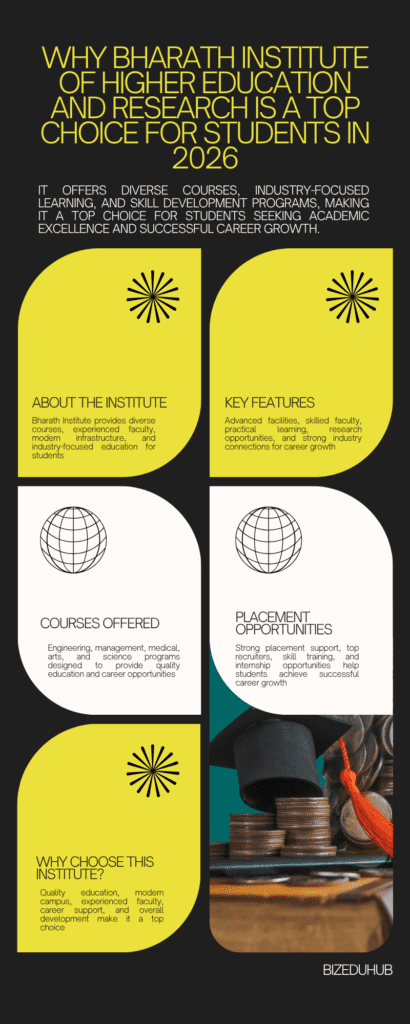
Conclusion
The decision of where to pursue your higher education will shape far more than your resume. It will shape the questions you learn to ask, the people you choose to surround yourself with, the professional habits you form, and the sense of possibility you carry into the rest of your working life. That is a weighty set of outcomes to hang on a single institutional choice — which is precisely why that choice deserves serious, unhurried thought.
Bharath Institute of Higher Education and Research has spent four decades building something that goes beyond infrastructure and rankings. It has built a community of learning that takes seriously both the academic depth and the practical preparation its students require to thrive in a world that is changing faster than any single curriculum can fully anticipate. In 2026, with the higher education landscape more competitive and more consequential than ever, that commitment to genuine quality.
If you are a prospective student weighing your options, do not simply take this article’s word for it. Visit. Ask questions. Speak with people who have studied there. Read the research that faculty are producing. Talk to graduates about where their degrees have taken them. The institution that welcomes that scrutiny with confidence is the one worth trusting.
Bharath Institute of Higher Education and Research, by most serious measures, is ready for that conversation. The question is whether you are ready to ask it.
!You might be interested in reading this page as well
Punjab School Education Board 2026: Key Changes Improving Education Quality