
Introduction to Front-End Development Courses
Picture this: you’re using a website, and everything works. The button responds the moment you tap it. The layout shifts gracefully when you tilt your phone. The color palette feels calm and inviting, the fonts are crisp, and the whole experience leaves you thinking nothing at all — because good front-end development courses are invisible when it’s done right. But when it’s done wrong? You notice immediately. Broken layouts, sluggish interactions, text that spills off the screen.
If you’ve ever wanted to be the person who builds those seamless, beautiful experiences, then you’re looking at one of the most creatively fulfilling and consistently in-demand skills in tech. And the first real question is always the same: where do you actually learn this stuff?
The market for front-end development courses in 2026 is enormous — and honestly, a bit overwhelming. Hundreds of programs compete for your attention, your time, and your money. Some are outstanding. Some are outdated.
This guide cuts through all of it. Whether you’re an absolute beginner or a developer filling in gaps, here are the ten best front-end development programs available right now — evaluated honestly, explained clearly, and matched to different kinds of learners.
What are Front-End Development Courses?
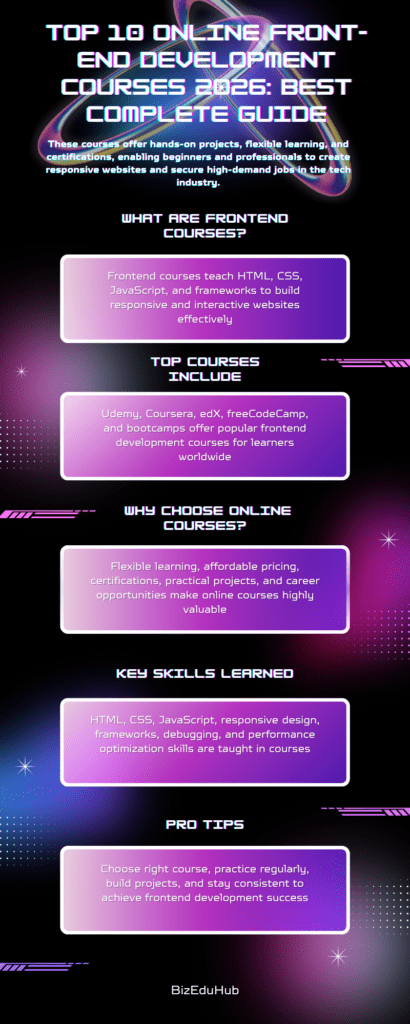
Front-end development refers to the practice of building everything a user directly sees and interacts with in a browser or app. It lives at the intersection of code and design. Itires proficiency in three foundational technologies: HTML, CSS, and JavaScript.
Modern front-end development goes significantly beyond these basics. In 2026, a working front-end developer is also expected to know at least one JavaScript framework — typically React, Vue, or Angular — along with tools like Git for version control, npm for package management, Webpack or Vite for bundling, and some understanding of accessibility standards and performance optimization.
Front-end development courses are structured programs — ranging from free self-paced curricula to intensive paid bootcamps — designed to take learners from zero to professional competency in these skills. The best ones don’t just teach syntax. They teach you how to think through layout problems, how to debug JavaScript without panic, how to read documentation, and how to work within the constraints of real browsers and real users.
A front-end development courses that covers only HTML and CSS is technically useful, but a genuinely useful one in 2026 extends into JavaScript deeply and introduces at least one modern framework.
Why Front-End Development Courses Matter in 2026
Front-end developers are hired by virtually every industry. Retail companies need e-commerce interfaces. Healthcare providers need patient portals. Banks need online dashboards. Media companies need content platforms. The ubiquity of web-based experiences means front-end talent is needed far beyond the traditional “tech company” category. This breadth of demand offers working stability that few technical specializations can match.
For freelancers and independent developers, front-end skills are particularly powerful. A client who needs a business website, a portfolio, or a marketing landing page doesn’t need a backend system — they need someone who can make something look great and work smoothly in a browser. Front-end development is often where freelance careers begin because the feedback loop between your work and a client’s satisfaction is so direct and visible.
There’s also a creative dimension that attracts a different kind of learner. Front-end development sits closer to design than most programming disciplines. Decisions about layout, typography, color, and motion are as much aesthetic as technical. For people who feel drawn to both visual craft and logical problem-solving, it’s a rare and satisfying middle ground through front-end development courses.
From a learning investment standpoint, quality front-end development courses are more accessible than ever. Free programs have become genuinely excellent. Paid programs have become more outcome-focused. And the technologies themselves — while evolving — have stabilized enough that completing a rigorous program today leads to durable, employable skills rather than knowledge that expires in eighteen months.
Top 10 Front-End Development Courses in 2026
1. The Odin Project — Free, Project-Driven, and Battle-Tested
Overview and Approach
The Odin Project’s Foundations and Full Stack JavaScript paths are among the most respected free learning resources in web development. The front-end development courses cover HTML, CSS, JavaScript, and React, all built around a philosophy of independent problem-solving: you’re expected to read documentation, debug your own code, and research solutions the way professional developers actually do.
The projects are real. You build an Etch-a-Sketch app, a calculator, a weather application that fetches live data from an API, and eventually a complete frontend project with React. None of these are toy examples dressed up as learning material.
Best For
Self-motivated learners who don’t need someone holding their hand, and who want to develop professional instincts alongside technical skills. If you can stay consistent without external accountability, The Odin Project delivers exceptional value for zero cost.
2. freeCodeCamp — The Non-Profit That Has Launched Thousands of Careers
Overview and Approach
freeCodeCamp’s Responsive Web Design and JavaScript Algorithms & Data Structures certifications form a comprehensive front-end foundation. The platform is entirely free, non-profit, and has been refined through the experience of millions of learners over nearly a decade.
The project-based certification structure gives learners concrete milestones. Each certification requires completing five portfolio projects, which means by the time you finish, you have real work to show. The community forums are active, the alumni stories are genuinely inspiring, and the content is regularly updated to reflect changes in the web ecosystem.
Best For
Budget-conscious learners, career-changers who need to demonstrate commitment and output, and anyone who thrives with clear milestones and a community of fellow learners for front-end development courses.
3. Scrimba Frontend Developer Career Path — Interactive Learning Reimagined
Overview and Approach
Scrimba built something genuinely new in online education: interactive screencasts where you can pause the video mid-lesson and edit the instructor’s code directly inside the browser. It sounds subtle, but the shift from passive watching to active coding changes everything about how material lands.
The front-end development courses cover HTML, CSS, JavaScript, React, and basic responsive design, with a strong emphasis on building projects you’d actually be proud to show in a portfolio. The community is tight-knit, and Scrimba runs weekly coding challenges that keep engagement high throughout what can otherwise feel like a solitary journey.
Best For
Visual learners find traditional video tutorials frustrating because they can’t immediately touch and modify what they’re watching. Scrimba is also excellent for learners who want some community interaction without the price tag of a full bootcamp.
4. Jonas Schmedtmann’s JavaScript and CSS Courses (Udemy) — Deep Dives Worth Every Minute
Overview and Approach
Jonas Schmedtmann has built two of the most highly rated courses on Udemy: The Complete JavaScript Course and Advanced CSS and Sass. While these are technically separate purchases, together they form one of the most thorough front-end foundations available on any platform.
The JavaScript course is legendary among self-taught developers for its depth — it doesn’t just show you how JavaScript works, it explains why, covering the engine, the event loop, closures, prototypal inheritance, and asynchronous programming with a level of clarity that makes genuinely difficult concepts accessible. The CSS course is equally impressive, teaching Flexbox, Grid, animations, and Sass through a series of beautiful, real-world projects.
Best For
Learners who hate shallow “just copy this” tutorials and want to understand the underlying mechanics of the web technologies they use. Also excellent for developers who’ve been writing JavaScript for a while but know they’re missing a foundational understanding.
5. Codecademy Front-End Engineer Career Path — Structured, Beginner-Friendly, and Comprehensive
Overview and Approach
Codecademy’s Front-End Engineer career path is one of the most polished, structured programs available. It covers HTML, CSS, JavaScript, React, Redux, and testing, with an in-browser code editor that removes setup friction for beginners entirely. Lessons are bite-sized, progress is trackable, and the path includes portfolio projects and interview prep at the end.
The trade-off for its beginner-friendliness is that Codecademy holds your hand more than some alternatives, which means learners need to deliberately seek independent challenges to develop genuine problem-solving confidence. But as an introduction to the material, few programs are more approachable.
Best For
Absolute beginners who need a gentle, structured onramp and aren’t yet ready for the sink-or-swim approach of more independent programs.
6. Frontend Masters — Professional-Grade Video Instruction from Industry Practitioners
Overview and Approach
Frontend Masters is a subscription-based platform where the instructors aren’t educators by profession — they’re working engineers, often from companies like Netflix, Google, and Stripe, teaching the skills they use in their actual jobs. The production quality is high, the content is deep, and the learning paths cover everything from CSS fundamentals to advanced React patterns to web performance optimization.
The platform’s front-end development courses learning path includes instructors like Jen Kramer (CSS), Kyle Simpson (JavaScript), and Scott Moss (APIs and Node). It’s expensive relative to alternatives, but the depth and professional relevance are unmatched for intermediate-to-advanced learners.
Best For
Developers who already have some foundation and want to level up toward senior-engineer territory. Also excellent for working developers who want to fill in specific gaps with short, intensive courses rather than committing to a full curriculum.
7. Coursera — Meta Front-End Developer Professional Certificate
Overview and Approach
Meta’s Front-End Developer certificate on Coursera is taught by Meta engineers and covers HTML, CSS, JavaScript, React, version control, UI/UX principles, and a capstone project. The certificate carries employer recognition, and Coursera’s partnership with universities means academic credit may be available in some programs.
The pace is designed for working adults — roughly six hours per week over approximately nine months — and the capstone project serves as the portfolio centerpiece. Career coaching and interview preparation are included, giving it more employment infrastructure than purely self-paced alternatives.
Best For
Career-changers or working professionals who want an employer-recognized credential, structured pacing compatible with a busy schedule, and explicit career support built into the program.
8. Zero to Mastery — Complete Web Developer and React Courses
Overview and Approach
Andrei Neagoie’s Zero to Mastery platform has earned a strong reputation for production quality, curriculum depth, and regular updates. The Complete Web Developer course covers HTML, CSS, JavaScript, React, and deployment. A separate React course goes deep on hooks, context, performance, and testing patterns.
ZTM’s community is particularly active and supportive, which matters more than it might seem over the months that a serious front-end curriculum requires. The platform also includes sections on developer branding, GitHub portfolio building, and interview strategy.
Best For
Learners who want a high-quality, modern curriculum that extends beyond pure technical content into career readiness, delivered in a community-oriented environment for front-end development courses.
9. Kevin Powell’s CSS Courses — The Best CSS Instruction on the Internet
Overview and Approach
Kevin Powell is, without exaggeration, the most respected CSS educator working today. His YouTube channel alone has helped millions of developers finally understand Flexbox, Grid, and responsive design — but his paid courses on Scrimba and his own platform go significantly deeper.
For developers who feel confident in JavaScript but shaky on layout and visual presentation — a painfully common gap — Kevin Powell’s material is the single most efficient fix available. His approach is methodical, his explanations are clear, and he has a rare gift for making CSS feel logical rather than arbitrary.
Best For
Any front-end development courses who struggles with CSS layout, responsive design, or the visual side of front-end work. Also invaluable for developers preparing for roles where UI quality is a primary job requirement.
10. Springboard UX/Front-End Bootcamp — Mentored, Job-Guaranteed, and Design-Aware
Overview and Approach
Springboard’s front-end bootcamp blends technical instruction with UX and design principles — a combination that reflects what modern front-end roles increasingly require. The program includes one-on-one mentorship with a working developer, a job guarantee (refund if you don’t land a role within six months of graduation), and career coaching throughout.
The front-end development courses cover HTML, CSS, JavaScript, React, and accessibility, with deliberate attention to the design thinking skills that distinguish strong front-end developers from developers who can technically write a layout but don’t understand why it should look a certain way.
Best For
Learners who want maximum support, human accountability, a design-integrated curriculum, and the financial confidence of a job guarantee backing their investment.
Practical Tips for Getting the Most from Front-End Development Courses

- Code every single example. Watching code appear on screen and actually typing it yourself engages different parts of your brain. Even when an example seems obvious, type it. Then break it. Then fix it.
- Build projects before you feel ready. The instinct to wait until you know more before building something original is almost always counterproductive. Premature building is how you discover what you actually need to learn.
- Embrace the browser’s DevTools. Chrome and Firefox DevTools are front-end developers’ best friends. Learn to inspect elements, debug JavaScript in the console, analyze network requests, and audit performance. Most courses teach this tool.
- Learn accessibility from the start. Many front-end development courses treat accessibility as an afterthought. It isn’t — it’s a core professional competency. Understanding ARIA attributes, semantic HTML, keyboard navigation, and color contrast is increasingly expected by employers and is ethically important for users.
- Study websites you admire. Open DevTools on sites with layouts or interactions you find impressive. Inspect how they’re built. This habit accelerates real-world pattern recognition faster than most formal instruction.
- Use Git for every project, always. Even for a three-page static site. Professional habits built early compound over a career.
- Read the error messages. Browser console errors are specific and informative. Train yourself to read them fully before searching for solutions. This single habit dramatically accelerates debugging speed on front-end development courses.
Real-Life Examples: Learning Paths That Worked Front-End Development Courses
A high school art teacher with zero programming background decided she wanted a career change at thirty-four. She started with freeCodeCamp’s Responsive Web Design certification, working through it over three months during evenings. The structure suited her need for clear milestones, and the community forums felt approachable. She followed it with Jonas Schmedtmann’s JavaScript course on Udemy to go deep on the language, then built three portfolio projects — a recipe site, a local art gallery page, and a weather app using a public API.
A software engineering student who felt confident in backend Python but weak on visual development took a different path. He spent two months with Kevin Powell’s CSS content specifically to address that gap, then completed the Scrimba front-end development courses for its React curriculum. The interactive format suited his learning style, and the weekly coding challenges kept him engaged. He graduated with a portfolio that demonstrated both technical rigor and genuine visual sensibility.
Both stories share the same underlying pattern: identify your starting point honestly, choose programs matched to your gaps and learning style, build real projects throughout, and stay consistent longer than feels comfortable through front-end development courses.
Common Mistakes to Avoid Front-End Development Courses
- Jumping to React before mastering vanilla JavaScript. React is built on JavaScript. If your JavaScript foundation is weak, learning React will feel like assembling furniture without understanding how joints work. Spend real time on JavaScript — functions, scope, the DOM, fetch, promises.
- Collecting certificates instead of building projects. A certificate proves you completed a course. A deployed project proves you can build something. Employers look at your GitHub and your portfolio URL before they look at your certifications in front-end development courses.
- Ignoring CSS layout fundamentals. Many learners rush through CSS toward JavaScript because it feels more “real” programming. Then they struggle for years with layouts they can’t understand or control. Invest proper time in Flexbox, Grid, and responsive design.
- Building only tutorial projects. Every front-end development courses who’s been through this journey has a portfolio full of to-do apps and weather widgets cloned from tutorials. These demonstrate completion, not creativity. Build at least one or two projects from your own idea.
- Studying in isolation indefinitely. There’s a kind of comfort in the endless preparation loop — always one more course before applying, one more project before showing anyone your work. Break it. Share work-in-progress. Ask for feedback. Apply before you feel ready.
Frequently Asked Questions About Front-End Development Courses
Q1. How long does it take to become job-ready from a front-end development course?
For most learners starting from scratch and studying two to four hours daily, job-readiness typically arrives somewhere between six and twelve months. The range is wide because it depends heavily on prior technical exposure, study consistency, and project output. Learners who build throughout their learning journey — rather than waiting until they “know enough” — consistently reach employability faster than those who focus purely on consumption.
Q2. Should I learn React, Vue, or Angular as my first JavaScript framework?
In 2026, React remains the dominant choice in the job market and is covered by the largest number of quality learning resources. For most learners, starting with React is the pragmatic choice. Vue is an excellent alternative for learners who find React’s ecosystem overwhelming — it has a gentler learning curve. Angular is more commonly required in enterprise environments for front-end development courses.
Q3. Are free front-end development courses good enough to get a job?
Yes — genuinely. The Odin Project, freeCodeCamp, and various free YouTube series have produced thousands of employed developers. What matters is not whether you paid for instruction but whether you built real projects, developed strong problem-solving habits, and can demonstrate your skills clearly. A polished portfolio built through free resources outweighs a certificate from a paid program with no portfolio work.
Q4. What should a front-end development portfolio include?
Aim for three to five deployed projects accessible via public URLs, a clean GitHub profile showing consistent activity, and a personal website that itself demonstrates your front-end skills. Projects should vary in type — a static site, a JavaScript app that fetches external data, and a React application at a minimum. Each project should have a clear README explaining what it does, why you built it, and what technologies it uses.
Q5. Do I need to know design to be a front-end development courses?
You don’t need to be a designer, but visual sensibility helps. Understanding basic design principles — spacing, hierarchy, color contrast, typography — makes you a significantly better front-end developer than someone who can only translate designs created by others. Even a casual familiarity with Figma, the industry-standard design tool, is increasingly expected in collaborative environments for front-end development courses.
Conclusion
The right front-end development courses can genuinely change the direction of your career — and your relationship with the web entirely. There’s something profound about the shift from being a passive consumer of digital experiences to being someone who builds them. Once you understand how a layout is constructed, how a JavaScript event triggers a chain of behavior, or how a CSS animation is timed, you never look at a website the same way again.
The ten programs covered in this guide represent the best of what’s available in 2026, at every price point and every experience level. The Odin Project and freeCodeCamp prove that world-class instruction doesn’t require a credit card. Frontend Masters and Jonas Schmedtmann’s courses prove that depth and rigor are available outside of university classrooms. Scrimba and Kevin Powell prove that the format of instruction matters as much as its content. Springboard proves that when mentorship and accountability are built into a program.
But here’s what’s true: the front-end developer who built the website experience you used this morning started exactly where you are. With a browser open, a question in mind, and a course about to begin through front-end development courses.
!You might be interested in reading this page as well
Front-End Development Best Practices in 2026: Build Fast and User-Friendly Websites