
Introduction: A Turning Point in the Story of Education Policy
Every generation gets a moment when it must rethink how it prepares its children for the future. For some, it was the Industrial Revolution. For others, it was the digital boom. Today, as we stand on the edge of artificial intelligence, climate uncertainty, global mobility, and rapid social change, the conversation has shifted once again. The spotlight is now firmly on the New Education Policy 2025.
Education has never been just about textbooks and exams. It’s about identity, opportunity, and hope. I still remember sitting in a crowded classroom as a student, memorizing chapters word-for-word because that’s what the exam demanded. Creativity took a back seat. Curiosity was often an inconvenience. If the new Education Policy promises anything, it’s a chance to rewrite that story.
But change is never simple. With every reform comes excitement—and resistance. Opportunity—and uncertainty. In this detailed analysis, we’ll unpack what the new Education Policy 2025 aims to achieve, the doors it opens, and the challenges that lie ahead.
Understanding the Vision Behind Education Policy 2025
Before analyzing its opportunities and challenges, it’s important to understand the spirit behind the reform.
1. A Shift From Rote Learning to Real Learning
For decades, education systems across many regions have leaned heavily on memorization. Students learned to score marks rather than solve problems. The New Education Policy takes a bold step away from this model.
Instead of asking, “Can you repeat what the book says?” it now asks, “Can you think, analyze, and apply?” The emphasis on critical thinking, problem-solving, creativity, and interdisciplinary learning reflects a deeper understanding of what the modern world demands.
This is not just curriculum reform—it’s philosophical reform.
2. Holistic Development as a Core Principle
Another defining pillar of the New Education Policy is holistic development. Education is no longer limited to academic scores. Emotional intelligence, physical health, ethical values, digital literacy, and life skills are equally prioritized.
Schools are encouraged to integrate sports, arts, vocational exposure, coding, environmental awareness, and entrepreneurship into mainstream education. In theory, this creates a balanced ecosystem where students can discover who they are—not just what they can memorize.
Structural Changes Under the New Education Policy
1. Reimagining School Structure
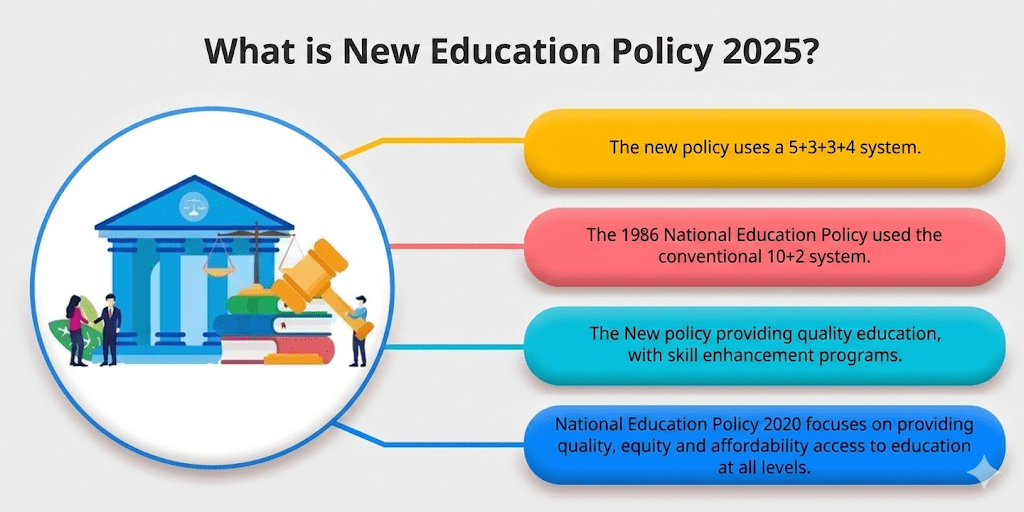
One of the most significant shifts introduced by the New Education Policy is restructuring the traditional schooling model. The rigid system is being replaced with a more flexible, age-appropriate learning framework.
Early childhood education is receiving long-overdue attention. Foundational literacy and numeracy are being treated as non-negotiable priorities. This move recognizes a truth many educators have known for years: if children struggle with basics in early grades, they carry that burden throughout their academic journey.
2. Flexible Subject Choices in Higher Grades
Perhaps one of the most talked-about changes is the removal of rigid streams in secondary education. The artificial divide between “science,” “commerce,” and “arts” is gradually dissolving.
A student passionate about physics can now also explore music or psychology. A commerce student can learn coding. This flexibility aligns education with real-world complexity, where careers are rarely confined to one discipline.
It’s refreshing—and long overdue.
3. Transforming Higher Education
Higher education under the New Education Policy introduces multidisciplinary universities, multiple entry and exit options, credit banks, and greater autonomy for institutions.
Students who need to pause their education for personal or financial reasons won’t lose everything they’ve worked for. Credits can be accumulated and transferred. Degrees can be completed in flexible timelines.
For many families navigating financial uncertainty, this is more than a policy change—it’s a safety net.
Opportunities Created by New Education Policy 2025
Change always carries potential. Let’s explore the biggest opportunities this New Education Policy creates.
1. Empowering Students With Choice and Agency
The ability to choose subjects across disciplines gives students ownership of their learning journey. When students have agency, engagement improves.
I’ve seen students transform when given the freedom to explore what genuinely interests them. They ask more questions. They stay longer after class. They research beyond the syllabus. Education becomes less about obligation and more about discovery.
That’s the power of choice.
2. Boosting Skill Development and Employability
The New Education Policy strongly integrates vocational training from the early stages. Internships, skill-based modules, coding, financial literacy, and entrepreneurship are no longer “extra”—they’re central.
In a world where degrees alone don’t guarantee jobs, skill development is essential. By bridging the gap between classroom theory and practical application, the policy strengthens employability.
Employers often say graduates lack real-world skills. This reform attempts to address that concern head-on.
3. Strengthening Early Childhood Education
The focus on foundational learning could have a long-term transformational impact. When children develop strong reading and math skills early, dropout rates decline, confidence improves, and academic performance stabilizes.
It’s not the most glamorous reform, but it might be the most powerful one.
4. Encouraging Innovation in Teaching
Teachers are being encouraged to move beyond lectures and embrace project-based learning, experiential learning, and technology integration.
This shift gives educators room to innovate. A history lesson can now include debates. A science chapter can become an experiment. A literature class can turn into a performance.
When teachers feel empowered, classrooms come alive.
5. Digital Integration and Access Expansion
Technology plays a central role in the New Education Policy. Online platforms, digital libraries, virtual labs, and hybrid learning models aim to increase accessibility.
For students in remote areas, digital tools can bridge geographic gaps. For working professionals, online education offers flexibility.
If implemented inclusively, this digital push could democratize learning in unprecedented ways.
The Challenges That Cannot Be Ignored
As promising as the New Education Policy appears, implementation will determine its success.
1. Infrastructure Gaps
Policies look powerful on paper. But schools in rural and under-resourced areas often struggle with basic infrastructure—electricity, internet connectivity, trained teachers, and classroom space.
Without adequate funding and monitoring, the vision may remain urban-centric, widening rather than reducing inequality.
2. Teacher Training and Adaptation
A policy shift of this scale requires extensive teacher training. Moving from rote instruction to experiential learning is not automatic.
Teachers need:
- Continuous professional development
- Digital literacy training
- Reduced administrative burden
- Emotional and institutional support
Without investing in educators, reform risks superficial implementation.
3. Resistance to Change
Education systems are deeply rooted in tradition. Parents often equate high marks with success. Competitive exams still dominate aspirations.
If assessment systems remain heavily exam-driven, schools may struggle to genuinely adopt holistic learning. Cultural mindset shifts take time.
4. Risk of Digital Divide
While digital integration is promising, not every household has stable internet access or devices. The new Education Policy must ensure that technological advancement does not exclude marginalized communities.
Access must be equitable—not optional.
5. Monitoring and Accountability
Large-scale reforms require consistent evaluation. Are schools truly implementing flexibility? Are vocational programs effective? Are dropout rates decreasing?
Without transparent monitoring systems, measuring success becomes difficult.
New Education Policy and the Changing Role of Teachers
1. From Instructor to Facilitator
The New Education Policy redefines teachers as facilitators of learning rather than sole knowledge providers.
This change is profound. Instead of standing at the front delivering content, teachers guide discussions, encourage exploration, and mentor students individually.
It’s a beautiful shift—but also demanding.
2. Emotional Labor and Burnout
With added responsibilities—personalized attention, skill mentoring, technology use—teachers may face burnout if workloads are not managed thoughtfully.
Supporting educators emotionally and financially is critical. Reform must include human sustainability.
The Economic and Social Impact of Education Policy
1. Economic Growth Through Skilled Workforce
A nation’s progress depends heavily on the quality of its education system. By emphasizing skills, innovation, and research, the New Education Policy aims to strengthen economic growth.
Startups, research labs, social enterprises, and technological innovation thrive when education fosters creativity and critical thinking.
2. Social Mobility and Equity
If implemented inclusively, the New Education Policy can become a powerful tool for social mobility. Flexible pathways, vocational integration, and credit transfer systems reduce barriers for disadvantaged students.
Education, at its best, levels the playing field.
Real-Life Implications: A Student’s Journey Under the New Education Policy
Imagine a student named Aarav.
Under the old system, Aarav might have been forced to choose between science and the arts at 16. He loved physics—but also music. He might have abandoned one passion for the sake of “career practicality.”
Under the New Education Policy, Aarav can pursue physics, music production, and entrepreneurship simultaneously. He can intern with a local startup, take online coding modules, and complete interdisciplinary projects.
Instead of narrowing his identity, education expands it.
That’s the promise.
Long-Term Outlook: What Lies Ahead?
1. Gradual Transformation, Not Overnight Change
Large-scale educational reform unfolds slowly. Textbooks change. Training programs roll out. Infrastructure develops. Cultural perceptions evolve.
The success of the New Education Policy 2025 will depend not just on political will but on collective commitment from educators, parents, institutions, and communities.
2. The Need for Patience and Persistence
True reform demands patience. Mistakes will happen. Adjustments will be necessary. Feedback loops must remain active.
But if sustained with integrity, this New Education Policy could redefine how future generations experience learning.
Rethinking Assessment: The Heart of Real Reform
One of the most critical—and least discussed—dimensions of the New Education Policy 2025 is assessment reform. Curriculum changes matter, but assessment decides what actually gets taught. As the saying goes, students learn what they are tested on.
For decades, exams have rewarded speed, memory, and predictability. A single three-hour paper often defined years of effort. This system created high-pressure environments where anxiety thrived, and genuine understanding took a back seat.
The New Education Policy signals a shift toward competency-based assessment. Instead of testing how much a student can recall, the focus moves toward how well they understand concepts, apply knowledge, and think independently.
This opens doors for:
- Open-book assessments
- Project-based evaluation
- Continuous formative assessment
- Peer and self-assessment
If implemented sincerely, exams could become learning tools rather than fear-inducing filters. However, changing assessment culture will be one of the toughest battles ahead. Parents, institutions, and competitive exam bodies are deeply invested in rank-oriented evaluation.
The question remains: can we truly value learning over scoring?
Parents as Stakeholders in the Reform Process
Education reform does not exist in isolation from family expectations. In many households, especially in competitive academic cultures, success is narrowly defined—top marks, prestigious colleges, and “safe” careers.
The New Education Policy 2025 challenges this mindset by encouraging exploration, flexibility, and multiple pathways. But for this vision to work, parents must also evolve.
A parent who equates success solely with exam ranks may resist interdisciplinary choices. A student interested in design, sports science, or vocational skills might still be pushed toward conventional professions.
This gap between policy intent and parental mindset can undermine reform.
To bridge it, awareness campaigns, counseling systems, and transparent communication are essential. Parents must be made partners in reform—not passive observers or silent resistors.
True change happens when families begin to ask:
“Is my child learning meaningfully?”
instead of
“How many marks did you score?”
Regional Diversity and the Challenge of Uniform Implementation
One country. Many realities.
Urban private schools with smart classrooms, low student-teacher ratios, and digital resources operate in a completely different ecosystem than rural schools struggling with basic infrastructure.
The New Education Policy 2025 attempts to create a unified vision, but implementation will inevitably vary across regions.
Key challenges include:
- Language diversity and multilingual education
- Teacher availability in remote areas
- Infrastructure limitations
- Socioeconomic disparities
The policy promotes learning inthe mother tongue or regional language in early years—a progressive move backed by research. But this requires high-quality textbooks, trained educators, and local academic material.
Without careful execution, well-intentioned reforms risk becoming uneven advantages rather than equal opportunities.
Equity must remain the central lens—not just excellence.
Public vs Private Education: A Widening Gap?
Another important question arises: who benefits first from reform?
Private institutions often have:
- Greater financial flexibility
- Faster adoption of new pedagogies
- Access to technology and training
Public institutions, especially in underfunded areas, may struggle to keep pace. This creates a risk where progressive policies benefit students who already have privilege, while others lag further behind.
To counter this, public investment in government schools and colleges must increase—not just in funding, but in leadership, accountability, and innovation.
Education reform should not become a privilege multiplier. It should be a bridge.
The Role of Language and Communication Skills
In a globalized world, communication skills matter as much as technical knowledge. The New Education Policy’s emphasis on multilingualism, communication, and expression reflects this reality.
Students are encouraged to:
- Speak, write, and think in multiple languages
- Engage in debates and presentations
- Develop clarity of thought
This focus strengthens confidence and prepares learners for diverse social and professional environments.
However, care must be taken to ensure that language does not become a barrier. Students from non-dominant language backgrounds should feel supported—not marginalized.
Language should empower identity, not erase it.
Research, Innovation, and Knowledge Creation
Historically, many education systems focused more on knowledge consumption than creation. Students learned theories developed elsewhere, with limited emphasis on original research or innovation.
The New Education Policy 2025 attempts to change this by strengthening:
- Research-oriented higher education
- Undergraduate research exposure
- Interdisciplinary problem-solving
- Innovation and startup ecosystems
By embedding research early, students learn to question assumptions, design experiments, and engage with uncertainty.
This shift is essential in a world where information is abundant, but insight is rare.
Mental Health, Well-Being, and Academic Pressure
A silent crisis has long existed within education systems: student mental health.
High competition, unrealistic expectations, and constant comparison have led to rising anxiety, burnout, and disengagement. The new policy acknowledges this by emphasizing well-being, counseling, and supportive learning environments.
But recognition alone is not enough.
Schools and colleges must actively integrate:
- Mental health education
- Accessible counseling services
- Reduced stigma around seeking help
- Balanced workloads
Education should challenge students—but not break them.
Teachers as Lifelong Learners
For reform to succeed, teachers must be learners too.
The New Education Policy recognizes this by emphasizing continuous professional development. But training should not be treated as a checkbox requirement.
Effective teacher development must be:
- Ongoing, not one-time
- Practical, not theoretical
- Collaborative, not top-down
When teachers grow, students benefit.
Respecting teachers as intellectual professionals—rather than delivery agents—is fundamental to long-term transformation.
Measuring Success: Beyond Rankings and Numbers
How will we know if the New Education Policy 2025 succeeds?
Not just through enrollment numbers or rankings—but through deeper indicators:
- Are students more curious?
- Are classrooms more inclusive?
- Are graduates adaptable and ethical?
- Are dropouts declining?
Educational success cannot be captured fully in spreadsheets. It reveals itself over time—in innovation, civic responsibility, social cohesion, and quality of life.
A Cultural Shift, Not Just a Policy Shift
At its core, the New Education Policy 2025 asks society to rethink what learning means.
Is education a race—or a journey?
Is it about security—or possibility?
Is it about conformity—or contribution?
Policies can open doors. But culture decides whether people walk through them.
Final Reflection: The Responsibility We All Share
The future of education does not rest solely with policymakers. It rests with:
- Teachers who dare to teach differently
- Parents who allow exploration
- Institutions willing to evolve
- Students brave enough to question
The New Education Policy 2025 is not a destination. It is an invitation.
An invitation to imagine classrooms where curiosity is rewarded, mistakes are welcomed, and learning feels alive.
If we accept that invitation with sincerity, patience, and courage, education may finally become what it was always meant to be—not preparation for life, but life itself.
Conclusion: A Bold Vision With Work Still to Be Done
The New Education Policy 2025 is ambitious. It attempts to address long-standing issues—rote learning, rigid structures, limited skill integration, and inequitable access.
Its opportunities are significant:
- Student-centered flexibility
- Skill-focused curriculum
- Digital integration
- Holistic development
- Strengthened early education
Yet its challenges are equally real:
- Infrastructure gaps
- Teacher readiness
- Digital divide
- Cultural resistance
- Monitoring complexities
Policy alone cannot transform classrooms. People do.
If implemented thoughtfully, inclusively, and consistently, the Education Policy could mark a turning point—shifting education from a system of compliance to a culture of curiosity.
And perhaps that is what this moment truly demands: not just reformation, but renewal.
Because education is not just about preparing students for exams.
It is about preparing them for life.
!You might be interested in reading this page as well