


Introduction to Front-End Development
There’s a moment that every web developer knows intimately — the moment a user lands on a page you built, and something goes wrong. Maybe it loads too slowly. Maybe a button is impossible to find on a small screen. Maybe the font is too small to read comfortably, or a form doesn’t tell the user what they did wrong until they’ve already given up. These aren’t dramatic failures. They’re quiet ones. And they cost real things: trust, time, conversions, and sometimes an entire relationship between a user and a product.
Front-end development is where those moments are made or broken. It’s the discipline that determines what people see, how they navigate, how fast the experience feels, and whether they leave feeling helped or frustrated. In 2026, with users more impatient and more discerning than ever, and with devices ranging from budget smartphones to ultra-wide monitors all demanding excellent experiences, the craft of building the client-side web has never required more precision or more empathy.
This guide is for front-end development who want to build things that genuinely work — fast, accessible, maintainable, and human.
What is Front-End Development?
At its most fundamental level, front-end development is the practice of building the parts of a website or web application that users directly interact with. If the backend is the engine under the hood — the server logic, the database queries, the authentication flows — then the frontend is everything the driver actually touches: the steering wheel, the dashboard, the display that tells them where they’re going.
The three core technologies are HTML, CSS, and JavaScript. HTML provides structure and semantic meaning — it tells the browser what kind of content it’s dealing with, whether that’s a heading, a navigation list, a form, or an article. CSS handles presentation: layout, color, typography, spacing, and responsiveness across different screen sizes. JavaScript adds behavior — the interactivity that makes web pages feel like applications rather than static documents.
In 2026, front-end development extends well beyond those three raw technologies. Modern practitioners work with component-based frameworks like React, Vue, and Svelte. They use build tools like Vite and Webpack to optimize their code for production. They write TypeScript instead of plain JavaScript to catch errors earlier and maintain larger codebases more reliably. They think seriously about Core Web Vitals — Google’s framework for measuring real-world user experience — because those metrics directly affect search rankings and user retention.
A simple example illustrates the stakes clearly: two competing e-commerce sites might sell identical products at identical prices. If one loads in 1.2 seconds and presents a clean, navigable interface, and the other takes 4 seconds and buries its checkout button below a wall of images, the faster, cleaner site wins. Not because its product is better, but because its front-end experience is.
Why Front-End Development Best Practices Matter in 2026
The reason best practices in this field matter isn’t abstract compliance with standards — it’s the direct relationship between what you build and how real people experience it. That relationship has become tighter in recent years, not looser.
Page speed is now a ranking factor in search engines, which means a slow website doesn’t just frustrate visitors; it becomes harder for new ones to find. Google’s Core Web Vitals — Largest Contentful Paint, Interaction to Next Paint, and Cumulative Layout Shift — measure specific, observable aspects of the loading and interaction experience, and they influence where your site appears in search results. A beautiful site that scores poorly on these metrics is effectively invisible to a significant portion of its potential audience with front-end development.
Accessibility has moved from ethical consideration to legal and commercial necessity. In many jurisdictions, web accessibility is governed by law, and organizations that fail to meet standards like WCAG 2.2 face genuine legal exposure. Beyond compliance, the business case is straightforward: roughly one in six people worldwide lives with some form of disability. Inaccessible interfaces exclude a substantial audience and signal a lack of care that observant users notice even when they don’t personally require accommodations.
Maintainability matters more as products grow. Code that works today but can’t be understood or modified six months from now is a liability disguised as an asset. Front-end development practices that prioritize clean architecture, consistent naming conventions, and modular components allow teams to move faster as their codebase scales, rather than slower.
Performance affects not just user experience but infrastructure costs. Efficient front-end code that delivers less data, parses less JavaScript, and makes smarter use of caching reduces server load and bandwidth usage in ways that compound across millions of page views.
Key Best Practices in Front-End Development for 2026
1. Performance Optimization: Speed as a Design Principle
The fastest way to lose a user is to make them wait. Research has consistently shown that users begin abandoning pages after three seconds of load time, and mobile users — who now represent the majority of web traffic in most markets — are particularly unforgiving. Performance optimization in front-end development is not a finishing step; it’s a design constraint that should inform decisions from the earliest stages of a project.
Minimize and Optimize JavaScript Delivery
JavaScript is the highest cost in most modern web applications — not because of its file size alone, but because of how browsers process it. Parsing and executing JavaScript blocks rendering, which means large JavaScript bundles make pages feel slow even on fast connections. In 2026, best practice means shipping only the JavaScript that’s needed for the current page, using code splitting to break bundles into smaller chunks that load on demand, and aggressively tree-shaking unused code from production builds.
Lazy loading — deferring the loading of non-critical resources until they’re actually needed — applies to JavaScript modules, images, and iframes. An image that exists below the fold doesn’t need to load before the user has scrolled anywhere near it. A modal’s JavaScript doesn’t need to be parsed before the user has triggered the modal.
Image Optimization: The Most Overlooked Performance Win
Images consistently represent the largest portion of a web page’s total byte size, and they’re also the easiest performance win available. Serving images in modern formats like WebP and AVIF — which deliver significantly better compression than JPEG and PNG without visible quality loss — can reduce image payload by thirty to fifty percent on compatible browsers. The <picture> element and srcset Attributes allow developers to serve appropriately sized images to different viewport widths, so a user on a 375px mobile screen doesn’t download an image sized for a 1440px desktop.
2. Accessibility: Building for Every User
Accessibility is not an add-on feature or a checklist to complete before launch. It’s a quality dimension, like performance or visual design, that should be woven into the front-end development process from the beginning. The good news is that accessible web development and good web development overlap almost entirely — semantic HTML, logical focus management, sufficient color contrast, and descriptive labels all produce cleaner, more maintainable, and more usable code for everyone.
Semantic HTML and ARIA
Using HTML elements for their intended purpose — <nav> for navigation, <main> for the primary content area, <button> for interactive controls — provides screen readers and other assistive technologies with the structural information they need to present content meaningfully. When semantic HTML isn’t sufficient for complex interactive patterns, ARIA (Accessible Rich Internet Applications) attributes fill the gaps, communicating roles, states, and properties that CSS and visual presentation alone can’t convey.
Keyboard Navigation and Focus Management
Every interactive element on a page should be reachable and operable using only a keyboard. This is a requirement for users who can’t use a mouse, but it also benefits power users who prefer keyboard navigation and developers testing their own work. Custom components — date pickers, dropdown menus, modal dialogs — require deliberate focus management. When a modal opens, focus should move to it. When it closes, focus should return to the element that triggered it. These behaviors don’t happen automatically; they’re implemented intentionally.
3. Responsive Design: Mobile-First, Not Mobile-Afterthought
Responsive design has been a front-end development consideration for over a decade, but the approach has matured significantly. In 2026, mobile-first is the professional standard — writing base CSS that targets small screens first, then adding complexity for larger viewports through min-width media queries. This approach forces developers to prioritize content and functionality, stripping away decorative complexity that large screens might accommodate but small ones cannot.
CSS Grid and Flexbox have made sophisticated responsive layouts achievable without frameworks, and container queries — which allow elements to respond to the size of their parent container rather than the viewport — have opened design possibilities that viewport-based media queries alone couldn’t address.
4. Code Quality and Maintainability
A codebase is a living document, read and modified by multiple people over time. The quality of that document determines how efficiently a team can work. In front-end development, code quality practices include consistent formatting enforced by tools like Prettier, static analysis through ESLint or similar linters, and meaningful naming conventions that communicate intent without requiring inline comments.
Component-based architecture — the model popularized by React and adopted across frameworks — promotes reusability and isolation. Well-designed components do one thing clearly: accept predictable inputs, and produce predictable outputs. Teams that invest in component design early build product surfaces faster over time because they’re assembling from a library of trusted, tested parts rather than writing new code for every variation.
Practical Tips for Front-End Development in 2026


- Measure performance with real tools. Google’s Lighthouse, PageSpeed Insights, and WebPageTest provide concrete, actionable data. Intuition about page speed is unreliable; metrics are not.
- Use a CSS reset or normalize sheet to establish a consistent baseline style across browsers before writing custom CSS.
- Write meaningful commit messages. Describe what changed and why, not just what file was touched. Future you — and your teammates — will be grateful.
- Test in real browsers on real devices. Browser DevTools responsive mode is useful but not sufficient. Behavior on actual hardware, particularly low-end Android devices, regularly surprises front-end development who test only in simulators.
- Audit your dependencies regularly. npm packages accumulate, and many projects carry outdated, unused, or security-risk dependencies. A smaller, more deliberate dependency tree is always preferable.
- Prefer native browser features over library solutions when they’re mature and well-supported. CSS animations, native lazy loading, the Intersection Observer API, and the dialog element all reduce JavaScript reliance meaningfully.
- Document your component library. Tools like Storybook make component documentation interactive and maintainable, helping teams understand what exists before building something new.
- Set performance budgets at the start of projects and treat violations as bugs. A bundled JavaScript size limit, a maximum total page weight, and target Core Web Vitals scores give the team objective criteria to work toward.
Real-Life Examples of Front-End Development Best Practices in Action
The BBC News website is a frequently cited example of disciplined front-end development. Their team famously operates under the constraint that pages should load and function even in degraded network conditions, which drove them toward a server-side rendering approach, progressive enhancement principles, and aggressive performance optimization. The result is a news experience that works on cheap smartphones in low-bandwidth environments, which matters enormously for a global news audience.
Airbnb’s design system, built and maintained internally, illustrates the compounding value of front-end development with well-designed component architecture. By standardizing UI components with clear APIs and documented behavior, their team can ship new product surfaces faster, maintain visual consistency across a complex product, and onboard new engineers more quickly.
A smaller but equally instructive example: a regional healthcare provider redesigned their patient portal with accessibility as a primary constraint. Using semantic HTML, keyboard-navigable components, and WCAG-compliant color contrast, they reduced support call volume by a measurable percentage because patients — many of them older adults with varying visual and motor abilities — could complete tasks independently that previously required phone assistance.
Common Mistakes to Avoid in Front-End Development
- Treating accessibility as optional. This mindset produces interfaces that exclude users and creates technical debt that’s expensive to fix retroactively. Accessibility built in from the start costs far less than accessibility retrofitted under pressure.
- Shipping too much JavaScript. The single most consistent source of front-end development performance problems is excessive JavaScript — large bundles, unused code, third-party scripts loaded without discipline. Every kilobyte of JavaScript carries a parse and execution cost beyond the download cost. Treat JavaScript as a limited resource and spend it deliberately.
- Designing only for your own device. Developers typically work on high-resolution displays with fast computers and fast internet connections. Most users don’t. Testing only in your own environment produces blind spots that become visible in production analytics.
- Neglecting error states. Beautiful designs often account for the happy path and nothing else. Empty states, loading states, error messages, and edge cases are design problems, not implementation afterthoughts. Forms that fail silently or display cryptic error messages are among the most common sources of user abandonment.
- Over-engineering component architecture early. Building a sophisticated, abstracted component system before you understand your actual requirements produces complexity without benefit. Start simpler, let patterns emerge from real usage, then abstract when repetition and variation make it genuinely valuable.
- Ignoring browser compatibility. The temptation to use the newest CSS or JavaScript features is understandable, but shipping features that don’t work in a significant portion of your users’ browsers is a real problem. Caniuse.com exists for a reason. Use it.
Frequently Asked Questions About Front-End Development
Q1. What are the most important skills for front-end development to learn in 2026?
The foundational trio — HTML, CSS, and JavaScript — remains non-negotiable. TypeScript has become a professional standard rather than an optional enhancement. React continues to dominate the framework landscape, though Vue and Svelte are strong alternatives. Beyond specific technologies, understanding performance measurement, accessibility principles, and responsive design methodology are skills that transfer across every tool and framework.
Q2. How does Core Web Vitals affect front-end development decisions?
Significantly. Largest Contentful Paint (LCP) measures how quickly the main content loads, driving decisions about image optimization, resource loading priority, and server response time. Interaction to Next Paint (INP) measures responsiveness to user input, focusing attention on JavaScript execution cost. Cumulative Layout Shift (CLS) measures visual stability, discouraging late-loading content that shifts the layout after initial render.
Q3. Is it still necessary to support older browsers in 2026?
It depends entirely on your audience. If your analytics show a meaningful percentage of users on older browsers, supporting them is a business decision that reflects the value of those users. In most cases, progressive enhancement — building a functional baseline that works everywhere, then layering enhanced experiences for modern browsers — is more practical than either full legacy support or full legacy abandonment with front-end development.
Q4. What’s the difference between progressive enhancement and graceful degradation?
Progressive enhancement starts with a baseline that works for everyone and adds capability for more capable environments. Graceful degradation starts with a full-featured experience and tries to ensure it doesn’t fail in limited environments. Progressive enhancement tends to produce more robust, accessible results because the baseline is a first-class concern rather than an afterthought.
Q5. How important is design knowledge for front-end development?
Fundamental design literacy — understanding typography, spacing, color relationships, and visual hierarchy — meaningfully improves the quality of work a front-end development produces. You don’t need to be a designer, but being able to read a design system, understand why visual decisions were made, and recognize when an implementation diverges from the design intent makes you a far more effective collaborator and produces better outcomes.

Conclusion
Front-end development is one of those fields where technical skill and human empathy are inseparable. The best practitioners aren’t just people who understand JavaScript deeply or write clean CSS — they’re people who think constantly about the person on the other side of the screen. The one with a slow phone and a spotty connection. The one who navigates with a keyboard because they can’t use a mouse. The one who gave up on your checkout flow because the error message didn’t tell them what to fix.
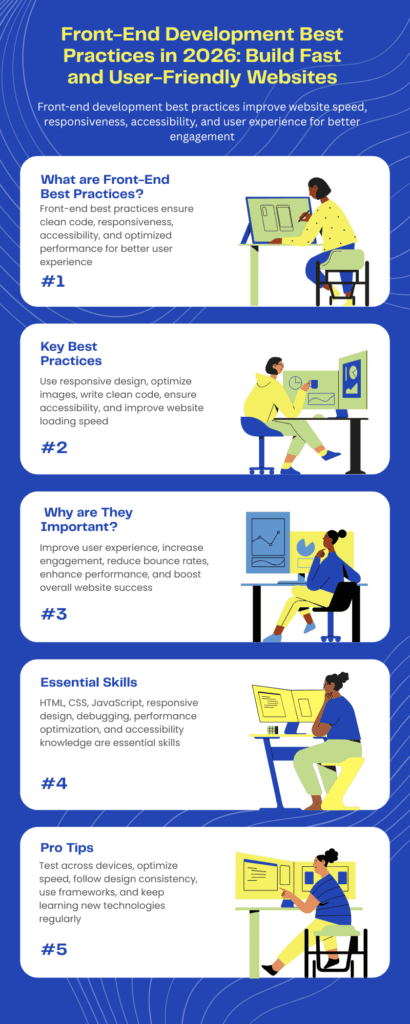
The best practices covered in this guide — performance optimization, accessibility, responsive design, code quality, progressive enhancement — aren’t rules to follow mechanically. They’re expressions of a particular attitude toward the work: that the details matter, that users deserve better than “good enough,” and that the gap between a website that merely functions and one that genuinely serves people is worth caring about and worth closing.
In 2026, the tools available to front-end development are more powerful than ever. Frameworks are mature. Build tooling is sophisticated. Browser capabilities have expanded. But tools are only as valuable as the judgment applied to them. The developers who build the most reliable, most human, most enduring web experiences aren’t necessarily the ones who know the most technologies — they’re the ones who understand why the practices exist, and who carry that understanding into every decision they make.
Build fast. Build accessibility. Build with the person who’ll actually use it firmly in mind.
!You might be interested in reading this page as well
Top 10 Full-Stack Development Languages in 2026: Complete Guide for Beginners