
Introduction to SSC Exam
Every year, millions of young Indians sit down at a desk, sharpen their pencils, and take a shot at one of the most competitive government recruitment processes in the country. Some of them have been preparing for months. Some for years. A few walk in underprepared, hoping luck will carry them through. It seldom does.
If you are reading this, you are probably somewhere in the middle — serious enough to look for a guide, but maybe not yet sure where to start or whether your current preparation is actually working. That is a good place to be. The SSC Exam rewards people who plan carefully, study consistently, and understand how the process actually works — not just those who study the hardest.
This guide is a step-by-step breakdown of how to prepare for the SSC Exam in 2026. It covers what the exam actually tests, why cracking it matters, how to build a study plan that works in real life, what mistakes to avoid, and what separates candidates who clear it from those who keep trying year after year.
What is the SSC Exam?
The Staff Selection Commission (SSC) is a government body that recruits candidates for various central government departments and ministries. The SSC Exam is not a single test — it is a family of examinations, each designed to fill different types of positions.
The most commonly attempted ones include:
- SSC CGL (Combined Graduate Level): For graduate-level posts like Inspector, Auditor, Assistant Section Officer, and Tax Assistant across departments like Income Tax, CBI, and various ministries.
- SSC CHSL (Combined Higher Secondary Level): For 12th-pass candidates applying for posts like Lower Division Clerk, Data Entry Operator, and Postal Assistant.
- SSC MTS (Multi-Tasking Staff): Entry-level positions open to 10th-pass candidates.
- SSC CPO (Central Police Organisations): For Sub-Inspector posts in Delhi Police, BSF, CRPF, and other paramilitary forces.
- SSC JE (Junior Engineer): For engineering graduates targeting civil, electrical, and mechanical roles in government departments.
Each exam has its own eligibility criteria, syllabus, and exam structure — but they share a common testing pattern: objective-type multiple-choice questions across four main subjects — General Intelligence & Reasoning, General Awareness, Quantitative Aptitude, and English Language.
Understanding which SSC exam you are targeting is the first real decision you need to make. Trying to prepare for “SSC” in general, without fixing a specific exam, is one of the most common ways candidates waste months of preparation time.
Why the SSC Exam Matters
Government jobs in India offer something that very few private sector roles can: stability. A confirmed SSC post comes with a fixed salary, annual increments, pension benefits, health coverage, housing allowance, and leave entitlements that compound over a career. For candidates from smaller cities and towns — where private sector opportunities are limited, and salaries are unpredictable — an SSC job is often the clearest path to a stable, respected livelihood through SSC Exam.
There is also a psychological dimension worth acknowledging. Many candidates come from families where a government job represents the first real economic security in a generation. That pressure is real, and it cuts both ways — it motivates, but it also creates anxiety that clouds judgment during preparation and panic during the exam itself. Recognizing this early matters. Your performance on the day depends not just on how much you studied, but on how well you manage the mental weight of the attempt. Candidates who treat preparation as a process — with measurable weekly targets and honest self-assessment — handle exam pressure significantly better than those who treat it as a high-stakes gamble.
The competition is fierce. SSC CGL 2024 saw over 17 lakh candidates register for roughly 17,000 vacancies. That is a 1% selection rate before accounting for candidates who don’t show up. The numbers for CHSL and MTS are even more lopsided. This is not shared to discourage you — it is shared so you understand that vague preparation will not work. You need a plan that is specific, sustained, and honest about the gaps in your current knowledge in the SSC Exam.
Key Aspects of SSC Exam Preparation
1. Understanding the Exam Structure
Before you open a single book, understand how the exam is structured — specifically for the SSC exam you are targeting.
For SSC CGL (the most widely attempted):
Tier 1 — Computer-based, 100 questions, 60 minutes, 200 marks. Covers all four subjects (25 questions each). There is a negative marking of 0.50 per wrong answer.
Tier 2 — Computer-based, more detailed. Paper 1 covers Maths and Reasoning (2.5 hours, 390 marks). Paper 2 is English and Comprehension. Paper 3 is Statistics (for specific posts). There is negative marking of 1 mark per wrong answer in Tier 2.
The pattern matters for two reasons:
- Negative marking changes your strategy. It means attempting every question recklessly will hurt your score. You need to know when to skip.
- Tier 1 is a filtering exam — it exists to reduce the candidate pool. Your Tier 1 strategy is about clearing the cutoff, not maximizing marks. Tier 2 is where you build your actual score.
2. Subject-by-Subject Breakdown
General Intelligence and Reasoning
This section tests logical thinking, not memorized knowledge. Topics include: Analogies, Series (number and letter), Coding-Decoding, Blood Relations, Direction Sense, Syllogisms, Matrix questions, and Figure-based questions (Venn diagrams, pattern completion).
The good news: this section is learnable through practice. The bad news: it cannot be crammed the night before. You need consistent, daily exposure to different question types so your brain starts recognizing patterns quickly. Target 30–40 minutes of Reasoning practice daily.
General Awareness
This is the widest section and the hardest to prepare completely. It covers: Current Affairs (last 6–12 months), Static GK (History, Geography, Polity, Economics, Science), and SSC-specific favorites like sports, awards, important dates, and government schemes.
The honest reality: you will never be fully prepared for this section. The questions are unpredictable. What you can do is cover the high-frequency topics thoroughly — Indian Polity (Constitution, Articles, Amendments), History (Modern India especially), Geography (Physical and Indian), and a strong 12-month current affairs base.
One habit that pays off: read a daily current affairs summary every morning. Not 45 minutes of newspaper — 10 minutes of a structured daily GK capsule. Over 6 months, this compounds.
Quantitative Aptitude
For most candidates, this is either the strongest section or the most feared. Topics include: Number System, Simplification, Percentage, Ratio & Proportion, Average, Profit & Loss, Simple & Compound Interest, Time & Work, Speed-Distance-Time, Geometry, Mensuration, Trigonometry, Algebra, and Data Interpretation.
The key insight is that SSC Maths questions follow patterns. The same types of problems appear year after year with different numbers. Studying previous year papers is not just useful here — it is essential. Once you have solved 200+ questions on Profit & Loss, you will recognize the underlying structure of any new problem in that category.
Do not ignore Geometry and Trigonometry. Many candidates skip them because they feel hard. But they appear consistently in both Tier 1 and Tier 2, and strong preparation here is a genuine differentiator.
English Language
This section tests: Reading Comprehension, Cloze Test, Para Jumbles, Error Spotting, Sentence Improvement, Fill in the Blanks, Synonyms, Antonyms, Idioms & Phrases, and One-word Substitution.
The most common mistake in this section is focusing only on vocabulary lists. Vocabulary matters — but grammar and sentence structure questions make up a large part of the paper. Work on both. Read one English editorial daily (The Hindu or Indian Express) — not to understand politics, but to absorb how correct, formal English is structured.
3. Building a Study Schedule That Works
Most study plans fail because they are built around ideal conditions. You need a plan built around your actual life.
Here is a realistic framework for a 6-month preparation timeline:
Months 1–2 (Foundation Phase)
- Cover each subject’s basic concepts thoroughly.
- Do not attempt full mock tests yet.
- Use standard textbooks: Rakesh Yadav or R.S. Aggarwal for Maths, Lucent’s GK for Static GK, R.S. Aggarwal for Reasoning, and Neetu Singh or SP Bakshi for English.
Months 3–4 (Practice Phase)
- Shift the majority of time to previous year papers and topic-wise practice sets.
- Start attempting sectional mock tests.
- Begin daily current affairs.
Months 5–6 (Revision and Mock Test Phase)
- Full-length mock tests every 2–3 days.
- Analyze every mock test — not just your score, but which questions you got wrong and why.
- Revise weak areas identified through mock analysis.
- Do not start new topics. Strengthen what you already know.
Practical Tips for SSC Exam Preparation

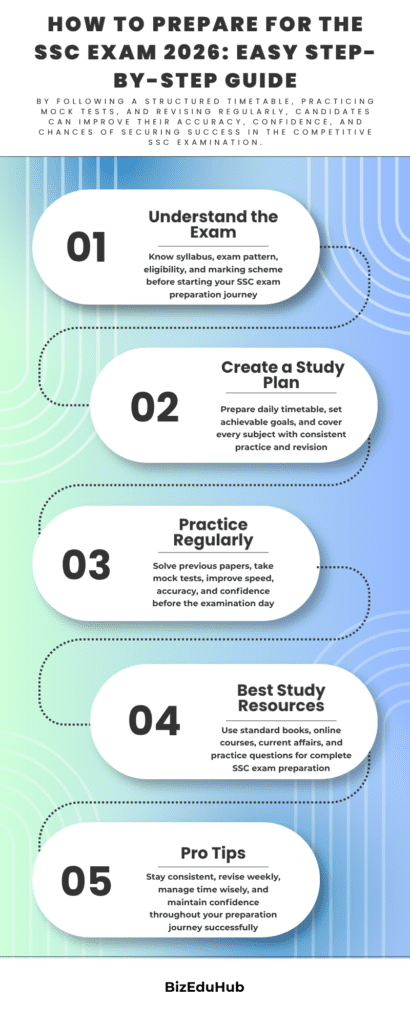
- Fix your exam before you fix your syllabus. SSC CGL and SSC CHSL have different syllabi and different difficulty levels. Know which one you are preparing for.
- Solve previous year papers first, not last. Most candidates treat past papers as revision material. They should be your starting point — they show you what the exam actually tests, and what level of difficulty you need to reach.
- Track your mock test performance in a spreadsheet. Write down your score, the number of attempts, accuracy percentage, and which topics you got wrong. Patterns emerge over 10–15 mocks that you will not notice otherwise.
- Learn the art of skipping. With negative marking, a question you are 50-50 on is statistically a bad attempt. Practice identifying questions you can solve confidently versus questions where you are guessing. Skip the latter in Tier 1; it protects your score on the SSC exam.
- Revise more than you study. Most candidates spend 80% of their time learning new content and 20% revising. Flip that ratio in the last two months. You forget more than you think.
- One coaching source is enough. Switching between five YouTube channels, three books, and two test series is how you create the feeling of productivity while making very little actual progress.
Real-Life Examples of SSC Exam
Ravi, from a small town in UP: Ravi attempted the SSC exam three times before clearing it in his fourth attempt. His first two attempts had no structure — he read everything, prepared nothing specifically. In his third attempt, he started attempting mocks and discovered his Maths score was consistently 15–20 marks below the cutoff, but his Reasoning and English were strong. He spent 3 months almost exclusively on Maths in his fourth attempt. He cleared Tier 1 with a comfortable margin and got posted as an Inspector.
The lesson: mock tests told him something that months of general study didn’t. Data from your own performance is more valuable than any coaching advice.
Prerna, a Delhi University graduate: Prerna prepared for the SSC exam alongside her final year of college. She had 2–3 hours of focused study time daily, not more. Instead of trying to cover everything, she built a very strong Reasoning and English base (her natural strengths) and targeted only high-frequency Maths topics. She cleared Tier 1 comfortably, struggled in Tier 2 Maths, but her English Paper 2 score was high enough to compensate.
The lesson: playing to your strengths while meeting the minimum threshold in weak areas is a legitimate strategy — especially in time-constrained preparation.
Common Mistakes to Avoid in the SSC Exam
- Preparing without a target exam: “I’m preparing for SSC exam” is not a preparation plan. Fix the exam, fix the date, build backward from there.
- Ignoring negative marking in mock tests: Many candidates attempt 95+ questions in Tier 1 practice sets without caring about accuracy. In the real exam, 20 wrong answers out of 100 attempts cost you 100 marks — often the difference between clearing and not clearing.
- Over-investing in Current Affairs at the cost of Static GK: Current Affairs is unpredictable. Static GK questions — especially from Polity, History, and Science — are more predictable and higher frequency. Balance your GK preparation accordingly.
- Not analyzing mock tests: Taking 30 mocks and improving by 5 marks total means you are practicing, not learning. The analysis — understanding why you got a question wrong — is where the actual improvement happens.
- Starting serious preparation too late: SSC Tier 1 dates are announced 3–4 months in advance. That is not enough time to build from zero. Preparation needs to start 6–8 months before the SSC exam.
- Relying on shortcuts for Maths: “Tricks” for Maths problems work when you recognize the problem type immediately. If your conceptual base is weak, you will freeze when a question is slightly different from what you practiced. Learn the concept first, shortcut second.
Frequently Asked Questions About SSC Exam
Q1. How many hours of study per day are required to crack the SSC exam?
There is no universal answer, but 5–6 focused hours daily is a realistic benchmark for a 6-month preparation. “Focused” means no phone, no distractions, and active engagement — not passive reading. Quality matters more than duration. 4 hours of active problem-solving beats 8 hours of unfocused reading every time.
Q2. Is coaching necessary for SSC exam preparation?
No. Thousands of candidates clear SSC exams every year through self-study using standard books and free online resources. Coaching helps candidates who need structure, accountability, or struggle with specific subjects. If you are disciplined and can follow a self-made schedule, you do not need paid coaching. What you do need is a good test series — that is not optional.
Q3. How important are previous year question papers?
They are the single most important study material you have. SSC exams follow patterns. The type of questions, the difficulty level, the topics that appear repeatedly — all of this is visible in previous year papers. Solve the last 5–7 years of papers for your target exam before you do anything else.
Q4. What is the best time to start preparing for SSC CGL 2026?
If the SSC exam is expected in mid-to-late 2026, starting in January 2026 gives you a 6–8 month preparation window — sufficient for most candidates with a graduate background. If you are starting from scratch with weak fundamentals, starting earlier (October–November 2025) is more realistic.
Q5. Can I prepare for SSC CGL and SSC CHSL simultaneously?
The syllabi overlap significantly, so joint preparation is possible. However, the difficulty level of CGL (especially Tier 2 Maths) is significantly higher than CHSL. If CGL is your primary target, prepare for CGL — CHSL will be a natural byproduct. Reversing this and preparing for CHSL while hoping CGL works out is a recipe for underperforming in both.
Conclusion
The SSC Exam is not an intelligence test. It is a preparation test. The candidates who clear it are not always the smartest people in the room — they are the ones who built the right habits, stuck to a plan when it got boring, and did not panic when the exam was harder than expected. What separates successful candidates from those who try year after year without clearing is almost always the same: specificity. Specific exam target. Specific subject-wise weaknesses addressed with specific practice. Specific mock test analysis, not just mock test attempts.
If you take one thing from this guide, let it be this: figure out exactly where you are weak, and spend disproportionate time there. Not on the subjects you enjoy. Not on the topics that feel comfortable. On the gaps between your current performance and the cutoff. The SSC exam does not care about your intentions, your background, or how many hours you sat at a desk. It only measures what you can actually do under time pressure — so practice under those exact conditions, every single time.
!You might be interested in reading this page as well
How to Understand the SSC Exam Syllabus 2026: Best Subject-Wise Guide