
Introduction to Finance Tips
There’s a moment most of us remember — that first time you checked your bank balance and felt a quiet dread settle in. Maybe it was after a semester of college, a big move to a new city, or simply the realization that nobody ever sat you down and explained how money actually works. You weren’t taught this in school. Your parents may have been too busy surviving their own financial reality to pass along a roadmap. And so here you are, figuring it out as you go, hoping you’re not already too far behind.
The good news? You’re not behind. And the fact that you’re looking for finance tips right now means you’re already ahead of the curve compared to most people your age.
Money management doesn’t have to be complicated, intimidating, or reserved for people who wear suits and talk about market portfolios. At its core, personal finance is about making intentional choices with your money — choices that give you freedom, security, and eventually, options. Whether you’re just starting your first job, navigating student loans, or trying to stop living paycheck to paycheck, these finance tips will help you lay the kind of foundation that actually holds.

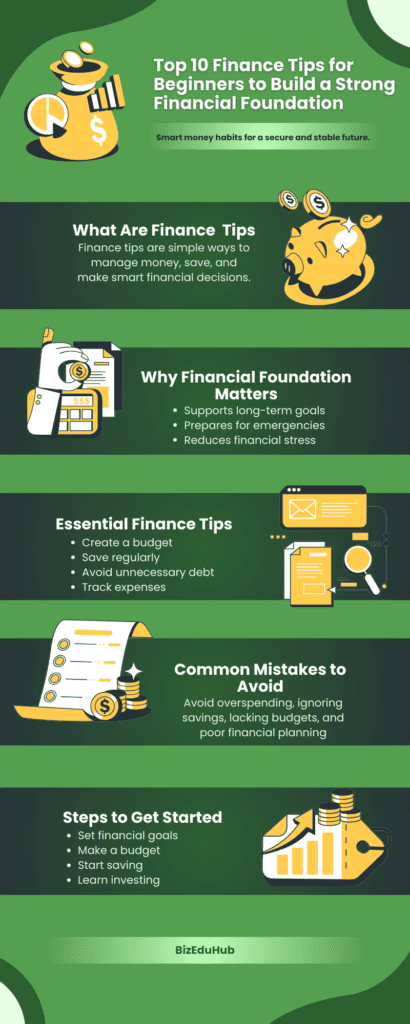
What Are Finance Tips and Why Do They Matter?
When people talk about finance tips, they’re really talking about practical, actionable guidance that helps individuals make smarter decisions about earning, saving, spending, investing, and protecting money. These aren’t abstract theories from a textbook — they’re lessons drawn from real-world experience, behavioral economics, and the hard-won wisdom of people who’ve made plenty of financial mistakes along the way.
Think of personal finance the way you’d think about physical health. You don’t need to become an elite athlete to be healthy. You just need consistent, sensible habits: sleep, movement, food that fuels you. Financial health works the same way. You don’t need to be a Wall Street analyst. You need a handful of solid habits, practiced consistently over time.
For example, a 22-year-old who starts saving just $200 a month and invests it wisely can potentially have over $500,000 by retirement — not because of some complicated strategy, but because of one simple habit started early. That’s the magic of compounding, and it begins with understanding the basics.
Finance tips for beginners focus on those basics: how to budget, how to save, how to avoid debt traps, and how to start building wealth even when you feel like there’s nothing to build with.
Finance Tips: Why Building a Strong Financial Foundation Matters
There’s a reason financial stress is one of the leading causes of anxiety, relationship strain, and even health problems in adults. When your finance tips are shaky, everything else feels unstable. You can’t take risks in your career. You can’t handle emergencies without panic. You can’t be generous to others or even to yourself.
A strong financial foundation changes all of that.
When you have savings behind you and a clear picture of where your money goes, something shifts psychologically. A car repair becomes an inconvenience, not a crisis. A job opportunity that pays less but offers growth becomes a real option. The ability to say “no” to things that don’t serve you — whether that’s a dead-end job, a relationship built on financial dependency, or a purchase you don’t really need — becomes something you actually possess.
Beyond the emotional benefits, the practical reasons are just as compelling. Building good financial habits early means you spend less of your life working to pay off mistakes. It means retiring with dignity rather than desperation. It means having the kind of stability that allows you to be present — for your family, your community, your own ambitions.
The earlier you begin, the less effort it ultimately takes. But it’s never too late to start. Every day you delay simply costs a little more to catch up.
Key Aspects of Personal Finance Tips Every Beginner Should Understand
Understanding the Difference Between Income, Expenses, and Net Worth
Most people think of financial health in terms of income — if you make more, you’re doing better. But the truth is more nuanced. Two people can earn the same salary and end up in completely different financial situations based on their spending habits and the assets they accumulate.
Net worth — the difference between what you own and what you owe — is a far more accurate picture of your financial health. Your income is the engine. Your expenses are the throttle. Your net worth is the destination.
The Role of Mindset in Money Management
Before any of the practical strategies, it’s worth addressing something deeper: your relationship with money. Many of us inherit finance tips attitudes from our families — scarcity mindsets, avoidance behaviors, or the belief that money is somehow dirty or complicated. These inherited beliefs often operate beneath the surface, quietly sabotaging decisions.
Developing financial awareness means examining these beliefs honestly. Do you avoid checking your account because you’re afraid of what you’ll see? Do you spend when you’re stressed as a form of emotional relief? Do you feel guilty about wanting financial security?
The Power of Compound Interest
Albert Einstein reportedly called compound interest the eighth wonder of the world. Whether or not he said it, the math is undeniably extraordinary. When your savings or investments generate returns, and those returns also start generating returns, the growth becomes exponential over time.
This is why starting early matters so much. The money you save at 25 has decades to compound. The money you save at 45 has half as long. Time is your most valuable financial asset when you’re young — more valuable than a high salary, stock finance tips, or any inheritance.
Top 10 Finance Tips for Beginners

1. Create a Budget That Reflects Your Real Life
The problem most people have with budgeting is that they create one based on how they wish they spent money rather than how they actually do. Go back through three months of bank statements, categorize every expense honestly, and build a budget from that reality.
A useful framework is the 50/30/20 rule: roughly 50% of your take-home pay goes to needs (rent, utilities, groceries), 30% to wants (dining out, entertainment, subscriptions), and 20% to savings and debt repayment. It’s not a rigid law — adjust it to fit your situation — but it gives you a solid starting point.
2. Build an Emergency Fund First
Before you invest, before you aggressively pay down debt, before anything else — build an emergency fund. Most financial advisors suggest three to six months of living expenses kept in a liquid, easily accessible savings account.
This fund is not an investment. It’s not meant to grow. It’s meant to protect you. Without it, every unexpected expense becomes a finance tips setback that pushes you further into debt.
3. Understand and Manage Your Debt
Not all debt is created equal. A mortgage at a low interest rate used to buy an appreciating asset is very different from credit card debt at 22% interest. Understanding the distinction — between debt that works for you and debt that works against you — is essential.
For high-interest consumer debt, focus on paying it down aggressively. Use either the avalanche method (tackling highest-interest debt first) or the snowball method (paying off smallest balances first for psychological momentum). Both work — the best one is the one you’ll stick with.
4. Automate Your Savings
Willpower is unreliable. Systems are not. One of the most effective finance tips strategies for beginners is to automate savings, so the decision is made before you ever see the money. Set up an automatic transfer on payday that moves a set amount directly into savings or an investment account.
When you never see the money in your spending account, you adjust your lifestyle to what remains. This is the behavioral hack that makes saving feel effortless over time.
5. Start Investing Early, Even in Small Amounts
Many beginners believe they need a significant amount of money to start investing. They don’t. Most investment platforms today allow you to begin with as little as $10 or $20. The sooner you start, even with modest contributions, the more time compounding has to work in your favor.
For most beginners, a simple index fund — one that tracks a broad market index like the S&P 500 — is a sensible starting point. It’s low-cost, diversified, and historically has outperformed most actively managed funds over the long term.
6. Learn the Basics of Taxes
Understanding how income taxes work, what deductions you might qualify for, and how different types of income are taxed differently is surprisingly impactful finance tips knowledge. Contributing to a 401(k) or IRA, for instance, can reduce your taxable income while simultaneously building retirement savings. That’s a double benefit that too many beginners miss.
You don’t need to become a tax expert. You just need enough knowledge to avoid leaving money on the table.
7. Track Your Spending Consistently
There’s a fascinating thing that happens when you start paying close attention to where your money goes: you naturally start spending less on things that don’t matter to you. Without any rigid restriction, awareness alone tends to shift behavior.
Apps like YNAB, Mint, or even a simple spreadsheet can make tracking easy. The goal isn’t to obsess over every dollar — it’s to stay conscious. Finance tips awareness is a practice, not a one-time audit.
8. Protect Yourself With Insurance
Building wealth is important. Protecting it is equally important. Health insurance, renters’ or homeowners’ insurance, and disability insurance are not optional extras for people who are “being careful.” They are foundational safeguards.
A single medical emergency without insurance coverage can wipe out years of savings. Protecting what you’ve built isn’t pessimism — it’s prudence.
9. Set Clear, Specific Financial Goals
Vague goals (“I want to save more money”) produce vague results. Specific goals with timelines (“I want to save $5,000 in 12 months for a down payment on a car”) give your financial decisions direction and meaning.
Write your goals down. Break them into monthly and weekly milestones. Review them regularly. When your money has a purpose, you become far more intentional about how you use it.
10. Never Stop Learning About Money
Personal finance tips are a lifelong practice, not a problem you solve once. Markets change. Tax laws change. Your income and circumstances change. The most financially secure people are not necessarily those who earned the most — they’re often the ones who kept learning, adjusting, and making informed decisions over time.
Read books. Follow credible financial educators. Talk to people who have achieved the financial stability you’re working toward. The investment in finance tips education pays dividends for the rest of your life.
Real-Life Examples That Bring These Finance Tips to Life
Consider two friends — let’s call them Priya and James. Both start their careers at 24, earning roughly the same income. Priya opens a basic investment account in her first month and sets up an automatic contribution of $150 each month. She builds a $2,000 emergency fund before doing anything else and tracks her spending loosely each week. She doesn’t follow the markets obsessively. She just stays consistent.
James plans to start investing “once things settle down.” He has good intentions but doesn’t automate anything, relies on a mental budget, and dips into savings whenever an unexpected expense arises — which seems to happen every few months.
By the time both are 40, the financial gap between them is staggering — not because Priya earned more or made riskier bets, but because she built simple systems early and let time do the heavy lifting.
This scenario plays out in real life constantly. The defining factor isn’t usually intelligence or income. It’s consistency, awareness, and the willingness to start finance tips for beginners before you feel ready.
Common Finance Tips Mistakes Beginners Make
- Lifestyle inflation. As income increases, expenses tend to rise right alongside it — often faster. The antidote is to increase your savings rate every time you get a raise, even by just a small percentage, before you adjust your lifestyle.
- Skipping the emergency fund. Investing before building a financial cushion is a common misstep. Without liquid savings, one bad month can force you to sell investments at a loss or take on high-interest debt — wiping out the gains you were trying to build.
- Ignoring employer benefits. If your employer offers a 401(k) match and you’re not contributing enough to claim the full match, you’re turning down free money. This is one of the most common — and most costly — finance tips oversights among beginners.
- Treating credit cards like income. Credit cards are a tool. Used well (paid in full each month), they offer rewards and help build credit history. Used poorly, they become a debt trap with brutal interest rates. The rule is simple: don’t charge what you can’t pay off at the end of the month.
- Waiting until you “know more” to start. Financial paralysis is real. People convince themselves they need to fully understand every investment vehicle, tax implication, and market cycle before they begin. But waiting costs more than a few mistakes ever would. Start simple, start now, and learn as you go, with finance tips.
Frequently Asked Questions About Finance Tips for Beginners
Q1. How much should I save each month as a beginner?
There’s no universal answer, but a good benchmark is to save at least 20% of your net income, divided between an emergency fund, short-term goals, and long-term investments. If 20% feels impossible right now, start with whatever you can — even 5% — and increase it gradually. The habit matters more than the number in the beginning.
Q2. What are the best finance tips for someone drowning in debt?
Stop adding to it, first finance tips. That sounds obvious, but the priority is to halt the bleeding before figuring out how to treat the wound. Once you’ve stopped accumulating new debt, list everything you owe, identify the highest-interest balances, and attack them with any extra money you can redirect. Consider whether debt consolidation or refinancing might lower your interest rates.
Q3. Is investing in your 20s really that important?
Absolutely. The mathematics of compounding makes the money you invest in your 20s potentially worth ten times more than money invested in your 40s. Even modest amounts invested consistently in a diversified index fund can grow dramatically over a 40-year horizon. Starting early is one of the most powerful financial advantages available to young people.
Q4. How do I start building good credit as a beginner?
Open a credit card (ideally with no annual fee), use it for small regular purchases like groceries or fuel, and pay the full balance every single month. Never miss a payment. Keep your utilization rate — the percentage of your available credit that you’re using — below 30%. Over time, this builds a strong credit history that will benefit you when applying for loans, renting apartments, or even getting certain jobs.
Q5. What’s the difference between saving and investing?
Saving means keeping money in a safe, accessible account — usually earning minimal interest — for short-term needs and emergencies. Investing means putting money into assets (stocks, bonds, real estate, etc.) with the expectation of growth over time, which comes with more risk but also more potential reward. Both are necessary. Saving protects you. Investing grows you.
Conclusion
Building financial stability isn’t about being perfectly disciplined or having all the answers from day one. It’s about making a series of small, consistent choices that compound over time — much like the interest you’re trying to earn. The finance tips in this article aren’t magic formulas. They’re practical habits that, when practiced with patience and honesty, genuinely transform your relationship with money.
Start where you are. Create a budget that reflects reality, not idealism. Build your emergency fund before anything else. Automate what you can. Invest early and keep learning. Protect what you build. And give yourself the grace to make mistakes, course-correct, and keep going.
The strongest financial foundation isn’t built in a day — it’s built in the daily choices you make about where your money goes and why. You don’t need to be wealthy to start managing money well. But managing money well is very often how people build wealth.
That journey begins right here, with the finance tips you choose to act on today.
!You might be interested in reading this page as well
How to Start an E-Commerce Business Successfully (Step-by-Step Guide)