
Introduction to UX Researcher
There’s a particular kind of satisfaction that comes with understanding people — really understanding them — not just what they click on, but why they hesitate before they do. That’s the quiet magic behind the work of a UX researcher. On paper, a UX researcher studies users and reports findings. In practice, they spend their days listening to frustrations that users can barely articulate, decoding behaviors that contradict what people say they want, and translating all of that messy, human complexity into insights that shape products used by millions.
It’s not a glamorous role in the way that design or engineering often appears. There are no sleek Figma prototypes to admire, no code deployments to celebrate. But the decisions a UX researcher influences — about onboarding flows, navigation structures, error messages, and checkout experiences — can determine whether a product thrives or quietly gets abandoned. If you’ve ever wondered what a day in this profession actually looks like, beyond the sanitized job descriptions, this article is for you. Whether you’re aspiring to enter the field or you’re a seasoned practitioner looking to reflect on your craft, there’s something here worth exploring.

What is a UX Researcher?
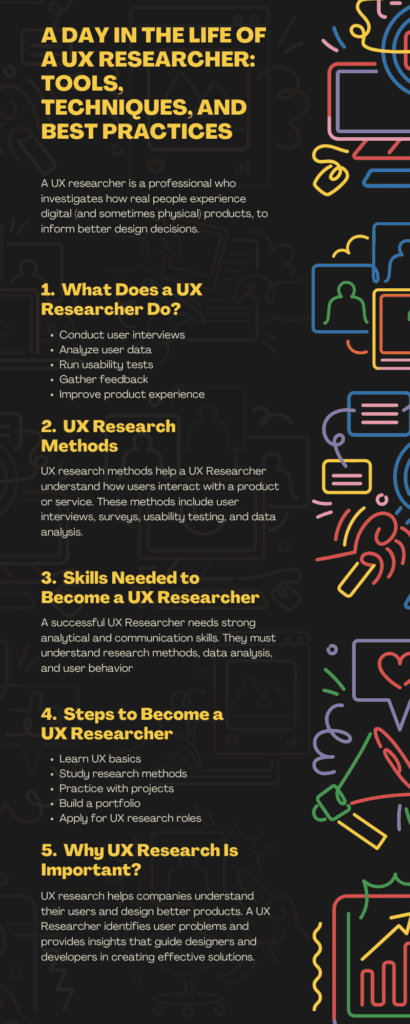
A UX researcher is a professional who investigates how real people experience digital (and sometimes physical) products, to inform better design decisions. The “UX” stands for user experience, but a researcher in this field is less focused on how something looks and more interested in how it feels — how intuitive it is, how it maps to a user’s mental model, and how it either reduces or amplifies friction in their lives.
To put it simply, if a designer asks, “How should this look?”, a UX researcher asks,s “Does this actually work for the person using it?”
The role spans a broad spectrum of methodologies. On one end, there’s qualitative research — one-on-one interviews, usability tests, contextual inquiries, and diary studies — that explores the depth of human experience. On the other end sits quantitative research: surveys, analytics analysis, A/B test interpretation, and card sorting data that reveal patterns across large populations. Most UX researchers live somewhere in the middle, combining both approaches depending on the question they’re trying to answer.
In a tech company, a UX researcher might work embedded within a product team, collaborating daily with product managers, designers, and engineers. In a consultancy, they might rotate across different clients and industries, bringing fresh eyes to problems in healthcare, finance, retail, and beyond. In either context, their core responsibility remains the same: bridging the gap between what a business assumes about its users and what those users actually need.
Why a UX Researcher is Important?
It might be tempting to think that a skilled designer can intuit what users need, or that product managers can gather enough insight from customer support tickets and app store reviews. In reality, those approaches catch symptoms but rarely diagnose causes. A dedicated UX researcher goes further — identifying not just what broke but why it felt broken, and what underlying expectation the interface violated.
Consider the example of a fintech startup that built a savings feature with all the right functionality: automatic round-ups, goal trackers, and visual progress bars. The team was proud of it. But activation rates were dismal. Only after a UX researcher conducted a series of user interviews did the team discover that users found the round-up mechanism deeply confusing — they didn’t trust that their checking account balance was accurate after automatic deductions. The feature wasn’t lacking in features; it was lacking in clarity and trust. No amount of dashboard analytics would have surfaced that insight. It took a conversation.
That story plays out across industries every day. UX researchers help organizations avoid building solutions to problems they’ve misunderstood. They reduce costly redesigns by catching usability issues early in the design process, often during the prototype stage when changes are cheap rather than after launch when they’re expensive. They also serve as a constant voice for users inside organizations that are otherwise dominated by internal priorities, business logic, and technical constraints.
Beyond problem-solving, UX researchers contribute to a culture of empathy within product teams. When developers and executives sit in on user interviews — watching real people struggle with the product they built — it changes how they think. It makes abstract “users” into real, specific human beings with real, specific contexts. That shift in perspective is arguably one of the most valuable things a UX researcher can offer.
Key Aspects of a UX Researcher’s Day
1. Morning: Planning and Prioritization
Most UX researchers don’t walk into an office and immediately begin interviewing users. The morning often starts with reviewing the research roadmap — a living document that maps out upcoming studies, their objectives, the methods to be used, and their expected timelines. Before a single participant is recruited, there’s significant work in scoping the research question.
a. Crafting Research Questions That Actually Matter
One of the most underappreciated skills in the field is the ability to translate a vague business question — “Why aren’t users upgrading to premium?” — into a specific, answerable research question: “What do users perceive as the primary barrier to upgrading, and what would need to change for them to reconsider?”
That distinction matters enormously. The first question invites speculation. The second guides methodology, recruitment criteria, discussion guides, and ultimately the kind of data that comes back.
b. Stakeholder Alignment
Before any research kicks off, a skilled UX researcher typically meets with stakeholders — the product manager, the designer, the data analyst — to align on what decisions the research needs to inform. This isn’t a formality. Without it, research can produce rich findings that sit unused because they don’t connect to any decision currently on the table.
2. Midday: In the Field
If there’s fieldwork scheduled — usability tests, remote interviews, or in-person contextual inquiries — midday is often the most intense and alive part of the day. This is where the craft shows up most visibly.
a. Conducting Usability Tests
A usability test typically involves asking a participant to complete a series of tasks using a product while thinking aloud. The researcher observes, probes, and resists the almost overwhelming urge to help. There’s an art to the silence in a usability test — knowing when not to answer a participant’s question because doing so would rob you of the insight hiding inside their confusion.
The tools here vary. Moderated tests might use Lookback, UserZoom, or simply Zoom with screen sharing. Unmoderated tests — where participants complete tasks independently — are often run through platforms like UserTesting or Maze. Each approach has tradeoffs in terms of depth, scalability, and the type of follow-up questions you can ask.
b. Interviewing Users
User interviews deserve their own category because they’re as much a conversational skill as a research skill. The best UX researchers are not just good questioners — they’re good listeners. They notice when a participant’s words and body language diverge. They follow threads that weren’t on the discussion guide because something interesting surfaced. They ask, “Can you say more about that?” at exactly the right moment.
The discussion guide — a semi-structured document of topics and questions — serves as a compass rather than a script. Sticking too rigidly to it produces the kind of sanitized interview data that looks complete but reveals little.
3. Afternoon: Analysis and Synthesis
The data has been collected. Now comes the part that separates good UX researchers from great ones: sense-making.
a. Affinity Diagramming and Thematic Analysis
After interviews or usability tests, researchers often transcribe key observations onto digital sticky notes (using tools like Miro, FigJam, or Dovetail) and begin clustering them into themes. This process — affinity diagramming — can feel chaotic at first, especially when you’re staring at 200 observations from 10 participants. But patterns begin to emerge. Recurring frustrations, shared mental models, unexpected workarounds — these clusters become the backbone of the research report.
b. Turning Findings into Actionable Insights
Here’s something that many newer UX researchers struggle with: the difference between an observation, a finding, and an insight. An observation is what you saw (“Users clicked the wrong button three times”). A finding is the pattern behind it (“Eight out of ten participants clicked the wrong button”). An insight explains why it matters and what it implies (“The button’s visual weight and placement suggest primary action, but it performs a secondary function — the interface is creating a systematic expectation mismatch”).
That last formulation is what drives design decisions. It’s also what makes UX research feel essential rather than optional.
Practical Tips for UX Researchers

- Recruit participants who represent real users, not convenient ones. It’s tempting to test with colleagues or friends, but proximity bias is real. Always recruit based on defined criteria that match your actual user base.
- Pilot every study before going live. Run a pilot session with someone outside the team to catch confusing instructions, broken prototype links, or questions that lead witnesses rather than invite honest responses.
- Document as you go. Don’t rely on memory between sessions. Even brief notes taken immediately after each interview dramatically improve the quality of your synthesis later.
- Bring stakeholders into the research process early, not just at the debrief. Invite a designer or PM to observe sessions — with camera off if the participant prefers. Observed insights land differently than reported ones.
- Never ask “Would you use this feature?” Direct questions about hypothetical future behavior are notoriously unreliable. Instead, explore past behavior: “Tell me about the last time you tried to accomplish this.”
- Separate data collection from interpretation. During the session, focus entirely on observation. Reserve judgment for the analysis phase, where you can see patterns across multiple participants.
- Make research visible. Share findings through channels the team already uses — Slack summaries, design system wikis, short video clips. A 40-page report read by two people is less valuable than a 10-minute presentation seen by twenty.
Real-Life Examples of a UX Researcher at Work
1. The Checkout Abandonment Mystery
An e-commerce team noticed a consistent spike in cart abandonment during the checkout flow, specifically at the payment step. The analytics data showed the drop-off clearly — but not why. The UX researcher running the project recruited twelve participants across different age groups and ran moderated usability tests.
What emerged was unexpected. A large proportion of participants abandoned checkout not because of payment friction, but because of the shipping cost reveal, which appeared for the first time at that final step. Several participants said, in different ways, “I just felt deceived.” The insight wasn’t about payment UX at all. It was about trust and expectation management earlier in the journey. The solution — surfacing estimated shipping costs on the product page — reduced abandonment by a significant margin in the subsequent A/B test.
2. The Onboarding That Felt Like Homework
A productivity app had strong download numbers but poor Day-7 retention. Diary studies commissioned by the UX researcher revealed that users felt overwhelmed during the first session. The onboarding was thorough — too thorough. It asked users to configure settings, connect integrations, and set goals before they’d experienced a single moment of the app’s core value.
The researcher’s recommendation was simple: let users experience one successful outcome before asking them to invest further. The redesigned onboarding — which deferred configuration in favor of an immediate “quick win” — improved Day-7 retention considerably. The insight came from watching users’ emotional states unfold over time through their diary entries, not from a one-time survey.
Common Mistakes UX Researchers Should Avoid
- Leading questions during interviews. “Do you find the navigation confusing?” presupposes confusion. “How do you feel when you’re looking for a specific section?” opens the door to an honest answer in either direction. Crafting neutral, open-ended questions is a discipline that takes consistent practice.
- Treating small samples as statistically significant. Qualitative research with eight participants is not meant to produce percentage findings. When a researcher says “most users struggled with this,” they mean most of the eight people they observed — a very different claim from “70% of all users struggle.” Being precise about what qualitative data can and cannot tell you prevents misuse of findings downstream.
- Reporting findings without connecting them to decisions. Research that doesn’t inform a choice or recommendation quickly earns a reputation for being interesting but not actionable. Always ask, before writing the report: “What should the team do differently as a result of this?”
- Skipping the debrief with participants. The last few minutes of a research session, when you step out of the structured questions and simply ask “, Is there anything else you’d want us to know?” sometimesproduce thee most important insight of the entire session. Don’t skip it.
- Confusing satisfaction with usability. A user can complete a task successfully and still leave feeling vaguely unsatisfied. Conversely, a user who struggles might feel that the product is engaging and worth the effort. Measuring both task success and emotional response gives a more complete picture.
Frequently Asked Questions
Q1. What qualifications does a UX researcher need?
There’s no single educational path that defines the role. Many UX researchers come from backgrounds in psychology, sociology, anthropology, human-computer interaction, or cognitive science. Others transition from design, journalism, or social work. What matters more than formal credentials is demonstrated ability — a portfolio of research work, familiarity with core methods, and the ability to communicate findings clearly. Several universities now offer UX-specific programs, and platforms like Coursera and Nielsen Norman Group offer respected certifications.
Q2. How is UX research different from market research?
Market research tends to focus on large-scale consumer attitudes and market opportunities — it answers questions like “Is there demand for this product?” or “How does our brand rank against competitors?” UX research focuses specifically on the experience of using a product — it answers questions like “Can people figure out how to use this?” or “What mental model do users bring to this interaction?” Both are valuable, but they ask fundamentally different questions and require different methodologies.
Q3. How many participants should a typical usability study include?
Jakob Nielsen’s widely cited research suggests that five participants are sufficient to uncover about 85% of usability issues in a qualitative study. This holds when the participant group is relatively homogeneous. For broader or more segmented user bases, larger samples — or multiple rounds of five — are often recommended. For quantitative studies (surveys, unmoderated tests), statistical validity typically requires much larger samples, often 50 to 200 or more, depending on the confidence level required.
Q4. What tools do UX researchers commonly use?
The toolkit varies by method and organization. For recruiting, tools like User Interviews or Respondent are popular. For remote moderated sessions, Zoom, Lookback, or UserZoom are common. For unmoderated testing, UserTesting, Maze, and Optimal Workshop are widely used. For analysis and synthesis, Dovetail, Miro, FigJam, and Notion are frequently mentioned. For surveys, Google Forms, Typeform, and Qualtrics serve different levels of analytical rigor. The specific tools matter less than knowing when and why to use each approach.
Q5. How do UX researchers measure the impact of their work?
This is one of the field’s ongoing challenges. Direct attribution is difficult — a researcher rarely gets to say “my study caused a 20% increase in conversion.” But impact can be tracked in more nuanced ways: Did a redesign informed by research perform better than previous iterations? Were usability issues identified in testing absent from post-launch support tickets? Did the research prevent a costly feature from being built on faulty assumptions? Building a habit of connecting research recommendations to outcomes — even informally — helps researchers demonstrate their value over time.
Conclusion
The day in the life of a UX researcher is rarely predictable, always human, and often quietly profound. It involves equal parts rigor and empathy — the statistical curiosity to notice patterns and the emotional intelligence to understand what those patterns mean for real people living real lives. A UX researcher doesn’t just study behavior; they advocate for the humans on the other side of every screen, every interface, every click.
What makes this work meaningful isn’t just the methodologies or the tools, though those matter. It’s the underlying conviction that the experience of using something should be designed with genuine understanding — not guesswork, not assumptions, not the perspective of a team room where everyone looks the same and thinks the same. It should be designed with evidence gathered in honest conversation with the people who matter most: the users themselves.
If you’re considering a career in this field, or if you’re already in it and looking to deepen your practice, the most important investment you can make is in your listening. Not just the active, nodding kind, but the deep, curious, patient kind that makes another person feel genuinely heard. Because at the end of a long day of sessions, sticky notes, and synthesis, that’s what UX research ultimately is: an organized, principled, evidence-based act of paying attention.
And in a world that moves faster every year, paying attention is more valuable than it has ever been.
!You might be interested in reading this page as well
Top AI Tools for Design in 2026: Transform Your Creative Process