
Introduction to the Right Career Path
There’s a moment most of us have experienced — sitting across from a relative at a family gathering, being asked the dreaded question: “So, what do you want to do with your life?” For some, that question lands like a lightning bolt of clarity. For the rest of us, it’s a quiet, low-grade panic dressed up in polite small talk.
Choosing the right career path is one of the most layered, personal, and consequential decisions you’ll ever make. It’s not just about picking a job title or chasing a salary — it’s about figuring out who you are, what you’re genuinely good at, and where you can contribute meaningfully to a world that’s constantly shifting beneath your feet. And yet, so many people stumble into careers by accident: they follow a parent’s suggestion, take the first offer that came along, or choose a major because it sounded impressive rather than because it felt true.
This guide is for anyone who’s ever felt lost at that crossroads. Whether you’re a fresh graduate staring down your first big decision or a mid-career professional wondering if it’s too late to pivot, understanding how to evaluate your interests, sharpen your self-awareness, and read market trends can be genuinely transformative. The right career path isn’t a fixed destination — it’s a direction, and finding it starts with asking better questions.

What is the Right Career Path?
The phrase “right career path” gets thrown around a lot, but it means something different for everyone. At its core, it refers to a professional trajectory that aligns with your authentic strengths, sustains your motivation over the long term, and places you in a market where your skills are valued and needed.
It’s worth separating this from a few common misconceptions. The right career path is not necessarily the most prestigious one, nor is it simply the most lucrative. A neurosurgeon might earn far more than a middle school teacher, but that doesn’t mean neurosurgery is the right path for someone whose deepest satisfaction comes from watching young minds light up with curiosity.
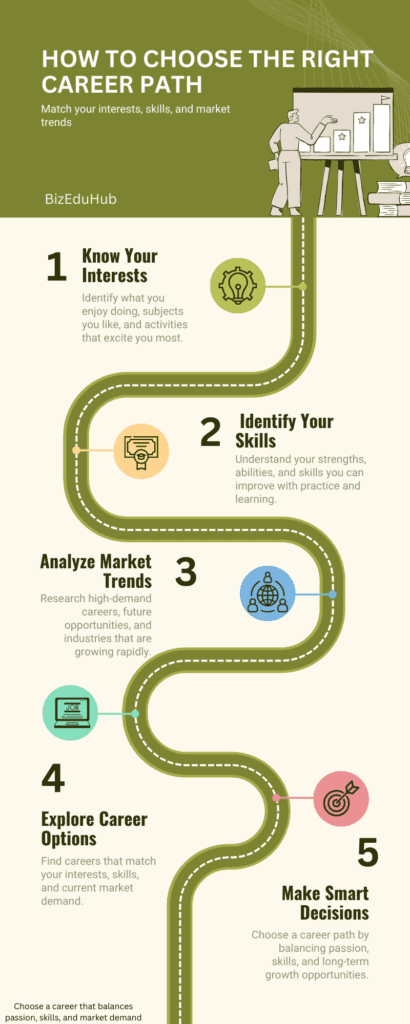
Think of career alignment on three intersecting axes: passion (what energizes you), proficiency (what you’re genuinely skilled at), and market demand (what the world is willing to pay for). The Japanese concept of ikigai captures this beautifully — it describes a sweet spot where what you love, what you’re good at, what the world needs, and what you can be paid for all converge. That intersection is rare, but it’s worth chasing.
Consider the case of a graphic designer named Priya who spent her twenties in a corporate marketing role that paid well but left her hollow. She was technically competent, but her real love was data visualization — transforming complex datasets into visual stories. After some reflection and retraining, she transitioned into data design, a niche that blended her artistic instincts with analytical thinking. The salary was comparable, but the sense of purpose was incomparably richer. That’s what finding the right career path actually looks like in practice.
Why Choosing the Right Career Path Matters
It’s tempting to think of the right career path choice as a practical matter — something that affects your income and your schedule but not much else. But the research tells a different story. Studies in occupational psychology consistently show that career satisfaction is one of the strongest predictors of overall life satisfaction, mental health, and even physical well-being.
When you’re in the wrong career, the effects seep into everything. You wake up dreading Mondays. You feel the slow erosion of your confidence when tasks that should challenge you in good ways only exhaust you. Relationships strain under the weight of unexpressed resentment. And perhaps most painfully, there’s a quiet sense of time slipping away — of spending your most energetic, capable years building something that doesn’t feel like yours.
Conversely, when people find meaningful professional direction, something shifts. They become more resilient in the face of setbacks because the work itself gives them a reason to persist. They’re more creative, more collaborative, more willing to invest in growth. The stakes of this decision, in other words, go far beyond the paycheck.
There’s also a social dimension worth acknowledging. A well-chosen right career path isn’t just good for the individual — it tends to produce better professionals, more dedicated employees, and more innovative contributors. Organizations benefit enormously when people are doing work that genuinely suits them. The entire ecosystem improves.
Key Aspects of Evaluating Your Right Career Path
1. Understanding Your Interests Deeply
Most right career path starts with “follow your passion,” but that framing can be paralyzing. What if you have multiple passions? What if your passions don’t seem marketable? A better question isn’t what do you love,e but what kinds of problems do you love solving?
Interests reveal themselves in specific behaviors. Notice what you read voluntarily, what conversations you lose track of time in, what tasks you’d do even if no one was watching or paying you. These breadcrumbs often point toward a core theme. Someone who obsessively reads about criminal justice reform, volunteers at legal aid clinics, and stays up late watching documentaries about wrongful convictions is telling you something important about their professional north star.
Tools for Uncovering Your Interests
The Holland Code assessment (RIASEC) categorizes people into six broad types — Realistic, Investigative, Artistic, Social, Enterprising, and Conventional — and maps those to career families. The Strong Interest Inventory goes further, comparing your responses to those of people who are already thriving in specific fields. These aren’t crystal balls, but they’re useful mirrors.
Journaling is equally powerful. Spend two weeks writing brief notes at the end of each day: What energized you today? What drained you? Over time, patterns emerge that are hard to ignore.
2. Honest Assessment of Your Skills
Interests and skills are related but not identical. You can be interested in music and have average pitch; you can be skilled at accounting and find it soul-crushing. Effective right career path planning requires an honest inventory of bot— and a willingness to sit with the gaps between them.
Hard skills — technical competencies like coding, writing, financial modeling, or surgical technique — are often easier to assess because they’re measurable. Soft skills — things like leadership, communication, empathy under pressure, or the ability to synthesize complexity into clarity — are subtler but often more decisive in long-term career success.
The Feedback Gap
One of the most reliable ways to understand your actual skills (versus your perceived skills) is to actively seek honest feedback. Ask a trusted mentor, a former colleague, or even a close friend: “What do you think I’m uniquely good at? Where do you see me struggle?” The answers will sometimes sting, but they’re invaluable.
There’s a concept in psychology called the Dunning-Kruger effect — the tendency for people with limited competence to overestimate their ability, while experts often underestimate theirs. Being right career path of aware of this bias helps you approach self-assessment with appropriate humility and openness.
3. Reading Market Trends Without Losing Yourself
Here’s where many people either over-correct or ignore the data entirely. Some chase market trends so aggressively that they end up in a high-demand field they deeply dislike — a recipe for burnout. Others romanticize their interests so completely that they ignore the reality of a shrinking market and struggle financially.
The healthiest approach is what might be called informed idealism — you stay true to what matters to you, but you equip yourself with knowledge about where industries are heading.
Sectors With Growing Demand
Fields like artificial intelligence, renewable energy, cybersecurity, healthcare technology, and mental health services are experiencing significant growth globally. But beyond the obvious tech-adjacent roles, there’s surging demand in areas that require distinctly human judgment: conflict resolution, elder care, climate policy, ethical governance of technology, and education redesign.
The key insight is that most future-proof right career paths aren’t about a specific job title — they’re about transferable skills deployed in an evolving landscape. A strong communicator who understands data will find themselves wanted in almost any industry. A curious problem-solver with genuine empathy will thrive in roles that haven’t been named yet.
Practical Steps to Identify and Pursue the Right Career Path

Clarity rarely arrives in a single epiphany. It builds through deliberate action. Here’s a framework grounded in what actually works:
- Conduct a life inventory. Before looking outward at the right career path, look inward. What have been the peak experiences of your life — academic, personal, professional? What were you doing in those moments, and what does that reveal about your values and natural energy?
- Informational interviews. Reach out to five people whose careers you find interesting. Ask them what a typical week looks like, what they wish they’d known earlier, and what skills they think are most essential. These conversations are gold — they replace abstract career fantasies with textured, real-world knowledge.
- Experiment before you commit. Freelance projects, internships, volunteer roles, and side work are all forms of low-stakes experimentation. Treat them as research, not just resume-builders.
- Build a skills bridge. Identify the gap between where you are and where you want to go. Then chart a specific, realistic path to close it — online courses, certifications, mentorships, or formal degrees where necessary.
- Set iterative goals. Instead of planning your entire career in one sweeping vision, plan in three-to-five-year arcs. Ask: “What do I want to be able to say I’ve accomplished in the next three years?” This keeps you ambitious but grounded.
- Consult a career coach. This is underutilized and undervalued. A good coach isn’t there to tell you what to do — they’re there to ask the questions that help you discover what you already know.
- Factor in lifestyle, not just work. The right career path considers the whole life you want to live. Do you want location flexibility? Deep expertise in one area, or breadth across many? Autonomy or structured environments? These preferences are not trivial — they’re central to sustainable satisfaction.
Real-Life Examples of Right Career Path Clarity
Arjun’s story is instructive. He graduated with an engineering degree, worked for four years at a manufacturing firm, and by all conventional measures was doing fine. But he found himself spending his lunch breaks volunteering at a literacy nonprofit, feeling more alive in those two hours than in the rest of the week combined. After deep reflection, he enrolled in a master’s program in education policy and now leads curriculum development for an NGO. His engineering background, it turns out, gave him an uncommon ability to design systems — a skill that’s remarkably valuable in education reform.
Sara spent twelve years as a nurse before acknowledging that what she truly loved wasn’t direct patient care but the training and mentorship of new staff. She transitioned into healthcare education and, within three years, had built a training department from scratch at a regional hospital. She didn’t abandon her field — she found the corner of it that felt most like home.
Both stories illustrate something important: finding the right professional direction rarely means starting from zero. More often, it means looking carefully at what you’ve already built and redirecting it toward something that resonates more deeply.
Common Mistakes to Avoid When Choosing the Right Career Path
- Confusing salary with satisfaction. Compensation matters — financial stress is real and harmful — but research consistently shows that beyond a certain income threshold, additional money contributes very little to day-to-day happiness. Choosing the right career path purely for pay without weighing fulfillment is a common trap.
- Letting other people’s definitions of success define your choices. Family expectations and social pressure are powerful forces. It takes real courage to say, “I know this doesn’t look impressive by the metrics you use, but it’s right for me.” That courage is worth cultivating.
- Treating the first career path as permanent. The average person changes careers (not just jobs) multiple times in their working life. Treating your first choice as irreversible creates unnecessary anxiety and robs you of the freedom to evolve.
- Skipping the research phase. Many people choose careers based on glamorized perceptions — what a job looks like in movies or on social media — rather than its daily texture. Informational interviews and internships exist precisely to close this perception gap.
- Waiting for certainty before moving. Clarifier precedes action — it usually follows it. Waiting until you’re 100% sure is a form of paralysis dressed as prudence. Start moving in a direction that feels right, stay curious and observant, and adjust as you learn.
Frequently Asked Questions
Q1. How do I know if I’m on the right career path?
There’s no single checklist, but a few signals are telling. Do you feel a genuine sense of growth and contribution in your work, even on hard days? Does your role align with your core values, not just your paycheck? Do you look forward to at least some of what you do each week? If most of your answers are yes, you’re likely in a healthy direction, even if the path still needs refining.
Q2. Is it too late to change careers after 40?
Not at all. Many people do their most meaningful and satisfying work after mid-life right career path transitions. The skills, relationships, and self-knowledge accumulated over decades are enormous assets in a new field. What changes is the approach — targeted retraining, leveraging existing expertise in a new context, and patience with the transition timeline.
Q3. How do market trends affect my career choice?
Market trends should inform but not dictate your direction. A field with strong demand is more sustainable financially, but enthusiasm and skill ultimately determine success. Look for the intersection: a direction that aligns with your strengths and interests and exists in a growing or stable market. That’s the most durable position.
Q4. What if my interests and skills don’t match?
This is more common than people admit, and it’s not a crisis. Skills can be developed — what can’t be manufactured is genuine interest and drive. If you’re deeply curious about a field but feel under-qualified, that’s often a training problem, not an incompatibility problem. Conversely, if you’re skilled in something but find it utterly joyless, it’s worth investing energy in building skills in an area you actually care about.
Q5. How do I balance passion with practicality when choosing the right career path?
Think of it as a negotiation rather than a binary choice. Ask yourself: “What is the most practical expression of what I care about?” This often reveals creative right career path configurations that honor both values. A passionate environmentalist with strong quantitative skills might find their place in sustainable finance. A natural storyteller with business acumen might thrive in brand strategy. The goal is to find the pragmatic path that still carries emotional weight.
Conclusion
The search for the right career path is, at its heart, a search for self-knowledge. It asks you to be honest about who you are — your strengths, your limits, your deepest sources of energy — and brave enough to act on what you find, even when it doesn’t fit neatly into other people’s expectations.
No formula spits out a perfect answer, and there’s no single moment where everything becomes crystalline and final. What there is, instead, is an ongoing practice of paying attention: to what engages you, to where you naturally add value, to how the world is changing, and where you might contribute something genuine to it.
The people who ultimately find deep satisfaction in their professional lives aren’t always those who chose perfectly at the start. More often, they’re people who stayed curious, remained willing to course-correct, and never stopped asking whether what they were doing actually mattered to them. That quality of reflective engagement — more than any single decision — is what eventually leads a person to meaningful, sustaining work.
So wherever you are in your journey, whether you’re just beginning to wonder or decades into a right career path that no longer fits, know this: it’s not too late to find your direction. Start with what you know about yourself. Add what you’re willing to learn. And walk, with intention, toward the intersection of what you love, what you’re good at, and what the world genuinely needs.
That intersection — your right career path — is worth every step it takes to find.
!You might be interested in reading this page as well
Top 10 Free Online Courses to Enhance Your Skills in 2026