
Piyush Goyal’s Startup Strategy: Empowering Entrepreneurs for Success
Startups are more than just new companies — they are the lifeblood of innovation, job creation, and economic transformation. In the last decade, India’s startup ecosystem has blossomed from a fledgling community of a few hundred ventures to a thriving global powerhouse with over 2 lakh recognised startups and millions of new jobs created. Central to this evolution has been the leadership and strategic direction of policymakers, among whom Piyush Goyal, India’s Minister of Commerce and Industry, stands out as a pivotal figure. In particular, Piyush Goyal’s Startup initiatives — from funding reforms to systemic ecosystem improvements — are redefining how India nurtures entrepreneurial dreams.
This comprehensive exploration unpacks how Piyush Goyal’s policies, programs, and vision are shaping the ecosystem, what real-world impacts are emerging on the ground, and why this matters not just for India but for global competitiveness and innovation leadership.
The Current Landscape: The Rise of Indian Startup Culture
India’s startup journey has been astonishing. As of early 2026, more than 2 lakh startups have been recognised by the government, a monumental increase from virtually none a decade ago. These enterprises — ranging from software platforms to biotech ventures — span diverse industries and geographical regions, from Bengaluru to Jaipur and rural districts alike.
What seemed improbable in 2014 — when only a few hundred startups were registered — has become reality today. This expansion has been driven by factors including rapid digital adoption, rising tech talent, affordable mobile internet, and, crucially, government support systems that make it easier for founders to pursue ambitious ideas.
At the core of India’s startup ecosystem is the belief that innovation can emerge anywhere — not only in major cities, but in every corner of the country. And it is this belief that Piyush Goyal’s Startup leadership has amplified through targeted initiatives and strategic policy frameworks.
The Vision: A Startup-Driven Economy for the Future
1. A Government That Listens — Not Just Regulates
One of the earliest and most impactful messages from Piyush Goyal’s tenure has been that the government’s role should be to facilitate innovation rather than stifle it with red tape. This mindset shift is reflected in his announcement of a dedicated startup helpline and support desk — a simple yet powerful tool that allows founders to raise regulatory concerns, request policy adjustments, and get direct responses from government representatives.
This initiative reflects a broader philosophy: innovation thrives when entrepreneurs feel heard. Rather than waiting months for bureaucratic responses, a startup should be able to lodge an issue and get timely assistance — a transformative change from traditional government interaction models.
2. Significant Funding Boosts and the Fund of Funds
Access to capital remains one of the biggest challenges for early-stage founders everywhere. In this context, Piyush Goyal’s Startup strategy has placed heavy emphasis on improving funding mechanisms:
- The Fund of Funds for Startups (FFS) — a government-backed financial pool — has been rebooted with ₹10,000 crore for its second phase, aimed especially at seed and early-stage startups.
- This funding not only increases available capital but also encourages private and alternative investment funds to deploy greater amounts of risk capital into Indian ventures.
- A portion of the funds is dedicated to cutting-edge technologies such as AI, robotics, quantum computing, and biotech, areas where traditional investors have historically been cautious.
These moves serve dual purposes: they reduce founders’ dependence on foreign capital, and they foster the development of deep-tech sectors where India has a critical strategic opportunity.
3. Nationwide Platforms for Knowledge and Collaboration
Recognition that innovation cannot be siloed led to the launch of initiatives like the Bharat Startup Knowledge Access Registry (Bhaskar) — a centralized digital ecosystem that connects founders with resources, investors, mentors, and collaborators.
By simplifying access to information and reducing fragmentation across states and domains, this kind of platform helps startups leapfrog traditional barriers such as a lack of visibility, funding access, or institutional contacts.
Government Events That Spark Momentum: Startup Mahakumbh
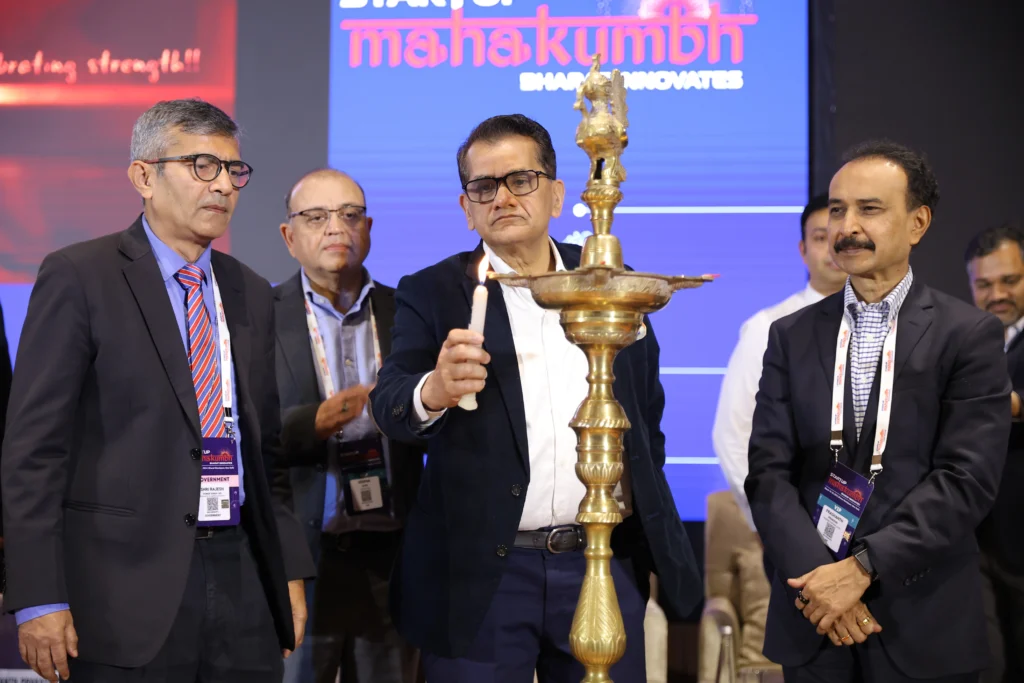
Large-scale ecosystem events have a dual purpose: they celebrate achievement and fuel ambition. One of the most notable in recent years has been Startup Mahakumbh, a multi-day gathering of entrepreneurs, investors, corporates, and policymakers.
At the 2025 edition, Goyal framed India’s startup ecosystem as poised to become the largest in the world, leveraging domestic talent and global capital alike.
What makes events like this truly impactful is that they go beyond rhetoric. They bring together thousands of startups and hundreds of investors under one roof, facilitate thousands of pitches, and generate deal flow that might otherwise never materialize. These gatherings also help startups benchmark their ideas against international peers — an essential step toward global competitiveness.
Real-World Impacts: Jobs, Scale, and Recognition
The effects of these policies are already visible. Today:
- Startups have generated over 21 lakh jobs, a critical impact in an economy with millions of young people entering the workforce each year.
- Venture funding — both domestic and international — is flowing into India at unprecedented levels, supporting everything from fintech to health tech.
- Women entrepreneurs are increasingly represented, with nearly half of all new startups having at least one woman director or partner.
These outcomes are not just statistics — they are stories of founders who can dream bigger than ever before. From a fintech startup in Pune scaling to international markets, to an AgriTech venture in Ludhiana using AI to help farmers increase yield, the ripple effects of policy support touch daily life and future possibilities.
Beyond Capital: Tackling Structural Challenges
While funding is essential, Piyush Goyal’s Startup strategy recognises that systemic challenges must also be addressed:
1. Encouraging Deep-Tech and Strategic Innovation
Piyush Goyal’s Startup has been vocal about encouraging startups to go beyond convenience-oriented models like food delivery and explore deep, high-impact technologies — AI, semiconductors, robotics, biotech — that can define future economic leadership.
This perspective pushes the ecosystem to evolve from transactional business models to transformative ones that solve complex problems and compete at a global level.
2. Promoting Domestic Capital Participation
Piyush Goyal’s Startup has also urged greater engagement from domestic institutional funds — including insurance and pension funds — to fuel startup growth. This is important because reliance on foreign capital can make founders vulnerable to external market fluctuations and exit-driven investment priorities.
By cultivating deeper domestic pools of capital, India can ensure that startups receive patient, long-term support aligned with national priorities.
Stories From the Ground: What Founders Are Saying
Real startup founders often offer the most grounded perspective on policy impact:
- Many appreciate the dedicated helpline as a way to cut through bureaucratic inertia, giving them direct channels to raise issues and seek guidance.
- Others cite the Fund of Funds as crucial early-stage support that previously was only accessible through heavy investor networks.
- Startup Mahakumbh has become a launchpad for founders who secured their first major investors or global partnerships at the event.
While some founders point out that challenges remain — particularly in terms of infrastructure and commercialization — there is broad consensus that policy momentum has improved the ecosystem significantly compared to 10 years ago.
The Road Ahead: Challenges and Opportunities
1. Creating a Global Deep-Tech Powerhouse
The vision for India’s startups is no longer just domestic growth — it is global leadership. Realising this potential will require:
- More targeted support for capital-intensive sectors.
- Stronger integration of research institutions with industry.
- Infrastructure that supports rapid prototyping and advanced manufacturing.
These are not easy problems, but they are exactly the kinds of areas where Piyush Goyal’s Startup strategy continues to push the boundaries.
2. Balancing Innovation With Practical Realities
Policy signals that encourage ambitious technological pursuits must be matched with on-ground infrastructure and execution support. Government programs need to balance aspiration with measurable pathways for execution — something that policymakers are increasingly aware of through feedback loops like the startup helpline.
Strengthening the Startup–Manufacturing Link
One of the most important but often under-discussed dimensions of India’s startup future is the connection between innovation and manufacturing. For years, India’s startup ecosystem leaned heavily toward software and platform-based businesses. While these created value and scale, they did not always translate into physical production capacity or supply-chain resilience.
Under Piyush Goyal’s Startup, a broader economic vision for startups, startups are increasingly being positioned as enablers of industrial transformation, not just digital services. This alignment is particularly visible in how startup policy intersects with initiatives such as Make in India, Production-Linked Incentive (PLI) schemes, and export-led growth strategies.
Startups working in electronics manufacturing, electric vehicles, semiconductors, renewable energy components, and precision engineering are now being encouraged through targeted incentives, procurement access, and policy signalling. The goal is clear: innovation should not end at the prototype stage — it should scale into production, exports, and global value chains.
This shift is especially critical as global supply chains diversify away from single-country dependence. India’s ability to host manufacturing-oriented startups positions it as both an innovation hub and a production base, strengthening economic resilience.
Public Procurement as a Startup Growth Engine
Another transformative lever in Piyush Goyal’s Startup vision is the use of government procurement as a market creator. For many startups, especially in deep-tech and infrastructure-focused sectors, the biggest challenge is not technology but early customers.
Government departments and public sector undertakings represent one of the largest buyers of goods and services in the country. By easing procurement norms, allowing pilot projects, and enabling startups to participate without extensive prior turnover requirements, policy reforms are opening doors that were previously closed.
This has three powerful effects:
- Credibility boost – A government contract validates a startup’s technology
- Revenue stability – Early cash flow supports sustainable scaling
- Market demonstration – Successful pilots attract private customers
From defence startups supplying indigenously developed components to clean-tech ventures deploying solutions in public infrastructure, procurement-led growth is becoming a cornerstone of ecosystem maturity.
Integrating Academia, Research, and Startups
India produces world-class scientific research, but historically struggled to commercialise it. Bridging this gap is essential for building a deep-tech powerhouse. Recognising this, startup policy increasingly emphasises research-to-market pipelines.
Universities, IITs, IISc, and national research laboratories are being encouraged to collaborate with startups through incubators, technology transfer offices, and joint development programs. Researchers are incentivised to spin off ventures, while startups gain access to cutting-edge intellectual property.
Piyush Goyal’s Startup emphasis on innovation with national impact reinforces the need for such integration. Deep-tech startups — whether in materials science, biotechnology, or quantum computing — cannot thrive without strong institutional research backing. By connecting academia with entrepreneurship, India strengthens its long-term innovation capacity.
Globalisation of Indian Startups

A notable evolution in recent years is the global ambition of Indian startups from day one. Unlike earlier generations that focused primarily on domestic markets, today’s founders often design products with international customers in mind.
Policy support has played a role here as well. Through trade facilitation, export promotion councils, and startup-focused international roadshows, Indian startups are gaining exposure to global markets. Commerce-focused diplomacy increasingly includes startups as strategic economic actors.
This global orientation is critical. Competing internationally forces startups to meet higher quality, security, and compliance standards. It also enables access to larger markets, diversified revenue streams, and cross-border partnerships.
India’s startup ecosystem is gradually transitioning from being a recipient of global capital to a provider of global innovation.
Inclusion, Diversity, and First-Generation Entrepreneurs
A defining strength of India’s startup growth is its inclusivity. A significant proportion of founders today are first-generation entrepreneurs — individuals without business family backgrounds or elite networks.
Women-led startups, rural innovators, and founders from non-traditional educational paths are increasingly visible. Policy frameworks that simplify incorporation, reduce compliance costs, and provide mentorship have helped level the playing field.
Piyush Goyal’s Startup repeated emphasis on entrepreneurship as a national movement rather than an elite pursuit reinforces this inclusivity. When innovation draws from diverse experiences, it produces solutions that are more grounded, scalable, and socially relevant.
Addressing the Infrastructure Gap
Despite progress, infrastructure remains a bottleneck for many startups — particularly those in hardware, manufacturing, and life sciences. Testing facilities, prototyping labs, cold-chain logistics, and advanced manufacturing clusters are not evenly distributed across the country.
Recognising this, policy discussions increasingly focus on shared infrastructure models, where startups can access high-quality facilities without bearing prohibitive costs. Public–private partnerships, common facility centres, and sector-specific clusters are emerging as solutions.
Such infrastructure is essential to ensure that startups do not stall at the prototype stage and can transition smoothly to commercial production.
Regulatory Stability and Long-Term Trust
Startups thrive in environments where rules are predictable. Sudden regulatory shifts can disrupt business models and investor confidence. One of the less visible but crucial aspects of Piyush Goyal’s Startup approach is the emphasis on consultative policymaking.
By engaging industry bodies, founders, and investors before major regulatory changes, the government reduces uncertainty and builds trust. This predictability encourages long-term investment and responsible risk-taking — both essential for sustainable growth.
India’s Startup Ecosystem in the Global Context
When compared globally, India’s startup ecosystem stands out for its scale, affordability, and diversity. While Silicon Valley excels in cutting-edge research and China in rapid manufacturing, India’s unique advantage lies in combining frugal innovation with massive domestic demand.
Piyush Goyal’s Startup vision positions India not as a copy of existing models, but as a distinct innovation economy — one that builds solutions for emerging markets while competing globally.
As geopolitical dynamics reshape trade, technology, and capital flows, India’s startup ecosystem is becoming a strategic asset on the world stage.
Looking Ahead: From Momentum to Mastery

The next phase of India’s startup journey will be defined not by numbers alone, but by depth, resilience, and global influence. Success will depend on how effectively startups scale, innovate, and integrate into broader economic systems.
Key priorities include:
- Scaling deep-tech startups into global leaders
- Strengthening domestic capital markets
- Building advanced infrastructure
- Enhancing academia–industry collaboration
The foundations are being laid. What matters now is execution.
Final Reflection: A Structural Shift, Not a Passing Phase
India’s startup boom is not a temporary trend — it represents a structural transformation in how the economy creates value. Through a combination of policy foresight, ecosystem building, and strategic alignment, Piyush Goyal’s startup vision has helped convert entrepreneurial energy into a national growth engine.
The challenges ahead are real, but so is the opportunity. If current momentum is sustained, Indian startups will not only solve domestic problems — they will define global solutions.
In shaping this ecosystem, Piyush Goyal’s Startup is contributing to something enduring: an India where innovation is institutional, ambition is inclusive, and entrepreneurship is central to economic leadership.
Conclusion: Piyush Goyal’s Startup Vision and India’s Future
The story of India’s startup ecosystem today is a testament to what coordinated policy and entrepreneurial ambition can achieve together. Through strategic reforms, robust funding mechanisms, ecosystem platforms, and high-visibility events, Piyush Goyal’s Startup initiatives have helped create fertile ground for innovators across the country.
India’s startup journey is far from complete — challenges remain in infrastructure, access to global markets, and deep-tech commercialization. But the direction is clear: a future where Indian startups are not just participants in global innovation, but leaders and trendsetters.
By nurturing this ecosystem with commitment and foresight, Piyush Goyal’s Startup is not just shaping startups — he’s shaping the future of India’s economy, its global technological footprint, and the dreams of millions of young innovators ready to build the next frontier of ideas.
!You might be interested in reading this page as well
The Role of Innovation in Entrepreneurship Development: A Comprehensive Guide