Introduction to Free Online Courses
There’s a particular kind of frustration that comes with wanting to grow but feeling like the door to better opportunities is locked behind expensive tuition fees or inaccessible institutions. I know that feeling well. Years ago, sitting in a cramped apartment with a laptop, a shaky Wi-Fi connection, and a burning desire to learn web development, I stumbled upon something that genuinely changed the course of my life — free online courses. Not paid trials, not freemium traps, but genuinely free, world-class education available to anyone with an internet connection.
Fast forward to 2026, and that landscape has only grown richer. Whether you’re a recent graduate trying to stand out in a brutal job market, a mid-career professional pivoting industries, or simply someone who believes learning never stops, the internet has never offered more for less. Free online courses have gone from being supplementary extras to fully structured, career-transforming resources trusted by employers worldwide. This article brings you the top 10, along with the honest context you need to make them work.
What Are Free Online Courses?
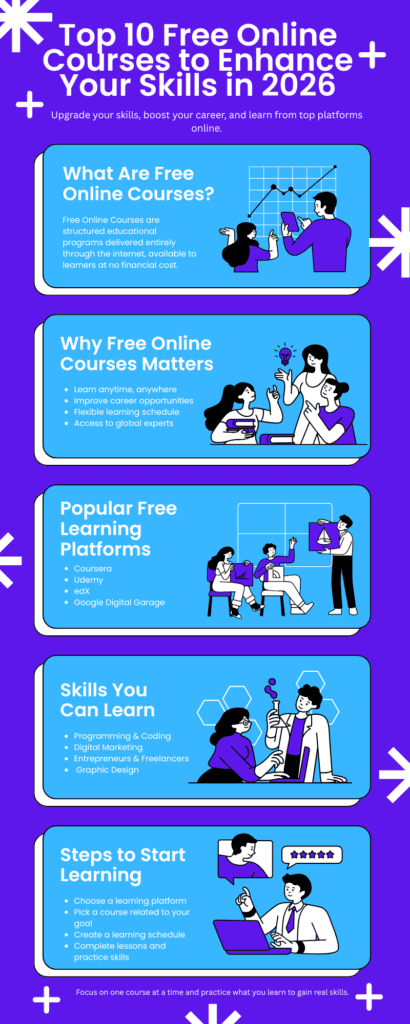
At their core, free online courses are structured educational programs delivered entirely through the internet, available to learners at no financial cost. They can range from a two-hour introductory module to a multi-month curriculum complete with projects, peer reviews, and certificates. Unlike traditional education, they don’t require physical attendance, fixed schedules, or enrollment fees — making them accessible to virtually anyone, anywhere.
The term “free” can mean a few different things in this space, so it’s worth clarifying. Some platforms offer courses completely free of charge, including the certificate at the end. Others offer the learning content for free but charge a nominal fee if you want an official certificate. Then there are courses where audit access — meaning you can view all videos and reading materials — is free, but graded assignments are behind a paywall. Each model has its place, and for most learners, the free tier offers more than enough to build genuine competence.
Examples span virtually every field imaginable: learning Python through Google’s crash course, picking up UX design principles through Google’s certificate program, exploring philosophy through Yale’s acclaimed happiness course, or mastering financial literacy through Khan Academy. The breadth is staggering, and in 2026, quality has never been higher.
Why Free Online Courses Are Important?
The significance of free online courses goes far beyond personal convenience. They represent a democratization of knowledge that previous generations simply didn’t have access to. A teenager in rural India can now learn the same machine learning fundamentals as a computer science student at MIT. A single parent in Lagos can acquire data analysis skills between night shifts, entirely on their own timeline. That’s not hyperbole — it’s what’s actually happening.
From a career standpoint, employers have steadily shifted their attitude toward self-directed learning. A 2025 LinkedIn Workforce Report found that hiring managers increasingly value demonstrated skills over formal credentials alone, particularly in technology, marketing, and design fields. Completing and showcasing free online courses — especially those backed by recognizable brands like Google, IBM, or Harvard — signals initiative, curiosity, and the ability to learn independently. These are qualities that no degree alone can fully communicate.
There’s also the economic reality. With the cost of traditional higher education continuing to climb, free online courses offer a genuine alternative pathway — not just supplementary enrichment. For career switchers who can’t afford to take two years off and spend $80,000 on a master’s degree, these courses represent a lifeline. And for those already employed, they offer a way to upskill without negotiating a training budget or justifying the time off.
Key Aspects: The Top 10 Free Online Courses in 2026
1. Google’s Crash Course on Python (Coursera)
Why It Stands Out
Programming often feels like a language reserved for people who’ve been coding since childhood. Google’s Crash Course on Python dismantles that myth with remarkable patience and humor. Designed for absolute beginners, it builds from the absolute basics — what a variable is, how a loop works — and scales up to real-world automation scripts within weeks.
The course runs roughly six weeks at a few hours per week, and the practical exercises are genuinely engaging rather than dry. By the end, learners have built functional programs and have a solid foundation for more advanced Python paths. It’s available for free through Coursera’s audit option.
2. CS50: Introduction to Computer Science (Harvard — edX)
The Gold Standard in Free Education
If there’s one course that appears on nearly every “best of” list year after year, it’s CS50. Taught by the legendarily engaging Professor David Malan, this Harvard course takes learners from zero programming knowledge through C, Python, SQL, HTML, CSS, and JavaScript — all in a single semester-equivalent. The production quality is cinema-grade, the problem sets are genuinely challenging, and the global community of learners makes the experience feel less like self-study and more like being part of something larger.
CS50 is available entirely free through edX (with a fee only if you want the verified certificate). Many learners describe it as the single course that unlocked their confidence in tech.
3. Google Data Analytics Certificate (Coursera)
For the Data-Curious
Data literacy has become what writing literacy was a generation ago — a baseline expectation rather than a specialty. Google’s Data Analytics Certificate teaches spreadsheet proficiency, SQL basics, R programming, and data visualization through Tableau in a structured, beginner-friendly format. While the full certificate involves a small cost, individual courses within the program can be audited for free.
The program was designed in collaboration with real Google employees and is explicitly recognized by many employers during hiring. For anyone looking to transition into analytics or simply understand data better in their current role, this is an exceptional starting point.
4. The Science of Well-Being (Yale — Coursera)
The Course That Went Viral for Good Reason
When Yale opened this course to the public, it became the most-enrolled course in the university’s 300-year history. That’s not a marketing claim — it genuinely struck a nerve. Taught by Dr. Laurie Santos, the course blends behavioral psychology and positive psychology research to explain why humans consistently mispredict what will make them happy — and what the evidence actually says about building a fulfilling life.
It’s auditable for free online courses on Coursera, takes about ten hours to complete, and offers something rarely found in professional development content: genuine self-reflection. Employers don’t always value “soft skills” openly, but the mindset shifts this course facilitates quietly improve how people communicate, handle stress, and collaborate.
5. Introduction to Cybersecurity (Cisco Networking Academy)
Security Skills That Actually Matter
Cyber threats in 2026 are more sophisticated and more frequent than at any point in history. The demand for cybersecurity professionals has outpaced supply by a significant margin, and entry-level roles remain some of the most accessible in the tech world for career changers. Cisco’s Networking Academy offers a free Introduction to Cybersecurity course that covers threat landscapes, network vulnerabilities, and defensive practices in clear, accessible terms.
It requires no prior technical background, runs about 15 hours, and comes with a certificate upon completion. For anyone testing the waters of a cybersecurity career path, this is the cleanest entry point available.
6. Digital Marketing Fundamentals (Google Digital Garage)
The Internet Changed Marketing. This Course Explains How.
Google Digital Garage’s Fundamentals of Digital Marketing remains one of the most consistently recommended free online courses for marketing professionals and small business owners alike. It covers search engine optimization, social media strategy, email campaigns, e-commerce basics, and analytics in 26 modules, each about 15–20 minutes long. The bite-sized format makes it genuinely sustainable alongside full-time work.
The course is entirely free and includes an official Google certification recognized across industries. In an age where every business operates partly online, these skills translate directly to employability and entrepreneurial capability.
7. Introduction to Machine Learning (Stanford — Coursera)
Andrew Ng’s Legendary Course, Refreshed for 2026
Andrew Ng’s machine learning course is arguably the most influential MOOC ever created. Now updated and repackaged into a specialization on Coursera, its first course can be audited for free and introduces the mathematical intuitions behind machine learning without requiring a PhD to understand. Ng has a rare gift for making complex mathematics feel approachable without dumbing it down.
This is not a course for total beginners — some comfort with basic algebra and statistics helps — but it rewards the effort magnificently. For anyone working in or aspiring to data science or AI, this is a foundational curriculum.
8. Financial Markets (Yale — Coursera)
Nobel Laureate Teaching. Free of Charge.
Robert Shiller, Nobel Prize winner in Economics, teaches this course on financial markets through Yale’s Coursera partnership. It covers how markets work, the role of risk, behavioral finance, and the psychological forces that move prices. It’s auditable for free online courses, runs about 33 hours across seven weeks, and consistently earns some of the highest learner satisfaction ratings on the platform.
Understanding financial markets isn’t just for aspiring bankers — it’s useful for anyone managing savings, considering investments, or simply trying to understand the economic forces shaping the world around them.
9. UX Design Fundamentals (Google — Coursera)
Designing for Humans
User experience design has become one of the most sought-after skills in the tech industry, and Google’s UX Design Certificate begins with a free foundational module that introduces the design thinking process, user research methods, wireframing, and prototyping concepts. It’s practical, visually engaging, and designed to build a portfolio alongside skills — something remarkably few free courses bother to prioritize.
Even for people who don’t aspire to become full-time UX designers, understanding how to think from the user’s perspective is valuable in product management, software engineering, marketing, and content strategy.
10. English for Career Development (University of Pennsylvania — Coursera)
Communication Skills That Open Doors
For the many millions of professionals worldwide for whom English is a second or third language, the University of Pennsylvania’s English for Career Development course offers something deeply practical: the language and communication skills needed to navigate job searching, interviewing, and professional correspondence in English-speaking contexts. It covers resume writing, cover letters, LinkedIn profiles, and interview techniques.
It’s available for free through Coursera’s audit option and has helped learners from Southeast Asia, Latin America, and Africa secure positions at global companies. The skill it builds isn’t just linguistic — it’s confidence.
Practical Tips for Getting the Most Out of Free Online Courses

Getting access to these free online courses is easy. Actually completing them — and applying what you learn — takes a bit more intentionality. Here’s what actually works:
- Treat your learning time like a meeting you can’t cancel. Block specific hours in your calendar and guard them. The biggest enemy of free online learning isn’t distraction — it’s the fact that there are no consequences for skipping. Create your own accountability.
- Pick one course at a time. The abundance of free content creates a temptation to enroll in six courses simultaneously, complete three percent of each, and feel vaguely productive. Resist it. Depth over breadth always produces better outcomes.
- Complete the projects, not just the videos. Watching lectures without doing the exercises is the rough equivalent of watching cooking shows but never cooking. The skill lives in the doing.
- Document what you’re learning publicly. Writing about your progress on LinkedIn, a personal blog, or even X (formerly Twitter) serves two purposes: it reinforces learning through reflection, and it builds a visible trail of growth that catches the attention of people who might hire you.
- Connect with fellow learners. Most major platforms have discussion forums or affiliated communities on Discord or Reddit. These communities offer help, accountability, and occasionally professional opportunities.
- Finish before you upgrade. Don’t let “paid certificate” upsells pull you into spending before you’ve proven you’ll complete the course. Audit first. Pay for the certificate only if you finish and the credential genuinely matters for your goals.
Real-Life Examples of Students Using Free Online Courses
Consider the story of someone like Maria, a former retail manager in her mid-thirties who’d always felt a quiet pull toward tech. After her store closed during an economic downturn, she enrolled in CS50 out of curiosity, working through it in the evenings while job hunting in retail. Eight months later, after completing CS50, Google’s Python course, and the Data Analytics certificate, she was hired as a junior data analyst at a mid-sized logistics firm — at a salary significantly higher than what she’d earned as a store manager.
Or think about Arjun, a marketing coordinator in Pune, India, who felt his career had plateaued. He completed Google’s Digital Marketing certificate over two months, rebuilt his LinkedIn profile around his new skills, and landed a remote position with a UK-based agency — his first internationally-compensating role, obtained without leaving his city.
These aren’t exceptional cases. They’re becoming increasingly common as employers grow more skills-focused and as free online courses grow more credible. The pattern is remarkably consistent: curiosity plus consistency plus real projects produces results.
Common Mistakes to Avoid When Taking Free Online Courses
Even with the best intentions, many learners fall into the same traps. Knowing them in advance can save months of frustration.
- Treating completion as the goal. Finishing a course is a milestone, not the destination. If you complete a course on data analytics but never touch a real dataset, analyze nothing, and build no projects, you haven’t gained a skill — you’ve gained familiarity. The goal is application, not completion.
- Choosing courses based on hype rather than fit. Machine learning sounds impressive, but if you’re three years away from needing it and you’d benefit far more from improving your writing or financial literacy, following the hype will leave you with a shallow skillset and misaligned time investment.
- Skipping prerequisites. Many intermediate and advanced free online courses assume foundational knowledge. Jumping into machine learning without basic Python or into financial markets without understanding what a stock is leads to confusion and dropout. Respect the sequencing.
- Never update your resume or LinkedIn. Completing a free online courses without updating your professional presence means the credential does nothing for your career. Update your profiles as you go, not after a mythical “I’m ready” moment that may never arrive.
- Giving up after the first hard week. Most structured courses have a “valley of despair” — usually around week three or four — when the initial excitement fades, and the material gets genuinely difficult. This is precisely when most people quit. The ones who push through almost always describe that moment as the turning point where real learning began.
Frequently Asked Questions (FAQ)
Q1. Are free online courses recognized by employers?
Increasingly, yes — particularly those from recognizable institutions or platforms. Free Online Courses and certificates from Google, Harvard, Yale, IBM, and Cisco carry real weight with many employers, especially in technology, marketing, and analytics fields. The key is to supplement the credential with a portfolio of actual work that demonstrates your ability to apply the skills, rather than relying on the certificate alone.
Q2. How long does it take to complete a free online course?
It varies enormously. Short introductory free online courses might take five to ten hours. More comprehensive programs like CS50 or Google’s Data Analytics Certificate can take 40 to 100 hours, depending on your pace. Most platforms provide estimated completion times, though the actual time varies based on prior experience and how deeply you engage with the exercises.
Q3. Can I get a job using only free online courses?
Yes, and it happens regularly — particularly in tech, digital marketing, and data roles. That said, courses alone rarely suffice. What actually secures jobs is the combination of course knowledge, applied projects, a visible portfolio, and networking. The courses provide the foundation; everything else you build on top of them determines the outcome.
Q4. Which platforms offer the best free online courses in 2026?
Coursera, edX, Google Digital Garage, Cisco Networking Academy, Khan Academy, and MIT OpenCourseWare remain the most reliable platforms for high-quality free content. Each has its strengths: Coursera excels in professional certificates, edX for university-backed academic content, Khan Academy for foundational math and science, and Google Digital Garage specifically for digital skills.
Q5. Do I need a strong internet connection or specific equipment to take free online courses?
Most platforms are designed to work on modest hardware and can accommodate slower connections, particularly in text-heavy courses. Video-heavy courses like CS50 benefit from a stable connection, but many platforms allow video downloads for offline viewing. A smartphone, a basic laptop, and a reasonably reliable internet connection are sufficient for the vast majority of free online courses available today.
Conclusion
The opportunity sitting inside free online courses is genuinely remarkable when you step back and look at it clearly. Within a single generation, the gap between what the world’s best institutions teach and what the average person can access has narrowed from a chasm to a click. The courses covered in this article — from Harvard’s CS50 to Google’s marketing and analytics programs to Yale’s lectures on financial markets and human happiness — represent the kind of education that was once gated by geography, wealth, and institutional connection.
But access alone is not transformation. The difference between someone who takes these free online courses and someone who doesn’t is intelligence or even effort — it’s decision and follow-through. Deciding what you want to learn, committing to a specific course rather than drifting between options, doing the projects rather than just watching the lectures, and making your learning visible to the world around you. That’s the whole formula.
If there’s one thing worth taking from this article, it’s this: 2026 is the best year in human history to learn something new for free. The Free online courses are there. The only real question is what you’ll do with them.
!You might be interested in reading this page as well
How to Check Your UPSC Result 2025: Easy Step-by-Step Guide